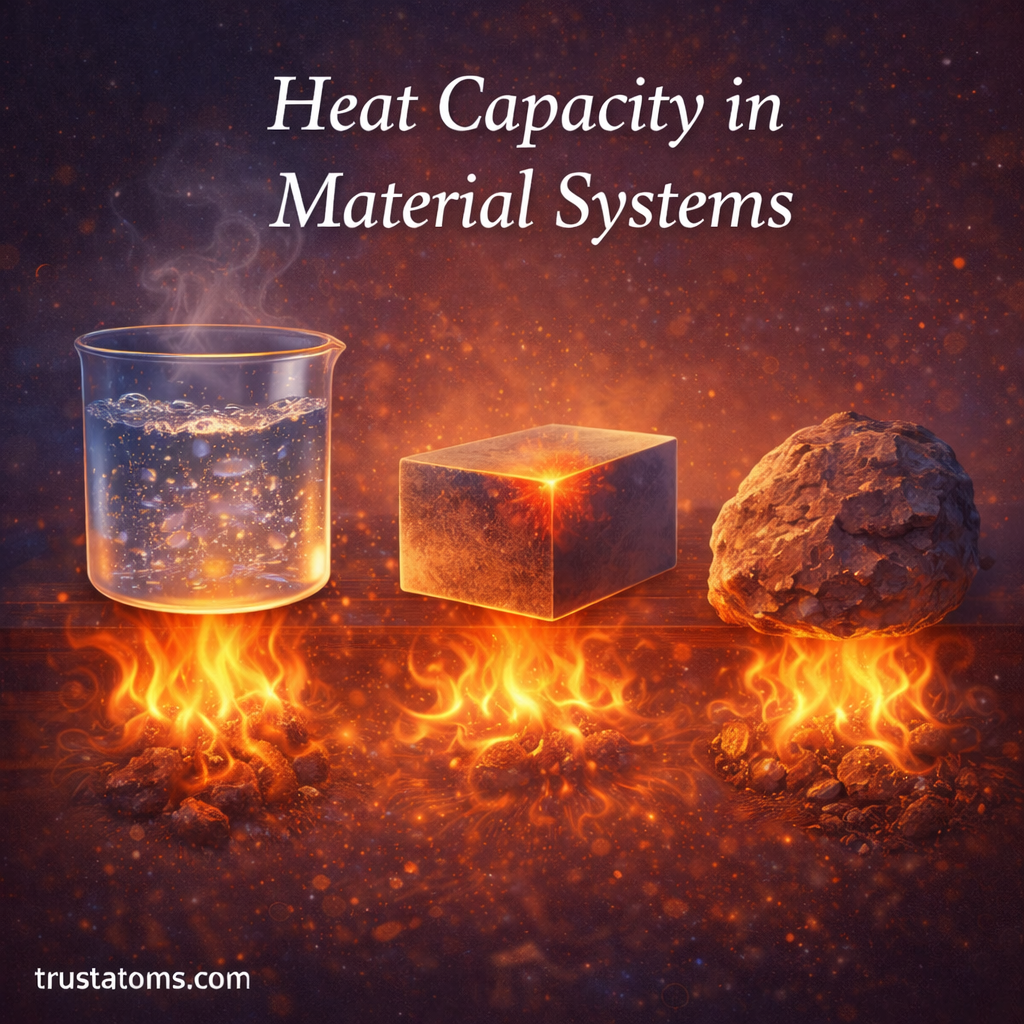
Heat capacity is one of the most important concepts in thermodynamics and materials science. It explains how materials absorb, store, and release thermal energy — and why some substances heat up quickly while others change temperature slowly.
From cooking utensils and building insulation to planetary science and industrial engineering, heat capacity plays a central role in how systems behave under temperature changes.
In this guide, you’ll learn what heat capacity is, how it works in material systems, and why it matters in real-world applications.
What Is Heat Capacity?
Heat capacity measures how much thermal energy is required to raise the temperature of a substance by a certain amount.
In simple terms:
- High heat capacity → temperature changes slowly
- Low heat capacity → temperature changes quickly
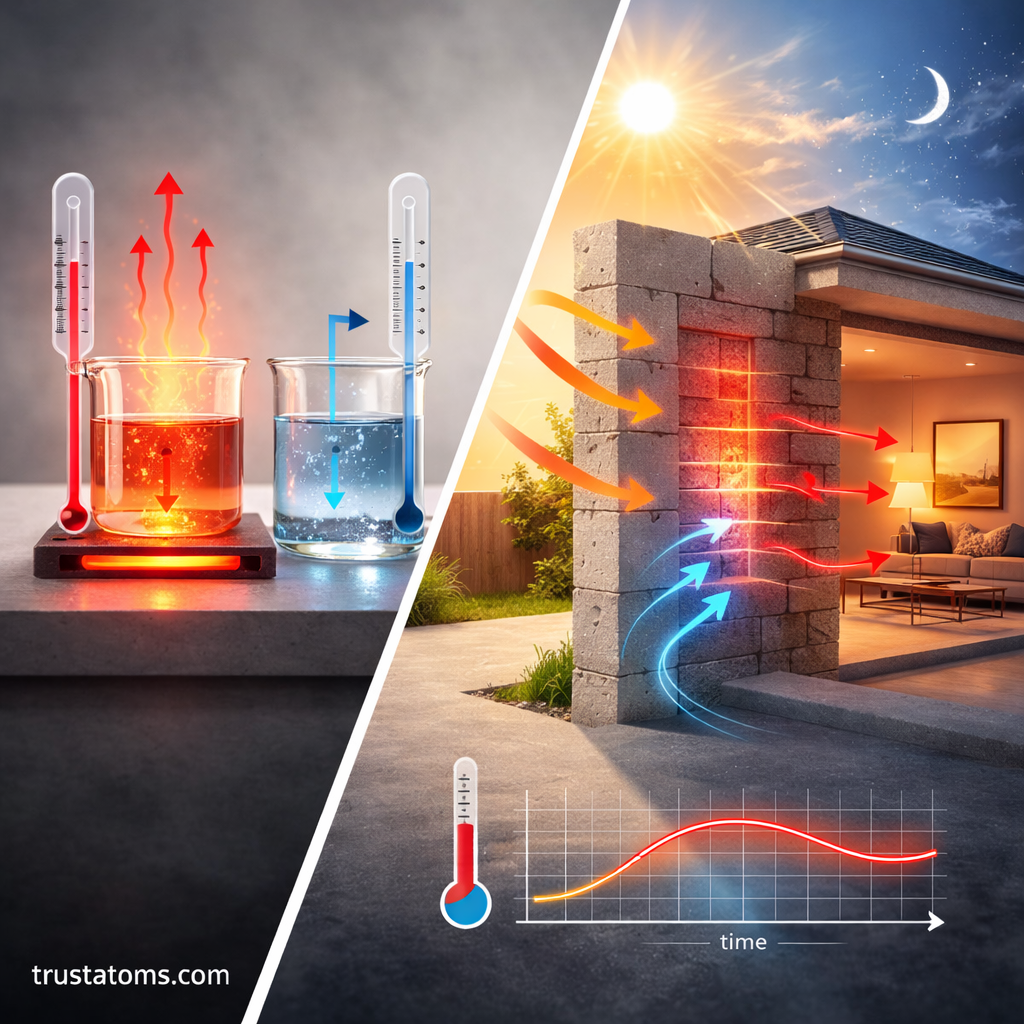
If two materials receive the same amount of heat, the one with higher heat capacity will experience a smaller temperature increase.
Heat Capacity vs. Specific Heat
These two terms are closely related but not identical.
Heat Capacity
- Applies to an entire object
- Depends on both material type and total mass
Specific Heat Capacity
- Refers to heat required per unit mass
- Independent of object size
- A property of the material itself
For example:
- Water has a high specific heat capacity.
- Metals like copper have lower specific heat capacity.
This is why metal spoons heat quickly, while water heats more slowly.
Why Heat Capacity Matters in Material Systems
Material systems respond to energy transfer based on:
- Molecular structure
- Bonding strength
- Density
- Phase (solid, liquid, gas)
Heat capacity determines how a system reacts when exposed to:
- Sunlight
- Electrical heating
- Chemical reactions
- Friction
Understanding this property allows engineers and scientists to predict temperature behavior.
Microscopic Explanation
At the microscopic level, heat energy increases:
- Molecular motion
- Atomic vibration
- Rotational and translational movement
In solids:
- Atoms vibrate around fixed positions.
In liquids:
- Molecules move more freely.
In gases:
- Particles move independently with high kinetic energy.
The more ways a material can store internal energy, the higher its heat capacity.
Factors That Influence Heat Capacity
Several variables affect heat capacity in material systems.
1. Molecular Complexity
Materials with complex molecular structures can store energy in:
- Vibrational modes
- Rotational motion
- Internal bonds
More internal degrees of freedom increase heat capacity.
2. Phase of Matter
Heat capacity varies across phases:
- Solids generally have lower heat capacity than liquids.
- Liquids often have higher heat capacity than gases.
Water is a special case because hydrogen bonding significantly increases its heat capacity.
3. Temperature Range
Heat capacity is not always constant.
In some materials:
- Heat capacity changes with temperature.
- Low-temperature behavior differs from room-temperature behavior.
This is especially important in cryogenic physics and high-temperature engineering.
Heat Capacity in Real-World Applications
1. Climate and Oceans
Oceans have high heat capacity.
This means:
- They absorb large amounts of solar energy.
- They moderate Earth’s climate.
- Coastal regions experience smaller temperature swings.
Without high heat capacity in water, climate systems would be far more extreme.
2. Building Materials
Materials like:
- Concrete
- Brick
- Stone
Have relatively high heat capacity.
They store heat during the day and release it slowly at night, improving energy efficiency.
3. Cooking and Kitchenware
Different cookware materials affect heat distribution.
- Cast iron retains heat well.
- Aluminum heats quickly but cools faster.
Heat capacity influences cooking performance and temperature stability.
4. Industrial Systems
In manufacturing:
- Heat exchangers rely on predictable thermal properties.
- Cooling systems are designed based on material heat capacity.
- Thermal management prevents overheating.
Electronic devices especially depend on careful heat regulation.
Energy Transfer and Heat Capacity
When heat is added to a material:
- Energy enters the system.
- Internal motion increases.
- Temperature rises depending on heat capacity.
A higher heat capacity means more energy is required for the same temperature change.
This relationship is essential in thermodynamics calculations and energy system design.
Heat Capacity and Phase Changes
An important distinction:
- During a phase change (like melting or boiling), temperature does not increase even though heat is added.
Instead:
- Energy goes into breaking intermolecular bonds.
This is called latent heat, and it is separate from heat capacity but closely related in thermal analysis.
Comparing Materials by Heat Capacity
Here’s a simplified comparison:
- Water → High heat capacity
- Metals → Moderate to low heat capacity
- Air → Lower heat capacity per volume
- Sand → Moderate heat capacity
These differences explain why:
- Desert temperatures fluctuate dramatically.
- Oceans change temperature gradually.
- Metal objects feel hot or cold quickly.
Heat Capacity in Engineering Design
Engineers consider heat capacity when designing:
- Engines
- Power plants
- Batteries
- HVAC systems
- Spacecraft materials
Thermal management ensures safety, efficiency, and longevity.
Even small miscalculations can result in overheating or system failure.
Common Misconceptions
“Heat Capacity Is the Same as Temperature”
Incorrect.
Temperature measures average kinetic energy, while heat capacity measures resistance to temperature change.
“All Materials Heat at the Same Rate”
False.
Different materials respond differently to identical energy input.
“High Heat Capacity Means High Temperature”
Not necessarily.
A material can absorb large amounts of heat without reaching a high temperature.
Why Heat Capacity Is Fundamental in Physics
Heat capacity connects:
- Energy conservation
- Thermodynamics
- Molecular motion
- Material science
It explains how systems store and distribute energy — from small laboratory samples to planetary-scale environments.
Understanding heat capacity allows us to predict how materials behave under thermal stress.
Final Takeaway
Heat capacity in material systems determines:
- How much energy is needed to raise temperature
- How materials respond to heating and cooling
- How energy is stored internally
High heat capacity materials change temperature slowly.
Low heat capacity materials respond quickly to energy input.
From climate systems to electronics and industrial design, heat capacity is a foundational concept in physics and engineering.
Mastering it gives you deeper insight into how energy moves through the physical world.