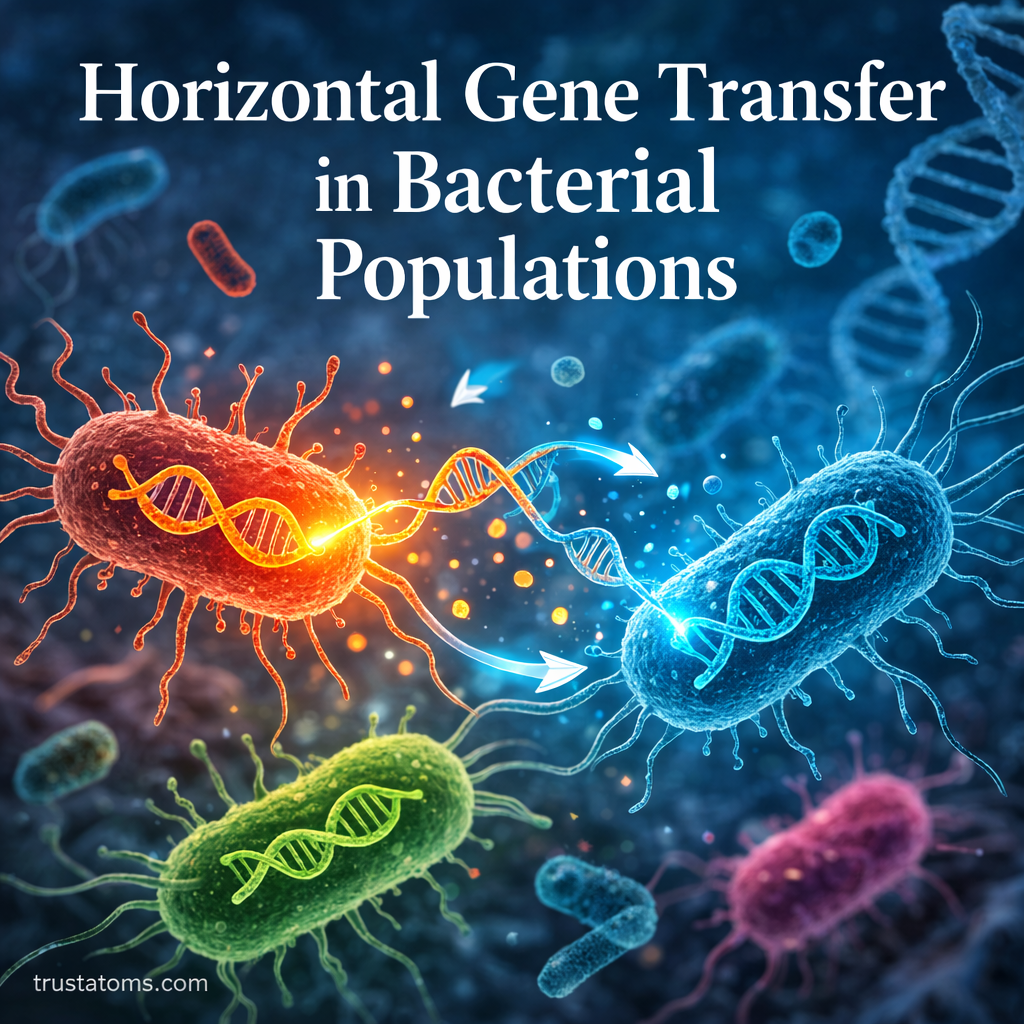
Bacteria are among the most adaptable organisms on Earth. One reason for their rapid adaptation is a process known as horizontal gene transfer (HGT). Unlike traditional inheritance, where genetic material passes from parent to offspring, horizontal gene transfer allows bacteria to exchange genes directly with neighboring cells.
This ability enables bacterial populations to rapidly acquire new traits, including antibiotic resistance, metabolic capabilities, and environmental adaptations. As a result, horizontal gene transfer plays a major role in microbial evolution, medical microbiology, and environmental biology.
Understanding how gene exchange occurs within bacterial populations helps scientists better predict microbial behavior, track disease outbreaks, and develop new treatment strategies.
What Is Horizontal Gene Transfer?
Horizontal gene transfer refers to the movement of genetic material between organisms that are not related through reproduction.
In bacterial populations, this means that genes can move between individual cells—even across different species.
This process differs from vertical gene transfer, which occurs during reproduction when bacteria pass genes to daughter cells.
Horizontal gene transfer allows bacteria to gain new genetic traits without waiting for mutations to occur.
Examples of traits transferred through HGT include:
- Antibiotic resistance
- Toxin production
- Metabolic enzymes
- Environmental tolerance mechanisms
- Virulence factors
These genetic exchanges significantly influence the behavior and survival of bacterial communities.
Why Horizontal Gene Transfer Is Important in Bacterial Populations
Horizontal gene transfer allows bacterial populations to evolve far more rapidly than organisms that rely solely on mutation and inheritance.
Key biological impacts include:
Rapid Adaptation
When bacteria encounter new environmental pressures—such as antibiotics or toxins—gene exchange allows them to rapidly acquire survival mechanisms.
Increased Genetic Diversity
Gene sharing introduces new genetic combinations into bacterial populations, increasing diversity and adaptability.
Spread of Antibiotic Resistance
One of the most significant consequences of HGT is the spread of antibiotic resistance genes between bacteria.
Resistance genes can move across species, allowing previously susceptible bacteria to become resistant.
Community-Level Evolution
Rather than evolving individually, bacteria can evolve collectively through shared genetic resources.
This phenomenon is sometimes described as a shared microbial gene pool.
Mechanisms of Horizontal Gene Transfer in Bacteria
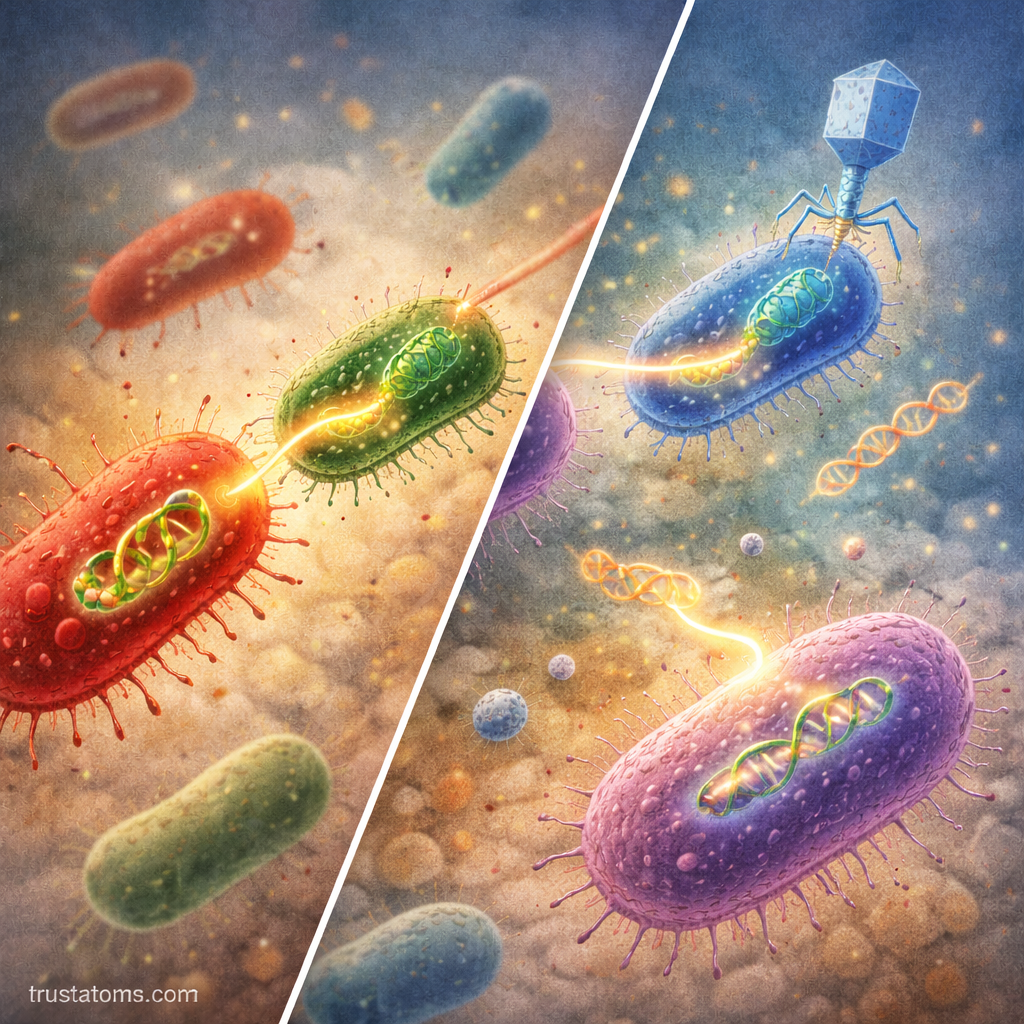
Bacteria use three primary mechanisms to exchange genetic material:
- Transformation
- Transduction
- Conjugation
Each mechanism operates differently but contributes to genetic exchange within microbial populations.
Transformation
Transformation occurs when bacteria take up free DNA from their environment.
This DNA often originates from dead or damaged bacterial cells that release genetic material into the surrounding environment.
How Transformation Occurs
The process generally involves the following steps:
- DNA fragments become available in the environment.
- A competent bacterial cell absorbs the DNA through its cell membrane.
- The new DNA integrates into the bacterium’s genome or remains as a separate genetic element.
If the absorbed DNA contains beneficial genes, the bacterium may gain a survival advantage.
Natural Competence
Some bacterial species are naturally capable of absorbing environmental DNA. These bacteria are described as naturally competent.
Examples include species within the genera:
- Streptococcus
- Neisseria
- Bacillus
Transduction
Transduction occurs when viruses transfer genetic material between bacterial cells.
Viruses that infect bacteria are known as bacteriophages.
How Transduction Works
During viral replication:
- A bacteriophage infects a bacterial cell.
- The virus replicates inside the host cell.
- Occasionally, fragments of bacterial DNA are mistakenly packaged into viral particles.
- The virus then infects another bacterial cell and transfers the DNA.
This process allows genes from one bacterium to move into another bacterium.
Types of Transduction
Two main forms exist:
Generalized transduction
- Random bacterial genes are transferred.
Specialized transduction
- Only specific genes near viral integration sites are transferred.
Conjugation
Conjugation is the direct transfer of genetic material between two bacterial cells through physical contact.
This process requires a specialized structure called a sex pilus, which forms a bridge between cells.
How Conjugation Works
The steps typically include:
- A donor cell extends a sex pilus toward a recipient cell.
- The cells connect through the pilus.
- A copy of DNA is transferred through the connection.
- The recipient cell incorporates the new genetic material.
Conjugation commonly transfers plasmids, which are small circular DNA molecules.
Plasmids and Gene Exchange
Plasmids play a central role in horizontal gene transfer within bacterial populations.
These DNA molecules replicate independently from the bacterial chromosome and often carry genes that benefit the host.
Common plasmid-associated traits include:
- Antibiotic resistance
- Heavy metal tolerance
- Toxin production
- Metabolic capabilities
Because plasmids can move easily between cells, they serve as vehicles for genetic exchange across bacterial populations.
Horizontal Gene Transfer and Antibiotic Resistance
The spread of antibiotic resistance is one of the most important consequences of horizontal gene transfer.
In hospitals and clinical settings, bacterial populations are exposed to strong selective pressures from antibiotic use.
Under these conditions:
- Resistant bacteria survive antibiotic treatment.
- Resistance genes spread through plasmids and mobile DNA elements.
- New bacterial strains rapidly develop multidrug resistance.
Common examples include resistant strains of:
- Staphylococcus aureus
- Escherichia coli
- Klebsiella pneumoniae
Tracking how resistance genes spread helps scientists develop better strategies for infection control.
Mobile Genetic Elements in Bacterial Populations
Horizontal gene transfer often relies on mobile genetic elements, which are DNA sequences capable of moving between genomes.
Important examples include:
Transposons
Transposons, sometimes called jumping genes, can move between different locations in DNA.
They can also transfer between plasmids and chromosomes.
Integrons
Integrons capture and store gene cassettes, often containing antibiotic resistance genes.
They act as genetic platforms that accumulate beneficial genes.
Genomic Islands
These are large segments of DNA acquired through horizontal gene transfer.
Genomic islands often contain genes related to virulence or environmental adaptation.
Horizontal Gene Transfer in Natural Environments
Horizontal gene transfer occurs in many natural ecosystems.
Soil Ecosystems
Soil contains highly diverse bacterial communities where gene exchange helps microbes adapt to changing nutrient conditions.
Aquatic Environments
Marine and freshwater bacteria frequently exchange genes that allow them to survive in nutrient-poor or extreme environments.
Human Microbiomes
Gene transfer occurs within microbial communities in the human gut, skin, and respiratory system.
These exchanges can influence:
- Digestion
- Immune responses
- Microbial balance
Studying Horizontal Gene Transfer in Bacterial Populations
Scientists use several techniques to detect and analyze gene transfer.
Genome Sequencing
Sequencing bacterial genomes allows researchers to identify genes that appear to originate from unrelated organisms.
Comparative Genomics
Scientists compare genetic sequences across species to detect patterns suggesting horizontal gene transfer.
Phylogenetic Analysis
Researchers examine evolutionary relationships between genes to identify unusual inheritance patterns.
These tools help scientists understand how bacterial populations evolve and adapt.
Applications in Biotechnology and Medicine
Research on horizontal gene transfer has many practical applications.
Antibiotic Resistance Monitoring
Understanding HGT helps public health agencies track the spread of resistant bacteria.
Genetic Engineering
Scientists use natural gene transfer systems to insert useful genes into bacteria for industrial purposes.
Examples include bacteria engineered to produce:
- Insulin
- Industrial enzymes
- Biofuels
Environmental Cleanup
Microbes engineered through gene transfer may help break down pollutants such as oil spills and toxic chemicals.
Final Thoughts
Horizontal gene transfer plays a central role in shaping bacterial populations. By exchanging genes across individuals and species, bacteria can rapidly adapt to environmental challenges, acquire new metabolic capabilities, and spread resistance traits.
This genetic flexibility allows bacterial communities to evolve collectively rather than individually. While horizontal gene transfer can pose challenges—especially in the spread of antibiotic resistance—it also provides valuable tools for biotechnology and scientific discovery.
Ongoing research continues to reveal how gene exchange drives microbial evolution and influences ecosystems around the world.