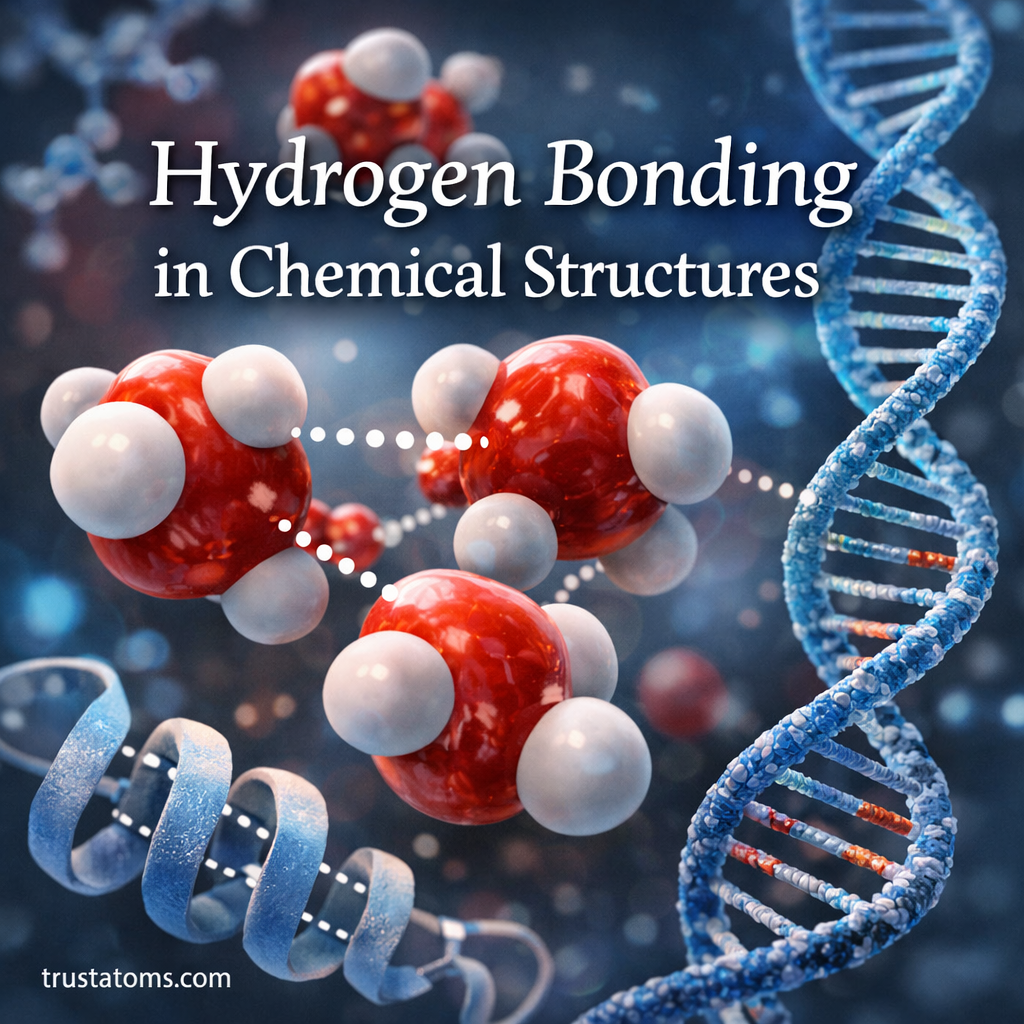
Hydrogen bonding is one of the most important intermolecular forces in chemistry. Although it is weaker than a covalent bond, hydrogen bonding has a major influence on how molecules behave, interact, and organize themselves.
From the structure of water to the shape of DNA, hydrogen bonds help determine the physical properties and stability of many chemical systems. Understanding hydrogen bonding is essential for studying molecular chemistry, biology, and materials science.
What Is Hydrogen Bonding?
Hydrogen bonding is a special type of intermolecular attraction that occurs when a hydrogen atom bonded to a highly electronegative atom is attracted to another electronegative atom nearby.
This interaction typically occurs when hydrogen is covalently bonded to:
- Oxygen (O)
- Nitrogen (N)
- Fluorine (F)
These atoms pull electron density away from hydrogen, leaving the hydrogen atom with a partial positive charge. The positively charged hydrogen can then interact with a nearby electronegative atom that has lone pairs of electrons.
This attraction forms a hydrogen bond.
General Representation
Hydrogen bonding is often represented as:
X–H ··· Y
Where:
- X = electronegative atom bonded to hydrogen
- H = hydrogen atom
- Y = electronegative atom with lone electron pairs
The dotted line indicates the hydrogen bond.
Why Hydrogen Bonding Occurs
Hydrogen bonding forms because of electronegativity differences and molecular polarity.
When hydrogen bonds with atoms like oxygen or nitrogen:
- The electronegative atom pulls electrons toward itself.
- Hydrogen becomes slightly positive.
- Nearby electronegative atoms attract the hydrogen atom.
This creates a directional intermolecular attraction.
Key factors that allow hydrogen bonding:
- Hydrogen attached to O, N, or F
- A nearby atom with lone electron pairs
- Polar molecules
- Short intermolecular distance
Because hydrogen is extremely small, the attraction between molecules can be relatively strong compared to other intermolecular forces.
Hydrogen Bonding in Water
Water is the most well-known example of hydrogen bonding.
Each water molecule (H₂O) contains:
- Two hydrogen atoms bonded to oxygen
- Two lone pairs on the oxygen atom
This allows a single water molecule to form up to four hydrogen bonds with surrounding water molecules.
As a result, water molecules form a temporary hydrogen-bonded network.
Unique Properties of Water Caused by Hydrogen Bonding
Hydrogen bonding gives water several unusual physical properties:
- High boiling point for such a small molecule
- High surface tension
- Strong cohesion between molecules
- Excellent solvent abilities
- Ice being less dense than liquid water
Without hydrogen bonding, water would behave more like other small molecules and would boil at a much lower temperature.
Hydrogen Bonding Within Molecules (Intramolecular)
Hydrogen bonding can occur within a single molecule, known as intramolecular hydrogen bonding.
This happens when a hydrogen atom bonded to an electronegative atom interacts with another electronegative atom in the same molecule.
Effects of Intramolecular Hydrogen Bonding
Intramolecular hydrogen bonding can:
- Stabilize certain molecular shapes
- Lock molecules into specific conformations
- Influence chemical reactivity
- Reduce intermolecular interactions
These effects are important in many organic molecules and pharmaceuticals.
Hydrogen Bonding Between Molecules (Intermolecular)
More commonly, hydrogen bonding occurs between separate molecules, called intermolecular hydrogen bonding.
This interaction significantly affects physical properties such as:
- Boiling point
- Melting point
- Solubility
- Viscosity
Example: Alcohols
Alcohol molecules contain an O–H group, which allows hydrogen bonding.
Because of this:
- Alcohols generally have higher boiling points than similar hydrocarbons.
- They dissolve well in water due to hydrogen bonding interactions.
For instance, ethanol mixes completely with water because both molecules can form hydrogen bonds with each other.
Hydrogen Bonding in Biological Molecules
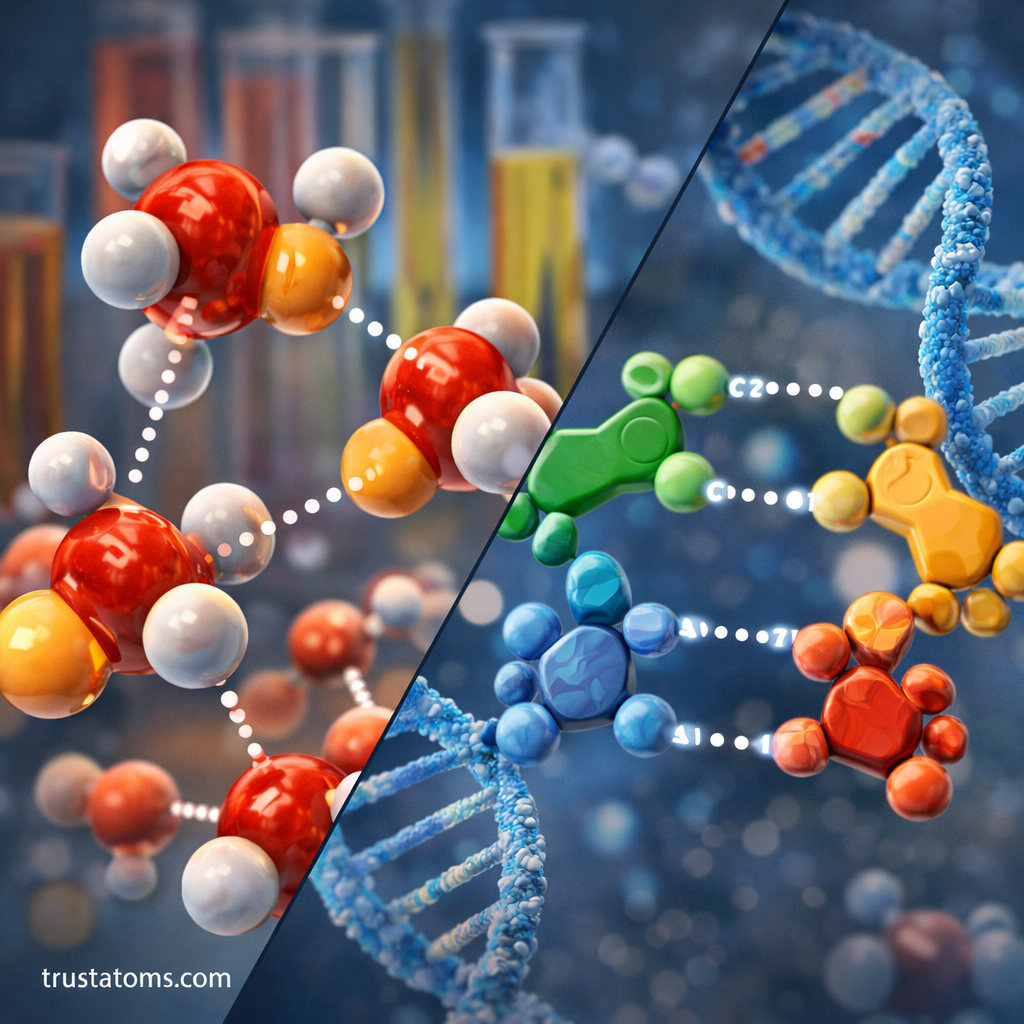
Hydrogen bonding plays a central role in biological structures.
DNA Structure
In DNA, hydrogen bonds hold the two strands of the double helix together.
Base pairs are connected through hydrogen bonds:
- Adenine pairs with thymine (two hydrogen bonds)
- Guanine pairs with cytosine (three hydrogen bonds)
These interactions provide stability while still allowing DNA strands to separate during replication.
Proteins
Protein structures are also stabilized by hydrogen bonds.
They help form:
- Alpha helices
- Beta sheets
- Folding patterns of enzymes and structural proteins
Without hydrogen bonding, proteins would struggle to maintain their functional shapes.
Strength of Hydrogen Bonds
Hydrogen bonds are stronger than most intermolecular forces but weaker than covalent bonds.
Typical bond strength ranges from:
10–40 kJ/mol
For comparison:
- Covalent bonds: ~150–1000 kJ/mol
- Hydrogen bonds: ~10–40 kJ/mol
- Van der Waals forces: ~1–10 kJ/mol
Because they are relatively weak, hydrogen bonds can break and reform easily, allowing molecules to remain dynamic.
Factors That Affect Hydrogen Bond Strength
Several factors influence hydrogen bond strength.
1. Electronegativity of the Atoms
More electronegative atoms create stronger partial charges and stronger hydrogen bonding.
2. Distance Between Atoms
Hydrogen bonds are strongest when atoms are very close.
3. Molecular Geometry
Linear alignment between atoms strengthens hydrogen bonding.
4. Number of Hydrogen Bonding Sites
Molecules with multiple donor and acceptor sites form stronger networks.
These factors explain why some substances form extensive hydrogen-bonded structures.
Common Examples of Hydrogen Bonding
Hydrogen bonding occurs in many familiar substances.
Examples include:
- Water (H₂O)
- Alcohols (such as ethanol)
- Ammonia (NH₃)
- Carboxylic acids
- DNA and proteins
These interactions influence both chemical behavior and biological function.
Hydrogen Bonding vs Other Intermolecular Forces
Hydrogen bonding is one of several intermolecular forces.
Here is how it compares:
Hydrogen Bonding
- Requires H bonded to O, N, or F
- Moderately strong attraction
- Highly directional interaction
Dipole–Dipole Forces
- Occur between polar molecules
- Weaker than hydrogen bonding
London Dispersion Forces
- Present in all molecules
- Caused by temporary electron movement
- Weakest intermolecular force
Because hydrogen bonding is stronger, it often dominates molecular interactions when present.
Why Hydrogen Bonding Matters in Chemistry
Hydrogen bonding influences many important chemical properties.
It helps explain:
- Why water behaves uniquely
- How biological molecules maintain structure
- Why some compounds dissolve in water
- Why certain substances have high boiling points
Chemists rely on understanding hydrogen bonding when designing:
- Pharmaceuticals
- Polymers
- Biomaterials
- Chemical solutions
Recognizing hydrogen bonding patterns helps scientists predict how molecules interact and behave.
Final Thoughts
Hydrogen bonding is a powerful yet subtle force that shapes the behavior of molecules in chemistry and biology. Although it is weaker than covalent bonding, its ability to create networks between molecules leads to remarkable physical and biological properties.
From the structure of water to the stability of DNA and proteins, hydrogen bonding plays a foundational role in the organization of matter at the molecular level. Understanding this interaction provides insight into how chemical structures form, interact, and function across many scientific fields.