Many chemical reactions occur in solutions that contain dissolved ions. These ions influence how molecules interact, how reactions proceed, and how stable compounds remain in solution. One key concept chemists use to understand these effects is ionic strength.
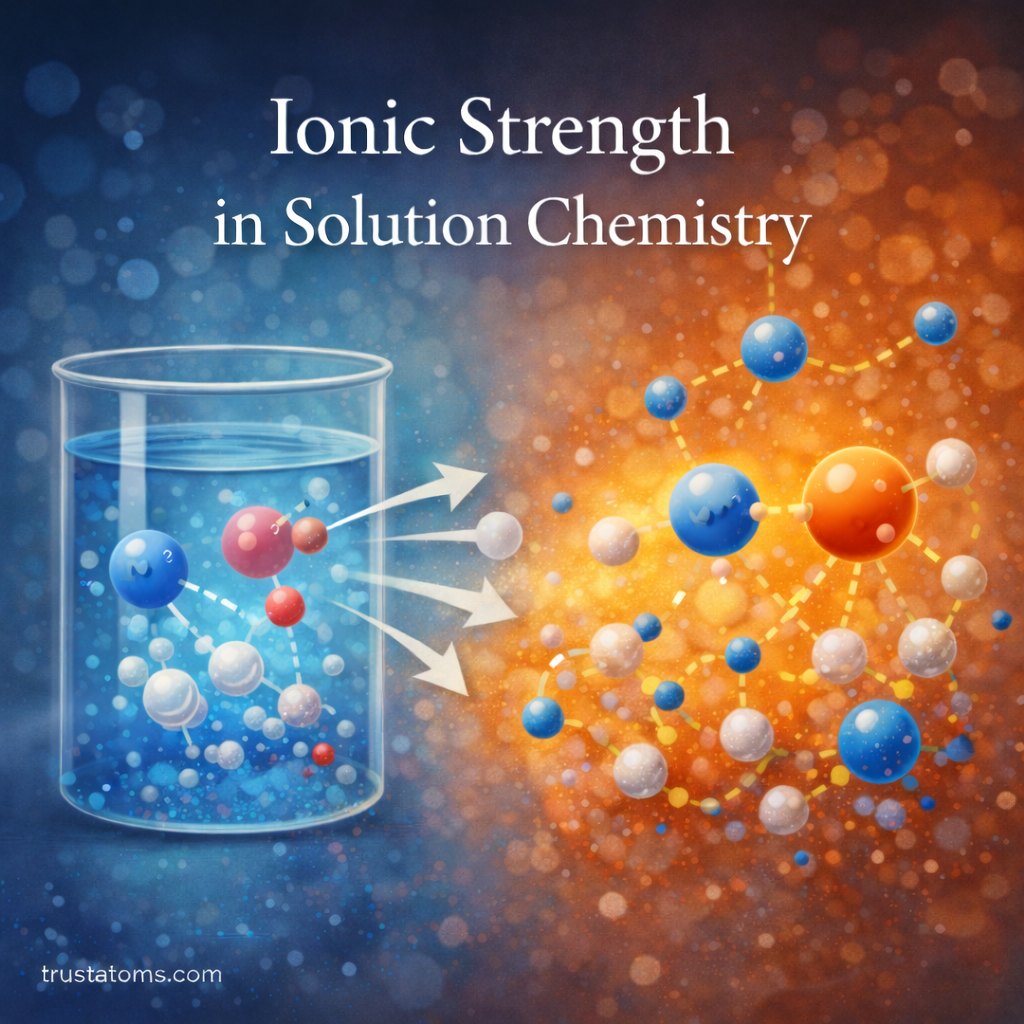
Ionic strength measures the total concentration of ions present in a solution and accounts for both the number of ions and their electrical charges. This property significantly influences reaction rates, equilibrium conditions, solubility, and the behavior of charged particles in chemical systems.
Understanding ionic strength helps scientists predict and control reactions in fields such as environmental chemistry, pharmaceuticals, biochemistry, and industrial processes.
What Is Ionic Strength?
Ionic strength describes how strongly ions in a solution interact with each other through electrostatic forces.
In simple terms, it reflects:
- How many ions are present in the solution
- The charges those ions carry
Solutions with higher concentrations of highly charged ions have greater ionic strength.
For example:
- A solution containing sodium chloride (NaCl) has moderate ionic strength.
- A solution containing magnesium sulfate (MgSO₄) may have higher ionic strength because the ions carry larger charges.
The more charged particles present, the stronger their collective influence on the chemical environment of the solution.
Why Ionic Strength Matters
Ions do not behave independently in solution. Because they carry electric charges, they attract or repel other ions and molecules.
These interactions affect several important chemical processes:
- Reaction rates
- Chemical equilibrium
- Solubility of compounds
- Stability of proteins and biomolecules
- Electrochemical reactions
In solutions with high ionic strength, the electric fields created by surrounding ions can shield charges, altering how particles interact.
Electrostatic Interactions in Solutions
Charged particles in solution interact through electrostatic forces. Opposite charges attract, while like charges repel.
However, in real solutions, these interactions are influenced by the presence of many other ions.
Ion Shielding
In solutions with many ions, surrounding ions partially block the electrostatic forces between charged particles. This effect is called charge shielding.
As ionic strength increases:
- Electrostatic interactions become weaker
- Charged species interact over shorter distances
- Reaction behavior may change
This phenomenon is especially important in biological and biochemical systems.
Ionic Atmosphere
One of the fundamental concepts related to ionic strength is the ionic atmosphere.
When an ion is dissolved in solution, it becomes surrounded by a cloud of nearby ions with opposite charges. This surrounding layer stabilizes the ion and reduces its effective electric field.
Example
If a positively charged ion is present in solution:
- Negatively charged ions tend to cluster nearby
- Positively charged ions are pushed slightly farther away
This distribution forms the ionic atmosphere, which affects how ions move and react.
Effects of Ionic Strength on Chemical Reactions
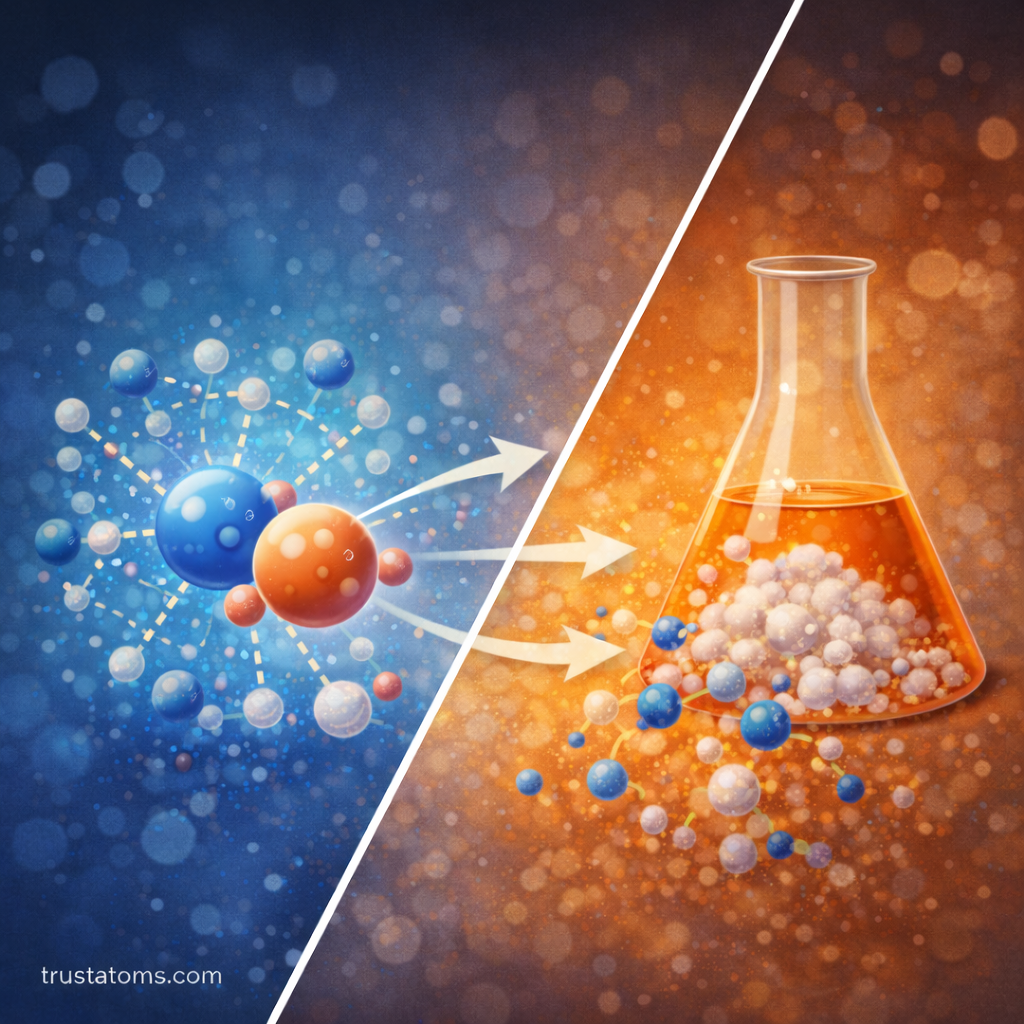
Ionic strength plays a major role in determining how quickly chemical reactions occur in solution.
Reaction Rate Changes
When ionic strength increases, reaction rates can change depending on the charges of the reacting particles.
For example:
- Reactions between oppositely charged ions may slow down due to shielding.
- Reactions between similarly charged ions may occur more easily because shielding reduces repulsion.
This relationship is often described using the primary salt effect in chemistry.
Influence on Chemical Equilibrium
Ionic strength can also affect chemical equilibrium.
Equilibrium depends on the effective concentration of reactants and products in solution. However, ions in solution do not behave ideally due to interactions with surrounding ions.
As ionic strength increases:
- Effective concentrations change
- Equilibrium constants may shift
- Reaction outcomes may vary
Chemists account for these changes using activity coefficients, which adjust for non-ideal solution behavior.
Ionic Strength and Solubility
The solubility of many compounds is affected by ionic strength.
In some cases, adding ions to a solution can increase solubility, while in others it may decrease it.
The Salt Effect
Adding salts to a solution can influence solubility through two mechanisms:
- Salting-in – increased solubility due to shielding of electrostatic attractions.
- Salting-out – decreased solubility due to competition between ions and solute molecules.
These effects are commonly observed in:
- Protein purification
- Industrial crystallization
- Environmental chemistry
Role of Ionic Strength in Biological Systems
Biological environments contain many dissolved ions, making ionic strength crucial in biochemical processes.
Inside cells and bodily fluids, ions such as:
- Sodium
- Potassium
- Calcium
- Chloride
help regulate molecular interactions.
Biological Impacts
Ionic strength influences:
- Protein folding
- Enzyme activity
- DNA stability
- Membrane transport processes
Maintaining proper ionic balance is essential for normal biological function.
Applications of Ionic Strength in Science and Industry
Understanding ionic strength allows scientists and engineers to control solution behavior in practical applications.
Environmental Chemistry
Ionic strength affects how pollutants move and react in natural water systems.
It influences:
- Metal solubility
- Nutrient transport
- Chemical reaction pathways in lakes and oceans
Pharmaceutical Development
Drug stability and effectiveness can depend on ionic strength.
Researchers must control ionic conditions to ensure proper:
- Drug formulation
- Solubility
- Absorption in the body
Industrial Chemistry
Many manufacturing processes rely on controlling ionic conditions to achieve desired results.
Industries use ionic strength adjustments in:
- Electroplating
- Water treatment
- Chemical synthesis
- Food processing
Factors That Influence Ionic Strength
Several variables determine the ionic strength of a solution.
Important factors include:
- Concentration of dissolved salts
- Charge of ions present
- Temperature
- Presence of complex ions
Solutions containing ions with higher charges generally produce stronger ionic effects than those containing singly charged ions.
Why Ionic Strength Is Important in Chemistry
Ionic strength provides insight into how real chemical solutions behave. While ideal solutions assume particles act independently, actual solutions involve complex interactions between charged particles.
By understanding ionic strength, chemists can:
- Predict reaction outcomes
- Improve experimental accuracy
- Design stable chemical systems
- Control industrial processes
This concept helps bridge the gap between theoretical chemistry and real-world chemical behavior.
Final Thoughts
Ionic strength is a fundamental concept in solution chemistry that describes how the concentration and charge of ions influence chemical systems. The presence of many charged particles creates complex interactions that affect reactions, equilibrium, solubility, and molecular stability.
From biological systems to industrial processes, ionic strength plays a crucial role in shaping the behavior of chemical solutions. By accounting for these ionic interactions, scientists can better understand and control chemical reactions in both natural and engineered environments.