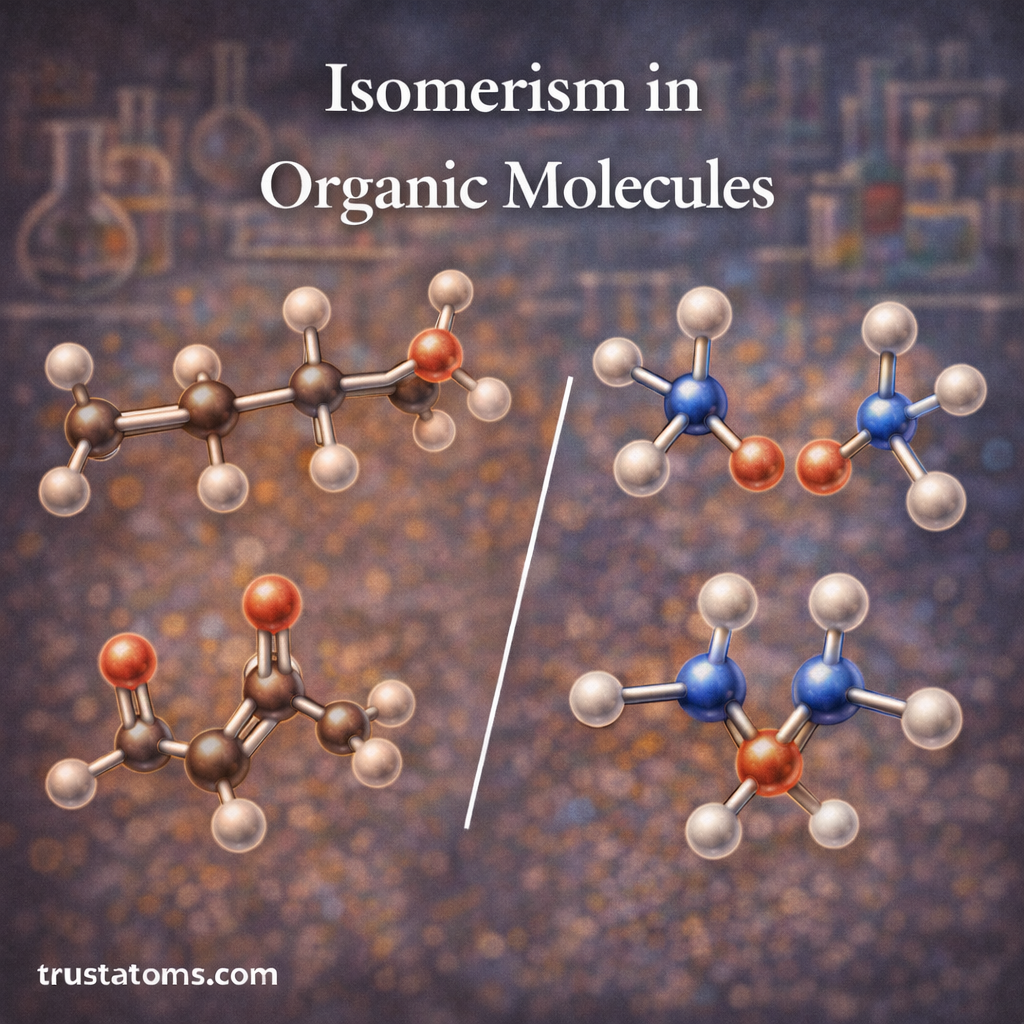
Isomerism is a fundamental concept in organic chemistry that explains how molecules with the same molecular formula can have different structures and properties. These variations arise because atoms in a molecule can be arranged in multiple ways while still maintaining the same overall chemical composition.
Isomers often display different chemical behaviors, physical properties, and biological effects, even though they contain the same types and numbers of atoms. Understanding isomerism helps chemists analyze molecular structure, design new compounds, and predict how substances will react.
What Is Isomerism?
Isomerism refers to the phenomenon where two or more compounds share the same molecular formula but differ in the arrangement of atoms.
These compounds are known as isomers.
Although isomers contain identical atoms, the differences in structure can lead to major changes in:
- Chemical reactivity
- Boiling and melting points
- Density
- Biological activity
- Solubility
Because of these differences, identifying the correct structure of a molecule is essential in chemistry.
Major Types of Isomerism
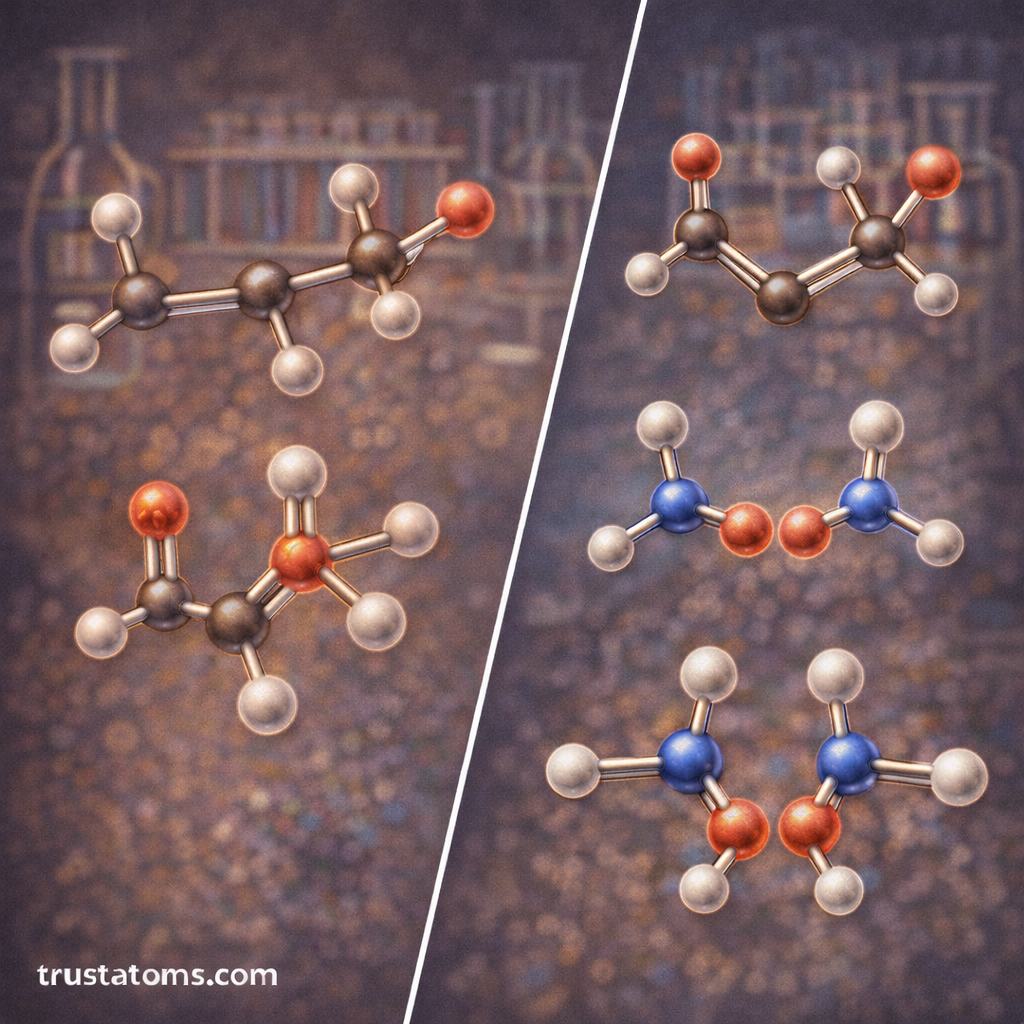
Isomerism in organic molecules is generally divided into two major categories:
- Structural (constitutional) isomerism
- Stereoisomerism
Each category represents a different way that atoms can be arranged within a molecule.
Structural Isomerism
Structural isomers have the same molecular formula but differ in the connectivity of atoms within the molecule.
In other words, the atoms are bonded in different ways.
Chain Isomerism
Chain isomerism occurs when the carbon skeleton of a molecule is arranged differently.
Examples include:
- Straight-chain hydrocarbons
- Branched hydrocarbons
Changes in the carbon chain can influence properties such as boiling point and stability.
Position Isomerism
Position isomerism occurs when the functional group or substituent appears in different positions along the carbon chain.
For example, a functional group may be located:
- At the end of a carbon chain
- In the middle of the molecule
This difference in placement can significantly alter the molecule’s chemical behavior.
Functional Group Isomerism
Functional group isomers share the same molecular formula but contain different functional groups.
Examples include compounds where the atoms rearrange to form different chemical groups.
This change can produce molecules with very different chemical properties and reactivity patterns.
Stereoisomerism
Stereoisomers have the same molecular formula and the same bonding sequence, but their atoms differ in three-dimensional arrangement.
These differences often influence biological activity and physical properties.
Two major types of stereoisomerism are commonly studied.
Geometric Isomerism
Geometric isomerism occurs when atoms or groups are arranged differently around a double bond or rigid structure.
Because rotation around a double bond is restricted, molecules can exist in two distinct configurations.
Common forms include:
- Cis configuration – substituent groups are on the same side
- Trans configuration – substituent groups are on opposite sides
These structural differences can affect molecular shape and polarity.
Optical Isomerism
Optical isomerism occurs when molecules have the same structure but are mirror images of each other.
These mirror-image molecules are called enantiomers.
Key characteristics include:
- Identical chemical composition
- Non-superimposable mirror images
- Ability to rotate plane-polarized light
Optical isomerism is especially important in biological chemistry because many biological molecules interact differently with each enantiomer.
Importance of Isomerism in Biology and Medicine
Isomerism plays a crucial role in biological systems.
Many biological molecules exist in specific three-dimensional arrangements that allow them to interact with enzymes and receptors.
In pharmaceuticals, different isomers of a compound may have very different effects.
For example:
- One isomer may be therapeutically active
- Another may be inactive or harmful
Because of this, pharmaceutical chemists carefully control molecular structure during drug development.
How Chemists Identify Isomers
Chemists use several techniques to determine whether compounds are isomers and to identify their structures.
Common analytical methods include:
- Spectroscopy
- Infrared spectroscopy
- Nuclear magnetic resonance
- Mass spectrometry
- Chromatography
- Gas chromatography
- Liquid chromatography
- X-ray crystallography
These tools allow scientists to analyze molecular structure and confirm the presence of specific isomers.
Applications of Isomerism in Chemistry
Isomerism is important across many areas of chemistry and industry.
Applications include:
- Pharmaceutical design
- Food and flavor chemistry
- Polymer science
- Materials engineering
- Agricultural chemical development
By understanding isomerism, chemists can design molecules with desired properties and improve the performance of chemical products.
Final Thoughts
Isomerism demonstrates how molecules with identical chemical formulas can behave very differently depending on how their atoms are arranged. Structural isomers vary in connectivity, while stereoisomers differ in spatial orientation.
These variations influence physical properties, chemical reactions, and biological activity. For chemists, studying isomerism provides deeper insight into molecular structure and helps guide the development of new compounds in medicine, materials science, and industrial chemistry.
Understanding isomerism is therefore essential for anyone studying organic chemistry and molecular science.