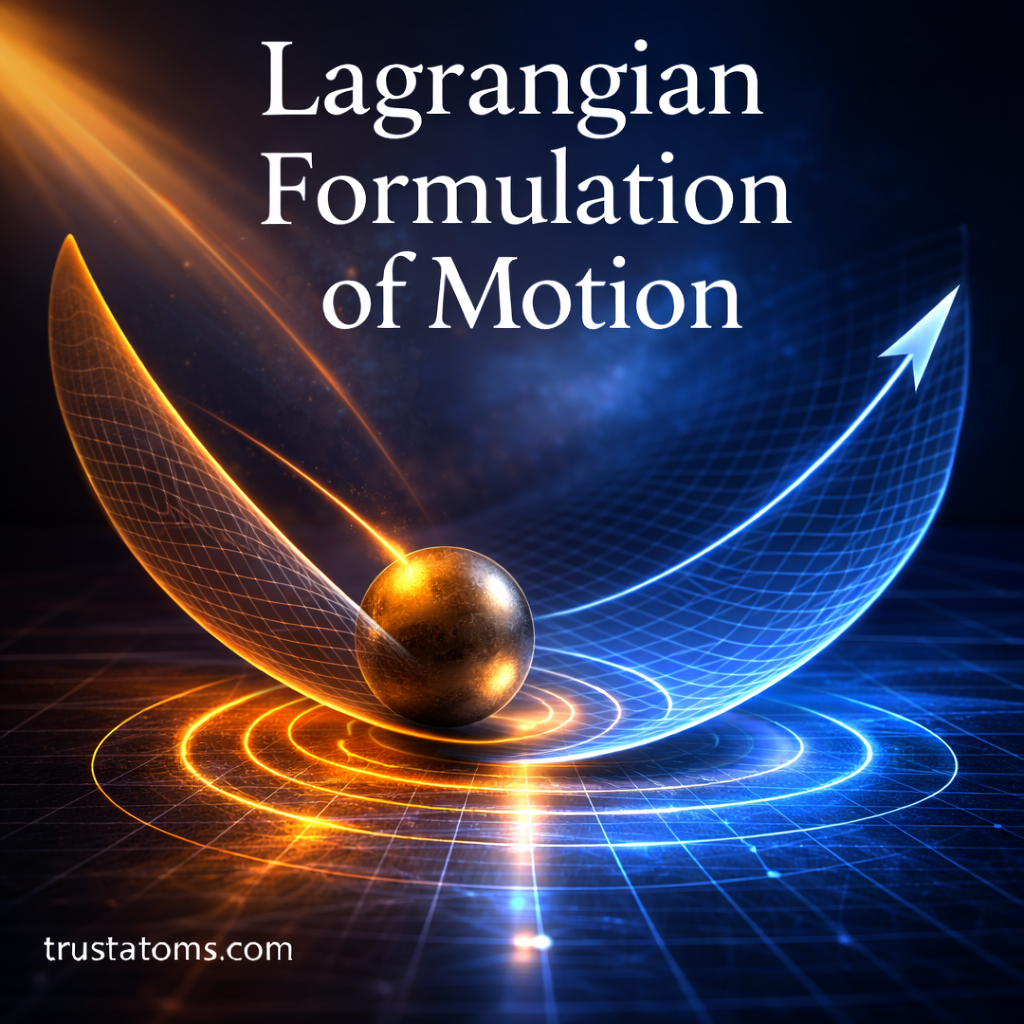
The Lagrangian formulation of motion is one of the most elegant ways to describe how physical systems evolve over time. Instead of focusing directly on forces — as Newtonian mechanics does — the Lagrangian approach focuses on energy.
This reformulation simplifies complex systems, reveals deep physical symmetries, and lays the groundwork for modern physics, including quantum mechanics and field theory.
In this article, we’ll explore what the Lagrangian formulation is, how it works, and why it remains essential in classical and modern physics.
From Forces to Energy
In Newtonian mechanics, motion is described by forces acting on objects.
However, analyzing forces can become complicated when:
- Systems have constraints
- Motion occurs in curved coordinates
- Multiple particles interact
The Lagrangian formulation shifts perspective.
Instead of asking:
What forces act on this system?
It asks:
How do kinetic and potential energy change over time?
This energy-based viewpoint often makes difficult problems much easier to solve.
What Is the Lagrangian?
The Lagrangian is a function that represents the difference between kinetic and potential energy.
In most classical systems:
Lagrangian = Kinetic Energy − Potential Energy
This simple definition leads to powerful equations of motion.
Rather than directly calculating forces, we analyze how this energy difference changes as the system evolves.
The Principle of Least Action
At the heart of the Lagrangian formulation is the Principle of Least Action.
It states:
A system moves along the path that makes the action stationary (usually minimized).
Action is a quantity defined as the time integral of the Lagrangian.
In simple terms:
- A system “chooses” the path that balances kinetic and potential energy in an optimal way.
- The actual path of motion is the one that satisfies this principle.
This idea unifies mechanics into a single mathematical rule.
Euler–Lagrange Equations
The mathematical result of applying the Principle of Least Action is the Euler–Lagrange equation.
This equation generates the equations of motion for a system.
Instead of solving force equations, we:
- Define kinetic energy
- Define potential energy
- Construct the Lagrangian
- Apply the Euler–Lagrange equation
The result describes how coordinates change over time.
This method works even in highly complex systems.
Generalized Coordinates
One major advantage of the Lagrangian formulation is the use of generalized coordinates.
Generalized coordinates:
- Do not have to be simple x, y, z positions.
- Can represent angles, distances, or other system parameters.
- Automatically account for constraints.
For example:
- A pendulum is easier described using an angle rather than horizontal and vertical coordinates.
- A rolling wheel can be described using rotation instead of linear displacement.
This flexibility simplifies many problems.
Why the Lagrangian Method Is Powerful
The Lagrangian formulation offers several advantages:
1. Handles Constraints Naturally
Systems with:
- Fixed lengths
- Surfaces
- Hinges
- Connected bodies
are easier to describe without explicitly calculating constraint forces.
2. Works in Any Coordinate System
The equations remain valid in:
- Cartesian coordinates
- Polar coordinates
- Spherical coordinates
This makes it ideal for rotational and orbital systems.
3. Reveals Conservation Laws
If the Lagrangian does not depend explicitly on a certain coordinate:
- The associated quantity is conserved.
Examples:
- If time does not appear explicitly → energy is conserved.
- If position symmetry exists → momentum is conserved.
This connection between symmetry and conservation is foundational in physics.
Example: The Simple Pendulum
Consider a simple pendulum.
Using Newtonian mechanics:
- Forces must be resolved into components.
- Tension forces complicate analysis.
Using the Lagrangian approach:
- Define kinetic energy in terms of angular motion.
- Define potential energy based on height.
- Construct the Lagrangian.
- Apply the Euler–Lagrange equation.
The resulting equation describes the pendulum’s oscillation directly — without calculating tension forces.
This demonstrates the efficiency of the energy-based method.
Lagrangian vs. Newtonian Mechanics
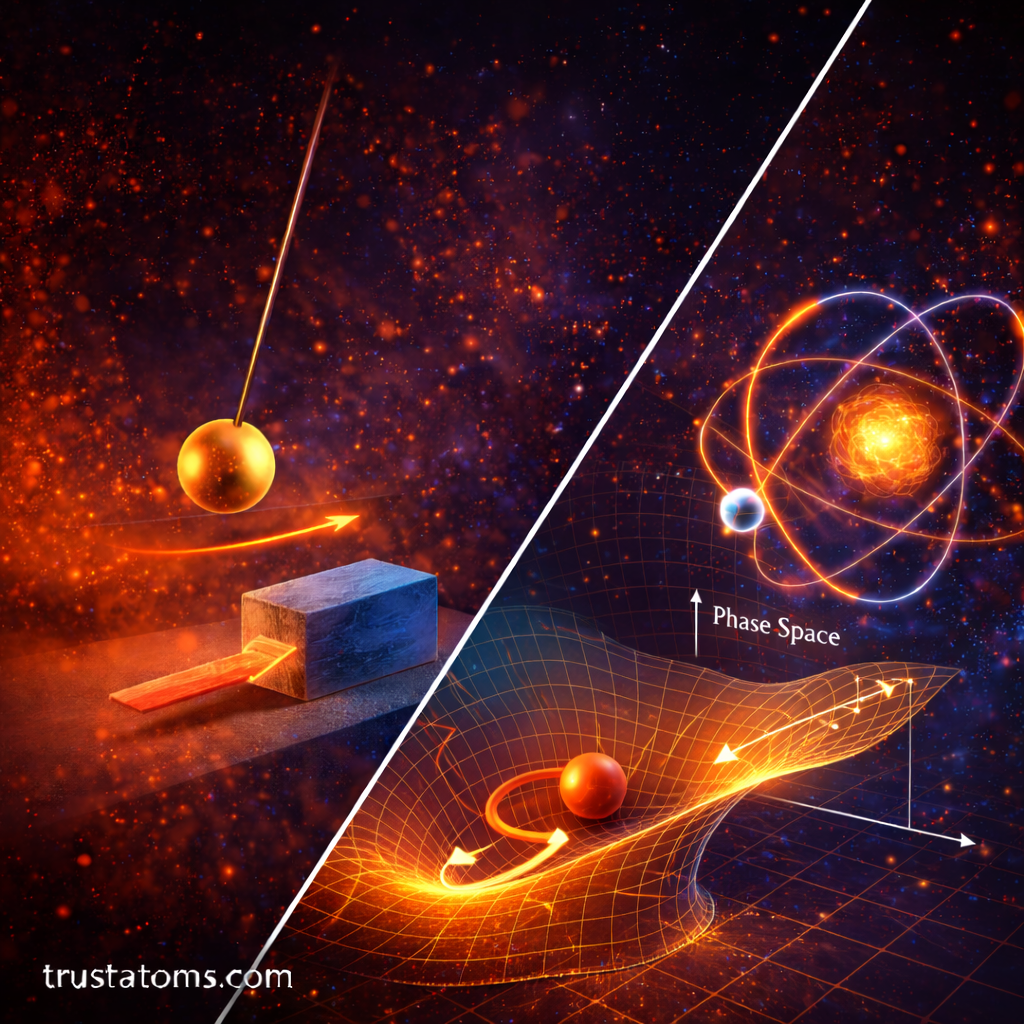
Newtonian mechanics:
- Focuses on forces.
- Uses vector equations.
- Best for simple systems.
Lagrangian mechanics:
- Focuses on energy.
- Uses scalar functions.
- Ideal for complex, constrained systems.
Both describe the same physical motion, but the Lagrangian method often simplifies the mathematics.
Applications Beyond Classical Mechanics
The Lagrangian framework extends far beyond simple motion problems.
It is fundamental in:
- Electromagnetism
- Quantum mechanics
- Relativity
- Field theory
- Particle physics
Modern theoretical physics is largely built upon Lagrangian principles.
In quantum mechanics, the action concept leads to path integral formulations.
In relativity, Lagrangian methods describe how particles move in curved spacetime.
Symmetry and Noether’s Theorem
One of the most profound results connected to the Lagrangian formulation is Noether’s theorem.
It states:
Every continuous symmetry of a system corresponds to a conserved quantity.
Examples:
- Time symmetry → energy conservation
- Spatial symmetry → momentum conservation
- Rotational symmetry → angular momentum conservation
This theorem shows how deeply symmetry shapes physical laws.
Why the Lagrangian Formulation Matters
The Lagrangian formulation of motion:
- Unifies mechanics under a single principle
- Simplifies complex systems
- Connects symmetry to conservation
- Serves as the foundation of modern theoretical physics
It provides a more general and flexible way to understand motion than force-based approaches alone.
Final Thoughts
The Lagrangian formulation of motion transforms classical mechanics from a study of forces into a study of energy and symmetry.
By focusing on the difference between kinetic and potential energy and applying the Principle of Least Action, physicists can derive equations of motion for even the most complex systems.
Far from being just an alternative to Newton’s laws, the Lagrangian approach is a gateway to deeper physical insight — bridging classical mechanics with quantum theory and modern physics.