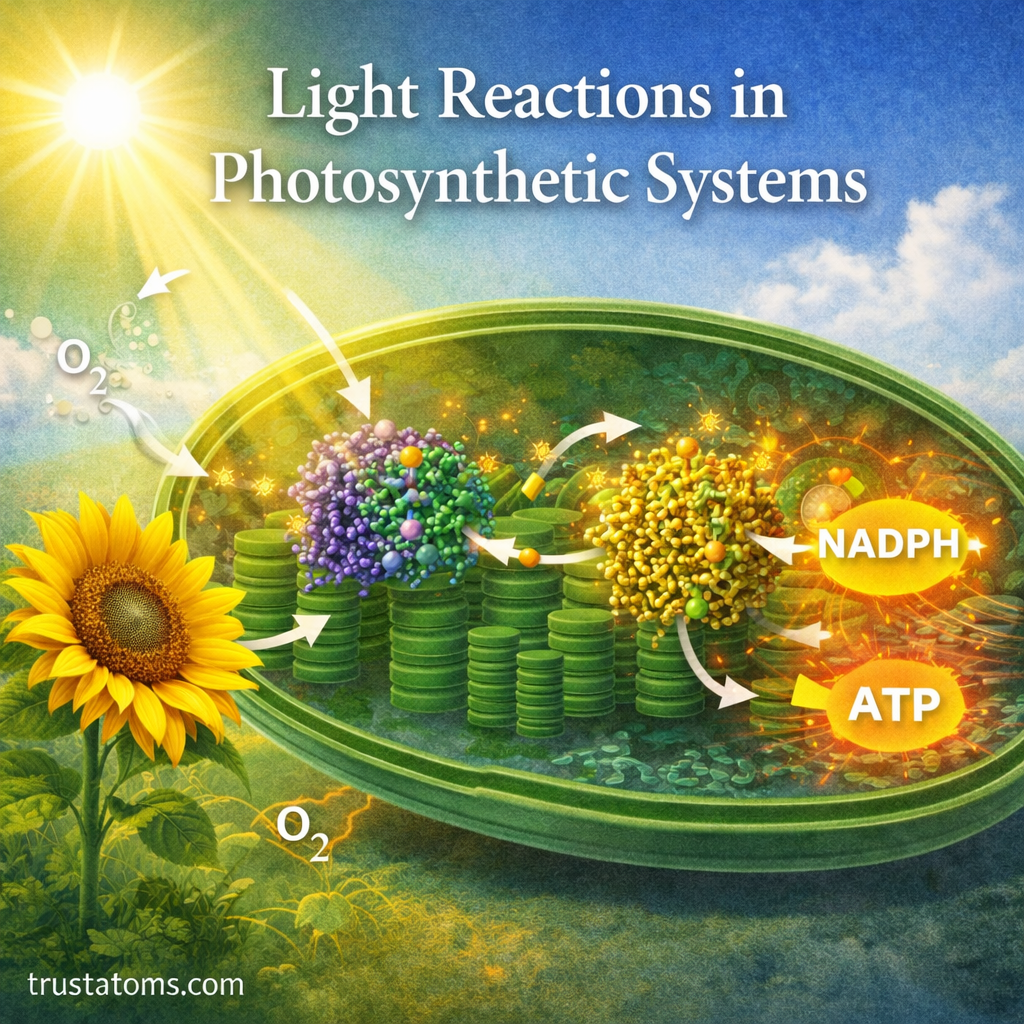
Photosynthesis is one of the most important biological processes on Earth. It allows plants, algae, and certain bacteria to convert sunlight into chemical energy that fuels life across ecosystems.
The first stage of this process is known as the light reactions, sometimes called the light-dependent reactions. These reactions capture energy from sunlight and convert it into chemical forms that cells can use to build energy-rich molecules.
Light reactions take place in specialized structures inside plant cells and form the foundation for the entire photosynthetic process.
What Are Light Reactions?
Light reactions are the initial stage of photosynthesis where sunlight energy is absorbed and converted into chemical energy.
These reactions produce two important molecules:
- ATP (adenosine triphosphate) – the main energy currency of the cell
- NADPH – a high-energy electron carrier used in later stages of photosynthesis
At the same time, light reactions release oxygen (O₂) as a byproduct.
The energy captured during this stage is later used in the Calvin cycle, where carbon dioxide is converted into glucose.
Where Light Reactions Occur
Light reactions occur in the chloroplasts, which are specialized organelles found in plant and algal cells.
Inside chloroplasts are stacks of membrane structures called thylakoids.
Key Chloroplast Structures
Understanding light reactions becomes easier when looking at the structure of the chloroplast:
- Outer membrane – protective outer layer
- Inner membrane – controls movement of substances
- Stroma – fluid-filled region where the Calvin cycle occurs
- Thylakoid membranes – location of the light reactions
- Grana – stacks of thylakoids that increase surface area
The thylakoid membranes contain the proteins and pigments responsible for capturing light energy.
These structures are highly organized to maximize sunlight absorption.
Pigments That Capture Light Energy
Plants use special molecules called pigments to absorb light.
The most important pigment is chlorophyll.
Chlorophyll
Chlorophyll absorbs light primarily in the blue and red wavelengths of the visible spectrum.
It reflects green wavelengths, which is why most plants appear green.
Chlorophyll molecules are embedded in protein complexes within the thylakoid membrane.
Accessory Pigments
In addition to chlorophyll, plants contain other pigments that help capture light energy.
Examples include:
- Carotenoids – absorb blue and green light
- Xanthophylls – help protect plants from excess light
- Phycobilins – found in certain algae and cyanobacteria
These pigments broaden the range of light wavelengths plants can use for photosynthesis.
Photosystems: The Light-Capturing Complexes
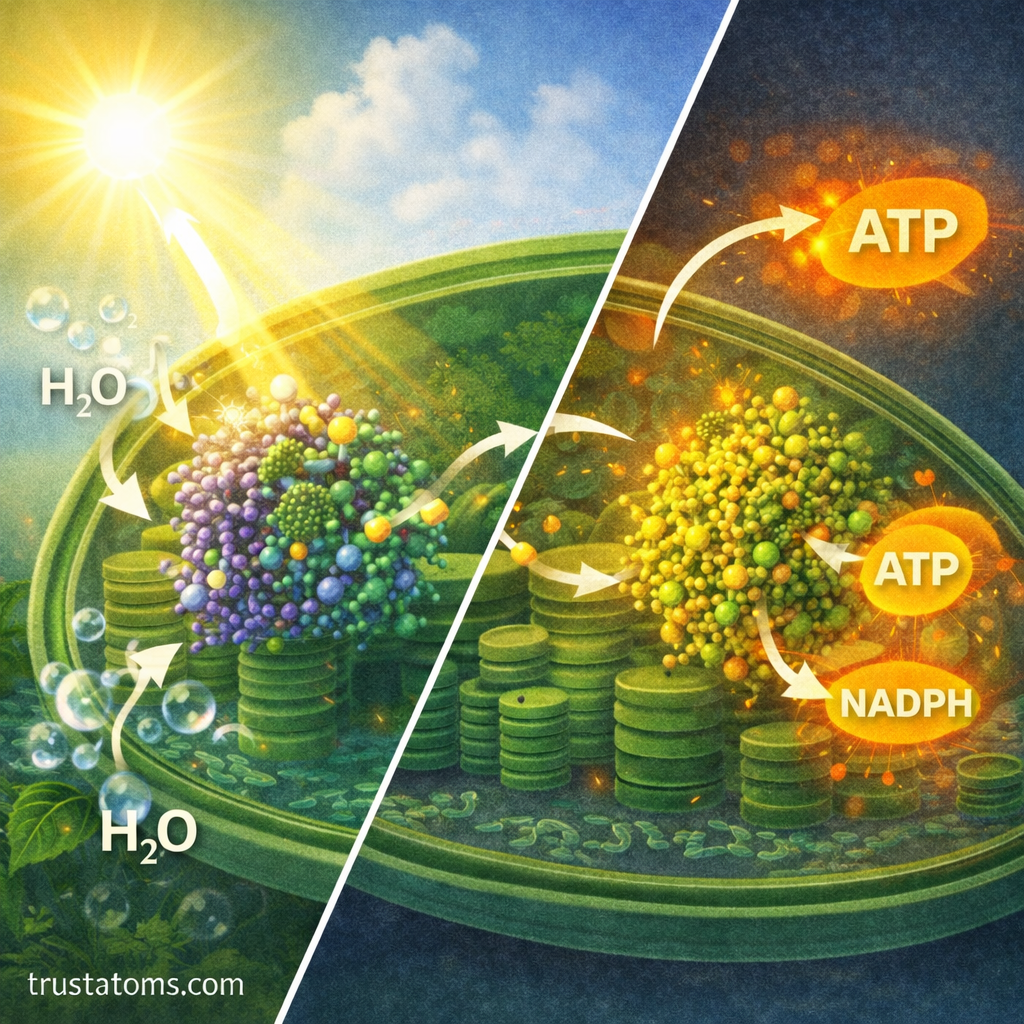
Light energy is captured by structures known as photosystems.
Photosystems are groups of pigments and proteins that work together to absorb light and transfer energy.
There are two main photosystems involved in light reactions:
- Photosystem II (PSII)
- Photosystem I (PSI)
Each photosystem plays a specific role in converting sunlight into chemical energy.
Photosystem II: Starting the Light Reactions
The light reactions begin when Photosystem II absorbs sunlight.
This energy excites electrons in chlorophyll molecules.
These high-energy electrons are transferred through a series of proteins known as the electron transport chain.
Splitting Water Molecules
Photosystem II also performs a critical process called photolysis, or the splitting of water molecules.
During this reaction:
- Water molecules are broken apart
- Oxygen gas is released
- Electrons replace those lost by chlorophyll
- Hydrogen ions (protons) are produced
The reaction can be summarized as:
Water → Oxygen + Electrons + Hydrogen ions
The oxygen released during this process is the source of most oxygen in Earth’s atmosphere.
The Electron Transport Chain
After electrons are energized in Photosystem II, they move through the electron transport chain located in the thylakoid membrane.
As electrons pass through this chain:
- Energy from the electrons is released
- That energy is used to pump hydrogen ions into the thylakoid interior
- A proton gradient builds up across the membrane
This gradient stores potential energy that will be used to produce ATP.
ATP Formation Through Chemiosmosis
The buildup of hydrogen ions inside the thylakoid creates pressure across the membrane.
Hydrogen ions then flow back across the membrane through an enzyme called ATP synthase.
This process is known as chemiosmosis.
As protons pass through ATP synthase:
- ADP combines with phosphate
- ATP is produced
ATP generated during light reactions provides the energy needed for later steps in photosynthesis.
Photosystem I and NADPH Production
After traveling through the electron transport chain, electrons arrive at Photosystem I.
Here, they absorb light energy again and become re-energized.
These electrons are then transferred to a molecule called NADP⁺, forming NADPH.
NADPH carries high-energy electrons that are used in the Calvin cycle to help build glucose molecules.
Summary of the Light Reactions
The light reactions accomplish several important tasks:
- Capture energy from sunlight
- Split water molecules
- Release oxygen
- Generate ATP
- Produce NADPH
These products provide both the energy and the reducing power required for carbon fixation in the next stage of photosynthesis.
Why Light Reactions Are Essential for Life
Light reactions are critical because they convert solar energy into forms that living organisms can use.
Without this process:
- Plants could not produce glucose
- Food chains would collapse
- Oxygen levels in the atmosphere would decline
The energy captured during light reactions ultimately fuels nearly every ecosystem on Earth.
Through this remarkable process, sunlight is transformed into chemical energy that powers the biological world.
Key Takeaways
- Light reactions are the first stage of photosynthesis.
- They occur in the thylakoid membranes of chloroplasts.
- Chlorophyll and other pigments absorb sunlight.
- Water molecules are split, releasing oxygen.
- Electron transport chains generate a proton gradient.
- ATP and NADPH are produced to power the Calvin cycle.
Together, these steps form a sophisticated system that allows plants to convert light energy into the chemical energy needed to sustain life.