Chemical reactions rarely occur under perfectly balanced conditions. In most reaction systems, one substance is consumed before the others, stopping the reaction from continuing. This substance is known as the limiting reactant (also called the limiting reagent).
Understanding limiting reactants is essential in chemistry because it determines how much product can actually form in a reaction. Whether in laboratory experiments, industrial manufacturing, or environmental chemistry, identifying the limiting reactant helps scientists predict reaction outcomes and manage resources efficiently.
What Is a Limiting Reactant?
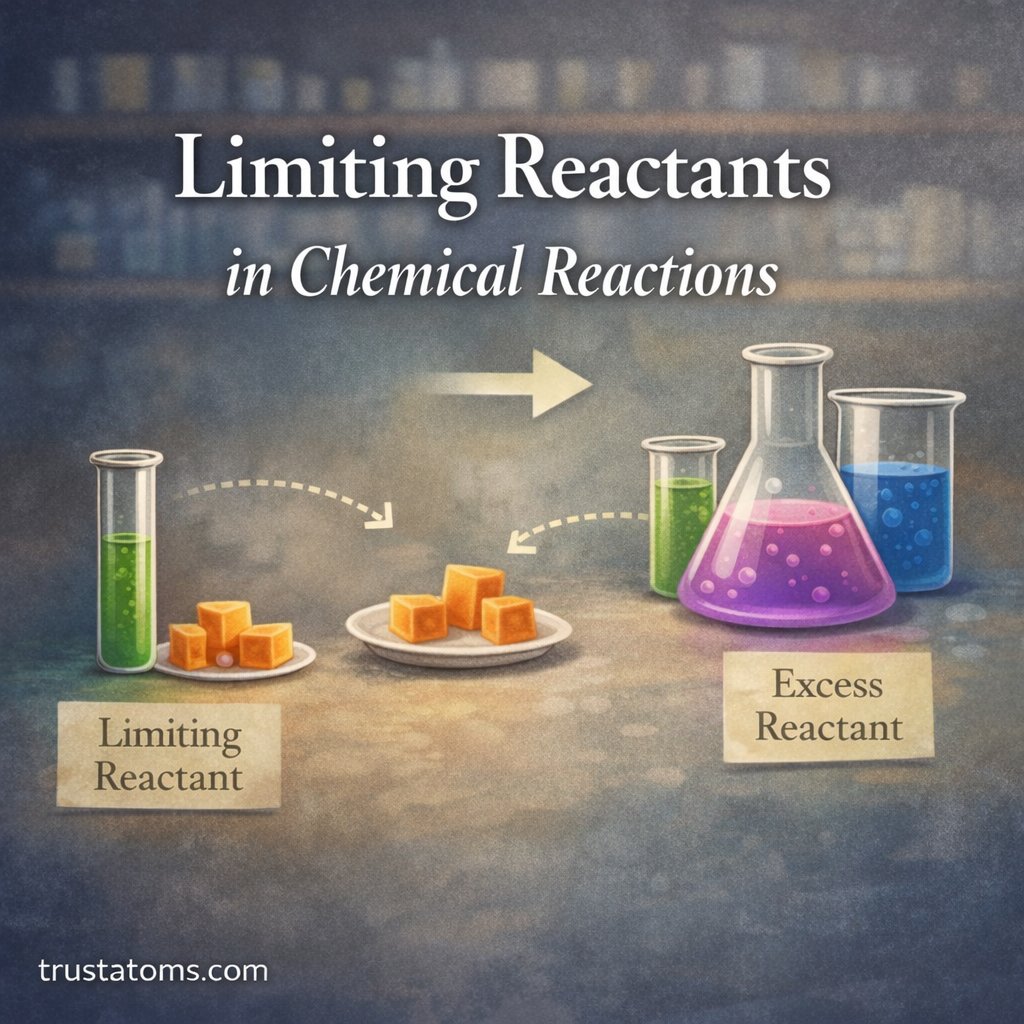
A limiting reactant is the substance that is completely used up first in a chemical reaction. Once it is consumed, the reaction cannot continue, even if other reactants remain.
Because of this, the limiting reactant determines:
- The maximum amount of product that can form
- When the reaction stops
- How much of other reactants remain unused
In simple terms, it is the ingredient that runs out first.
A Simple Everyday Analogy
Limiting reactants are easier to understand when compared to everyday processes.
Imagine making sandwiches:
- 2 slices of bread
- 1 slice of cheese
If you have:
- 10 slices of bread
- 3 slices of cheese
You can only make three sandwiches, because cheese runs out first. Even though bread remains, you cannot make more sandwiches without cheese.
In this scenario:
- Cheese is the limiting reactant
- Bread is the excess reactant
Chemical reactions follow the same principle.
Why Limiting Reactants Matter in Chemistry
Identifying the limiting reactant is critical for predicting how much product a reaction will generate.
Chemists rely on this concept to:
- Calculate maximum product yield
- Reduce chemical waste
- Optimize reaction efficiency
- Design industrial production systems
- Control reaction conditions in laboratories
Without determining the limiting reactant, stoichiometric calculations would produce inaccurate predictions.
The Role of Balanced Chemical Equations
Balanced chemical equations describe the ratio in which substances react.
For example:
2H₂ + O₂ → 2H₂O
This equation shows that:
- 2 moles of hydrogen react with
- 1 mole of oxygen to produce
- 2 moles of water
These coefficients define the required proportions of reactants. If the reactants are not present in these exact ratios, one will become the limiting reactant.
How to Identify the Limiting Reactant
Determining the limiting reactant follows a structured process. Chemists compare how much product each reactant could produce.
Step-by-Step Method
- Write and balance the chemical equation.
- Convert all given reactant quantities into moles.
- Use mole ratios from the equation to calculate possible product amounts.
- Identify which reactant produces the least product.
The reactant that forms the smallest amount of product is the limiting reactant.
Example Concept of a Limiting Reactant
Consider a reaction that requires:
2 units of substance A + 1 unit of substance B → product
If a reaction system contains:
- 6 units of A
- 2 units of B
You would need 4 units of A to react with 2 units of B.
Since there are enough units of A available, B becomes the limiting reactant because it runs out first.
Excess Reactants in Chemical Systems
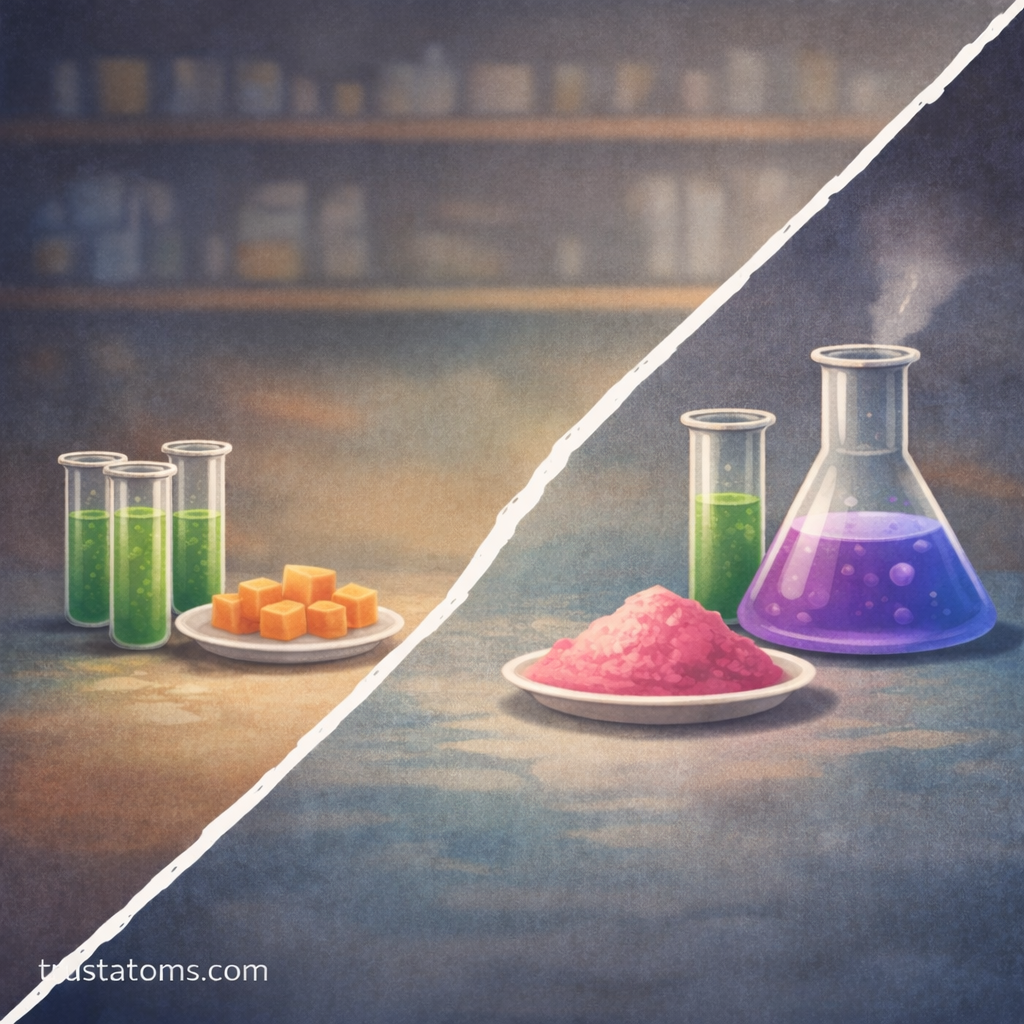
When a limiting reactant is present, at least one other reactant will remain unused. This is called the excess reactant.
Excess reactants serve several purposes in chemical reactions:
- Ensure complete consumption of the limiting reactant
- Increase reaction efficiency
- Maintain reaction stability
- Improve industrial process control
In industrial settings, using a slight excess of one reactant is often intentional to maximize production of the desired product.
Limiting Reactants and Theoretical Yield
The amount of product predicted from stoichiometric calculations using the limiting reactant is called the theoretical yield.
Theoretical yield represents the maximum amount of product possible under ideal conditions.
However, real reactions rarely achieve perfect results due to factors such as:
- Side reactions
- Energy loss
- Incomplete mixing
- Impurities
- Product loss during separation
Because of this, chemists often measure the actual yield obtained in an experiment.
Percent Yield and Reaction Efficiency
Chemists compare theoretical yield with actual experimental results using percent yield.
Percent Yield = (Actual Yield ÷ Theoretical Yield) × 100
This measurement helps scientists evaluate:
- Reaction efficiency
- Experimental accuracy
- Industrial process performance
Higher percent yield indicates a more efficient chemical reaction system.
Limiting Reactants in Industrial Chemistry
Large-scale chemical production depends heavily on limiting reactant calculations.
Industries use these calculations to control:
- Raw material usage
- Reactor conditions
- Waste management
- Production costs
Examples of industrial applications include:
- Fertilizer manufacturing
- Pharmaceutical production
- Polymer synthesis
- Fuel processing
- Chemical manufacturing
Properly managing limiting reactants ensures reactions proceed efficiently while minimizing unused chemicals.
Limiting Reactants in Environmental Chemistry
Environmental scientists also rely on limiting reactant principles to understand natural chemical processes.
Examples include:
- Oxygen availability in aquatic ecosystems
- Nutrient limitations in soil chemistry
- Combustion emissions in air pollution
- Chemical reactions in water treatment
In many ecosystems, nutrients such as nitrogen or phosphorus can act as limiting reactants that control biological growth and chemical cycles.
Common Mistakes When Identifying Limiting Reactants
When solving chemistry problems, several common errors can lead to incorrect results.
Frequent Mistakes
- Not balancing the chemical equation
- Skipping mole conversions
- Misinterpreting mole ratios
- Comparing reactant masses instead of moles
- Ignoring excess reactants
Careful step-by-step analysis helps prevent these issues.
Why Limiting Reactants Are a Core Chemistry Concept
Limiting reactants connect chemical equations with real-world reaction outcomes. They determine how reactions proceed and how much product forms.
From small laboratory reactions to massive industrial chemical plants, understanding limiting reactants allows scientists to control chemical systems with accuracy and efficiency.
Because nearly all chemical reactions involve unequal reactant amounts, this concept remains one of the most important tools in quantitative chemistry.
Final Thoughts
Limiting reactants play a central role in predicting the behavior of chemical reactions. By identifying which substance runs out first, chemists can calculate maximum product formation, determine excess materials, and measure reaction efficiency.
This concept is fundamental to stoichiometry and is widely used across laboratory research, industrial chemistry, environmental science, and engineering. Mastering limiting reactants helps transform chemical equations from theoretical expressions into practical predictions about how real reactions occur.