Magnetic dipoles are fundamental to understanding how magnets behave, how electric currents generate magnetic fields, and how materials respond to external magnetic influences.
From simple bar magnets to atomic-scale magnetic moments, dipoles shape the structure of magnetic field interactions across physics.
In this article, we’ll explore what magnetic dipoles are, how they interact with fields, and why they matter in both classical and modern physics.
What Is a Magnetic Dipole?
A magnetic dipole consists of two opposite magnetic poles separated by a small distance.
Unlike electric charges:
- Isolated magnetic monopoles have not been observed.
- Magnets always have both a north and south pole.
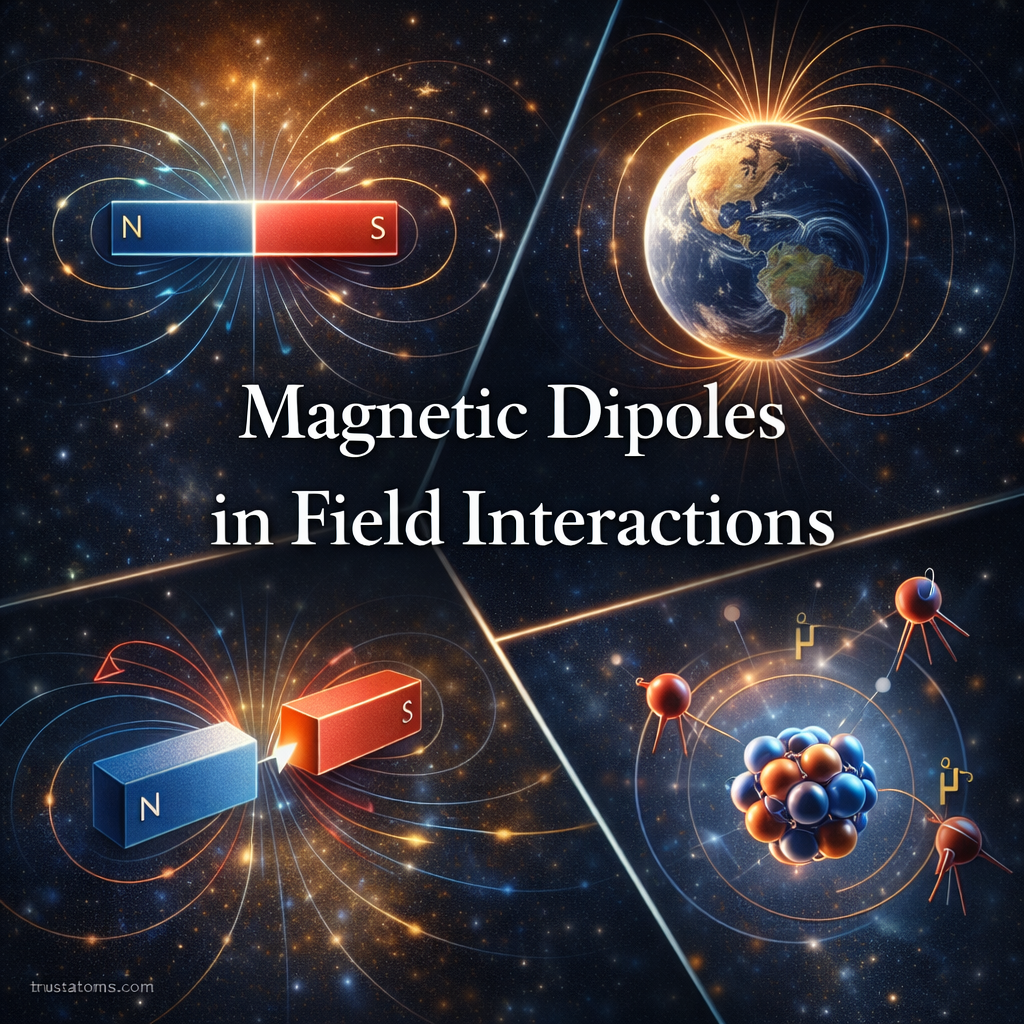
Common examples include:
- Bar magnets
- Current loops
- Atomic magnetic moments
A magnetic dipole is characterized by:
- Direction (from south to north)
- Strength (related to current or intrinsic magnetic properties)
Magnetic Dipole Moment
The magnetic dipole moment describes:
- The strength of the dipole
- Its orientation in space
For a current loop:
- Stronger current → stronger dipole moment
- Larger loop area → stronger dipole moment
In atoms:
- Electron spin
- Orbital motion
Both contribute to magnetic dipole moments.
The dipole moment determines how the object interacts with external magnetic fields.
Magnetic Field Around a Dipole
The magnetic field produced by a dipole:
- Emerges from the north pole
- Curves through space
- Re-enters at the south pole
Key features:
- Field strength decreases rapidly with distance
- The pattern forms closed loops
- The field is strongest near the poles
This dipole field pattern appears in bar magnets and current loops alike.
Interaction with External Magnetic Fields
When a magnetic dipole is placed in an external magnetic field, it experiences:
- A torque
- A potential energy change
- Sometimes a net force (if the field is non-uniform)
Torque on a Magnetic Dipole
A dipole in a magnetic field tends to rotate.
The torque:
- Aligns the dipole with the field
- Is strongest when the dipole is perpendicular to the field
- Is zero when aligned or anti-aligned
This explains why:
- Compass needles align with Earth’s magnetic field
- Magnets rotate to face certain directions
Potential Energy of a Dipole in a Field
Magnetic dipoles have potential energy in a magnetic field.
The system:
- Has lowest energy when aligned with the field
- Has highest energy when anti-aligned
This energy difference drives rotational motion.
Magnetic Dipoles in Materials
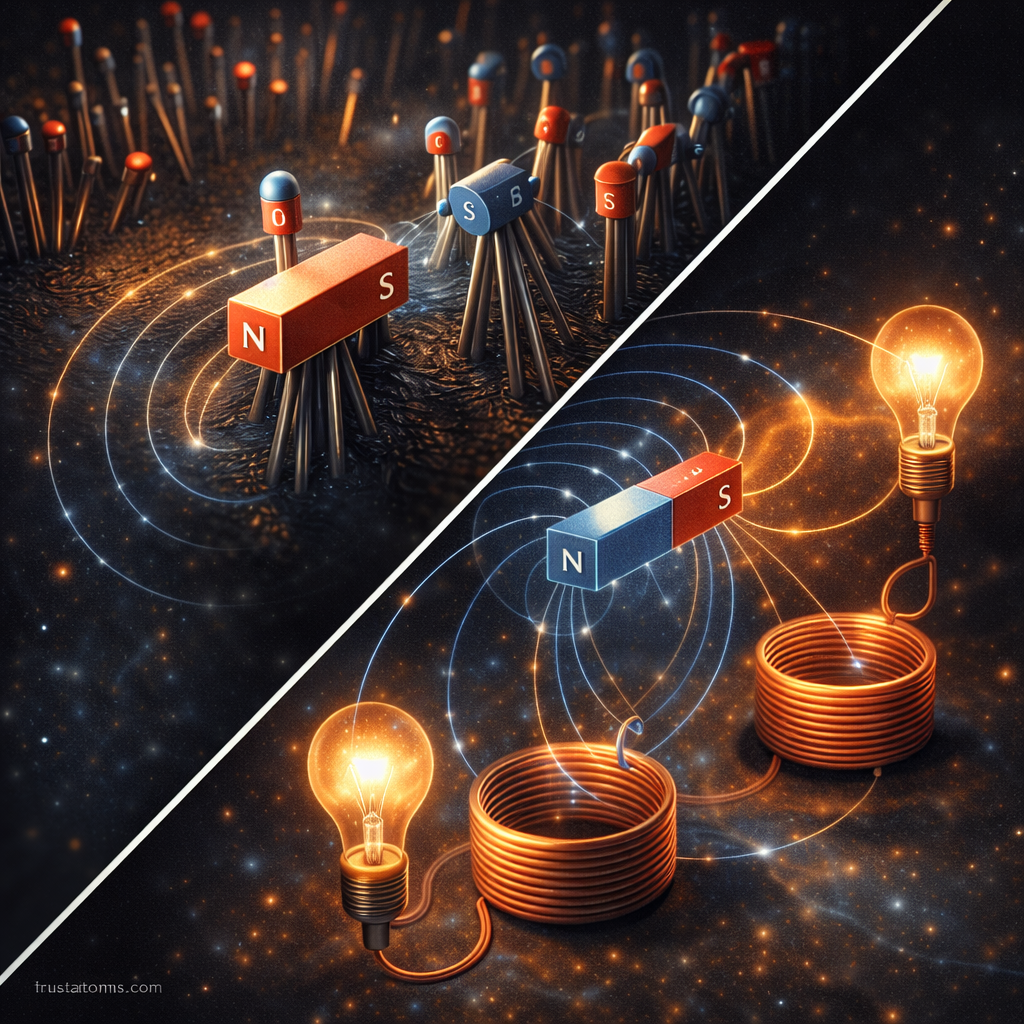
Magnetic behavior of materials arises from atomic dipoles.
There are three primary categories:
1. Diamagnetic Materials
- Weakly repel magnetic fields
- Do not retain magnetization
- Examples: copper, water
2. Paramagnetic Materials
- Weakly attracted to magnetic fields
- Atomic dipoles align partially in external fields
- Lose magnetization when the field is removed
3. Ferromagnetic Materials
- Strongly attracted to magnetic fields
- Atomic dipoles align collectively
- Can retain magnetization
Examples include iron, cobalt, and nickel.
Ferromagnetism arises from cooperative alignment of many magnetic dipoles.
Magnetic Dipole–Dipole Interactions
Magnetic dipoles also interact with each other.
Their interaction depends on:
- Distance
- Orientation
- Field strength
Dipoles may:
- Attract
- Repel
- Align side-by-side
- Form chains or patterns
Dipole–dipole interactions are important in:
- Magnetic materials
- Plasma physics
- Molecular magnetism
Magnetic Dipoles in Electromagnetism
In classical electromagnetism:
- A small current loop behaves like a magnetic dipole.
- The dipole field is a fundamental solution of Maxwell’s equations.
Electromagnetic devices such as:
- Electric motors
- Transformers
- Inductors
Rely on dipole interactions.
Magnetic Dipoles at the Atomic Level
At the atomic scale, magnetic dipoles originate from:
- Electron spin
- Electron orbital motion around the nucleus
Quantum mechanics explains:
- Why these magnetic moments exist
- How they interact with external fields
- Why materials behave magnetically
Although classical physics provides a useful model, atomic magnetism requires quantum theory for full explanation.
Earth as a Magnetic Dipole
Earth itself behaves approximately like a magnetic dipole.
Its magnetic field:
- Extends into space
- Forms the magnetosphere
- Protects the planet from solar radiation
The dipole arises from:
- Electric currents in Earth’s outer core
- Motion of conductive molten iron
This planetary-scale dipole demonstrates the universality of dipole field behavior.
Energy Considerations in Dipole Interactions
Magnetic dipoles minimize energy by aligning with external fields.
In systems of many dipoles:
- Collective alignment reduces total energy
- Magnetic domains form
- Stable configurations emerge
Energy minimization plays a central role in magnetic ordering.
Applications of Magnetic Dipole Physics
Understanding magnetic dipoles is essential in:
- MRI (Magnetic Resonance Imaging)
- Electric motors and generators
- Magnetic storage devices
- Particle accelerators
- Spintronics
These technologies rely on controlled dipole–field interactions.
Common Misconceptions
“Magnets Have Single Poles”
All known magnets are dipoles.
Breaking a magnet in half:
- Produces two smaller dipoles
- Does not isolate a single pole
“Magnetic Forces Work Like Electric Charges”
Magnetic dipoles interact differently from electric monopoles.
Magnetic field lines:
- Always form closed loops
- Do not begin or end at isolated charges
Final Thoughts
Magnetic dipoles in field interactions provide a powerful framework for understanding magnetism across scales.
From compass needles and bar magnets to atomic spins and planetary magnetic fields, dipoles govern how magnetic fields form and interact.
They:
- Experience torque in external fields
- Store potential energy
- Interact with other dipoles
- Form collective magnetic behavior in materials
Magnetic dipoles are not just classroom abstractions — they are foundational elements shaping both natural phenomena and modern technology.