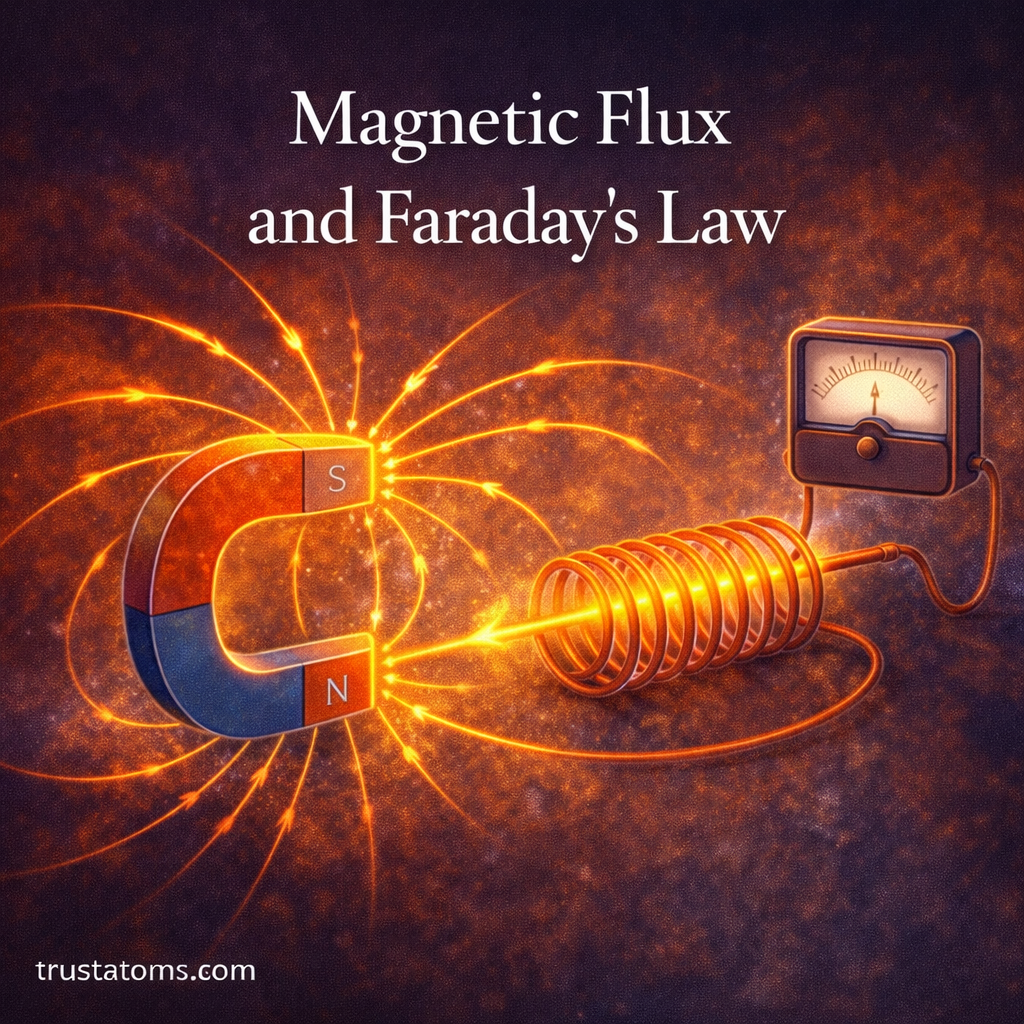
Magnetic flux and Faraday’s Law explain one of the most important discoveries in physics: changing magnetic fields can produce electric currents.
This principle is the foundation of electric generators, transformers, induction cooktops, wireless charging, and modern power grids.
In this guide, we’ll explore what magnetic flux is, how Faraday’s Law works, and why electromagnetic induction changed the world.
What Is Magnetic Flux?
Magnetic flux measures how much magnetic field passes through a surface.
You can visualize it as:
- Magnetic field lines flowing through space
- A surface placed within that field
- The number of field lines passing through that surface
Magnetic flux depends on:
- The strength of the magnetic field
- The area of the surface
- The angle between the field and the surface
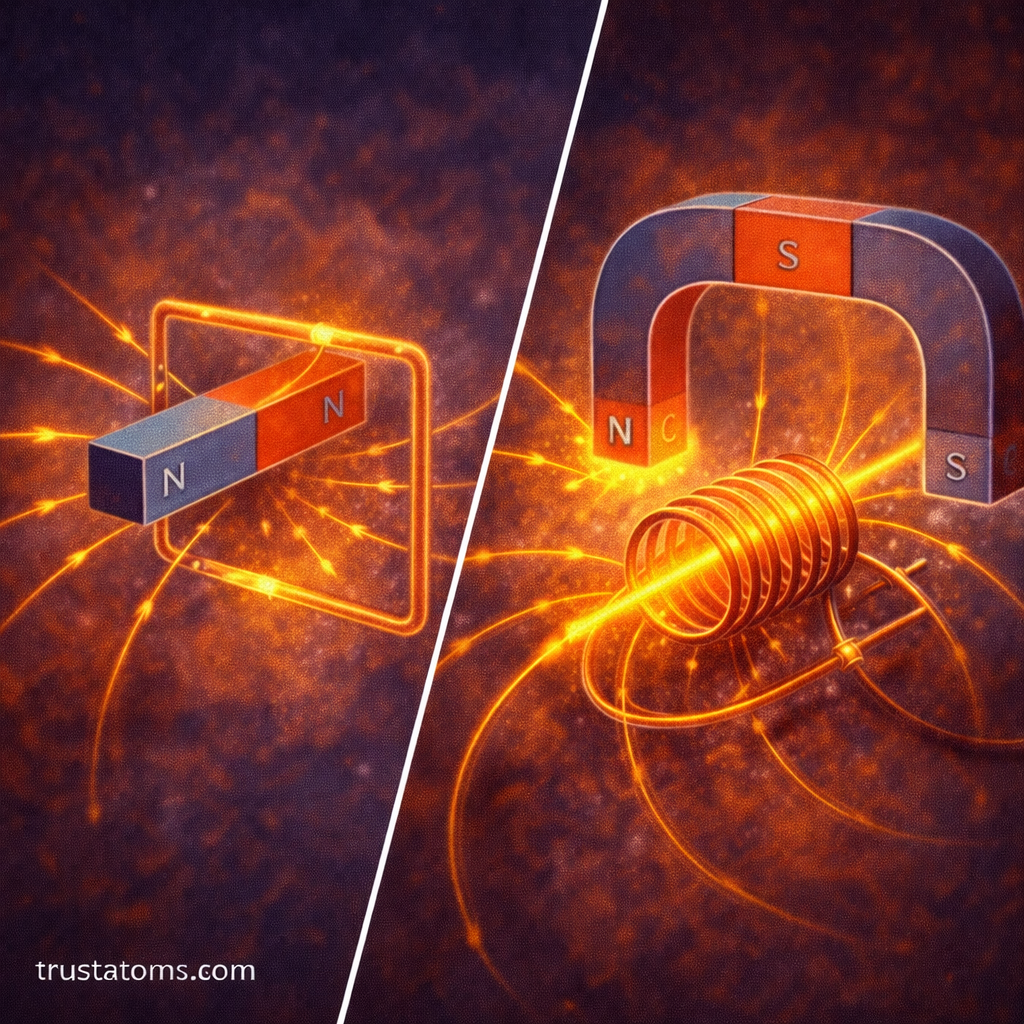
If the surface is perpendicular to the magnetic field, flux is maximum.
If the surface is parallel to the field, flux is zero.
Magnetic Fields and Field Lines
Magnetic field lines:
- Form closed loops
- Emerge from the north pole of a magnet
- Enter the south pole
Unlike electric field lines, magnetic field lines do not begin or end — they always form continuous loops.
This is because isolated magnetic monopoles have never been observed.
What Causes Magnetic Flux to Change?
Magnetic flux changes when:
- The magnetic field strength changes
- The area of the loop changes
- The orientation of the loop changes
- The loop moves relative to the magnetic field
Any of these changes can produce an important physical effect: induced voltage.
Faraday’s Law of Electromagnetic Induction
Faraday’s Law states:
A changing magnetic flux through a closed loop induces an electromotive force (EMF) in the loop.
In simple terms:
Change the magnetic flux → Generate voltage.
The greater the rate of change, the greater the induced voltage.
This is one of the fundamental laws of electromagnetism.
Understanding Electromotive Force (EMF)
EMF is not a force in the traditional sense.
It represents:
- A voltage generated by changing magnetic flux
- The energy per unit charge supplied by induction
If the loop forms a complete circuit:
- Current will flow
- Electrical energy is produced
This process is called electromagnetic induction.
Lenz’s Law: Direction of Induced Current
Faraday’s Law tells us that current is induced.
Lenz’s Law tells us the direction.
Lenz’s Law states:
The induced current opposes the change in magnetic flux that produced it.
This means:
- If flux increases, the induced current creates a field that reduces it.
- If flux decreases, the induced current creates a field that reinforces it.
This opposition ensures conservation of energy.
Real-World Example: Moving Magnet and Coil
Consider a simple experiment:
- Move a magnet toward a wire coil
- The magnetic flux through the coil changes
- A current is induced
If the magnet stops moving:
- Flux becomes constant
- Induced current stops
Only change creates induction — steady magnetic fields do not.
Electric Generators
Electric generators operate using Faraday’s Law.
How they work:
- A coil rotates in a magnetic field
- The angle between the field and coil changes
- Magnetic flux changes continuously
- Alternating current (AC) is produced
Nearly all large-scale electricity generation relies on electromagnetic induction.
Transformers
Transformers transfer electrical energy between circuits using changing magnetic flux.
They work by:
- Passing alternating current through a primary coil
- Creating a changing magnetic field
- Inducing voltage in a secondary coil
Transformers allow:
- Voltage to be stepped up for transmission
- Voltage to be stepped down for safe use
Modern power grids depend on this principle.
Magnetic Flux in Everyday Technology
Faraday’s Law powers:
- Induction cooktops
- Wireless phone chargers
- Electric guitar pickups
- MRI machines
- Electric vehicles
- Renewable energy systems
Without electromagnetic induction, modern civilization would look very different.
Relationship to Maxwell’s Equations
Faraday’s Law is one of Maxwell’s four equations.
It reveals something profound:
Changing magnetic fields create electric fields.
This insight led to the discovery of electromagnetic waves — including light.
James Clerk Maxwell showed that oscillating electric and magnetic fields propagate through space as waves.
Light itself is an electromagnetic wave.
Conservation of Energy and Induction
Electromagnetic induction does not create energy from nothing.
Energy must be supplied to:
- Move a magnet
- Rotate a generator
- Change a magnetic field
The induced current resists the change (Lenz’s Law), requiring input energy.
This maintains energy conservation.
Magnetic Flux vs Electric Flux
While similar in concept, they differ:
Electric flux:
- Related to electric fields
- Connected to electric charge
Magnetic flux:
- Related to magnetic fields
- Always forms closed loops
- No isolated magnetic charges observed
Both concepts help describe how fields interact with surfaces.
Common Misconceptions
- A constant magnetic field does not produce current.
- Magnetic flux itself is not electricity — change is required.
- EMF does not mean magnetic force pushes charges directly.
- Induction works even without physical contact.
Understanding these distinctions clarifies how generators and transformers operate.
Why Faraday’s Law Matters
Faraday’s discovery transformed science and technology.
It explains:
- How mechanical energy becomes electrical energy
- How power plants operate
- How renewable energy systems generate electricity
- How electromagnetic waves exist
It connects electricity and magnetism into a unified framework.
Final Thoughts
Magnetic flux and Faraday’s Law reveal a powerful principle:
Changing magnetic environments produce electric energy.
From simple lab experiments to global power infrastructure, electromagnetic induction shapes modern life.
Understanding magnetic flux and Faraday’s Law provides deeper insight into:
- Electromagnetism
- Energy conversion
- Electrical engineering
- The nature of light
It remains one of the most elegant and practical laws in physics.