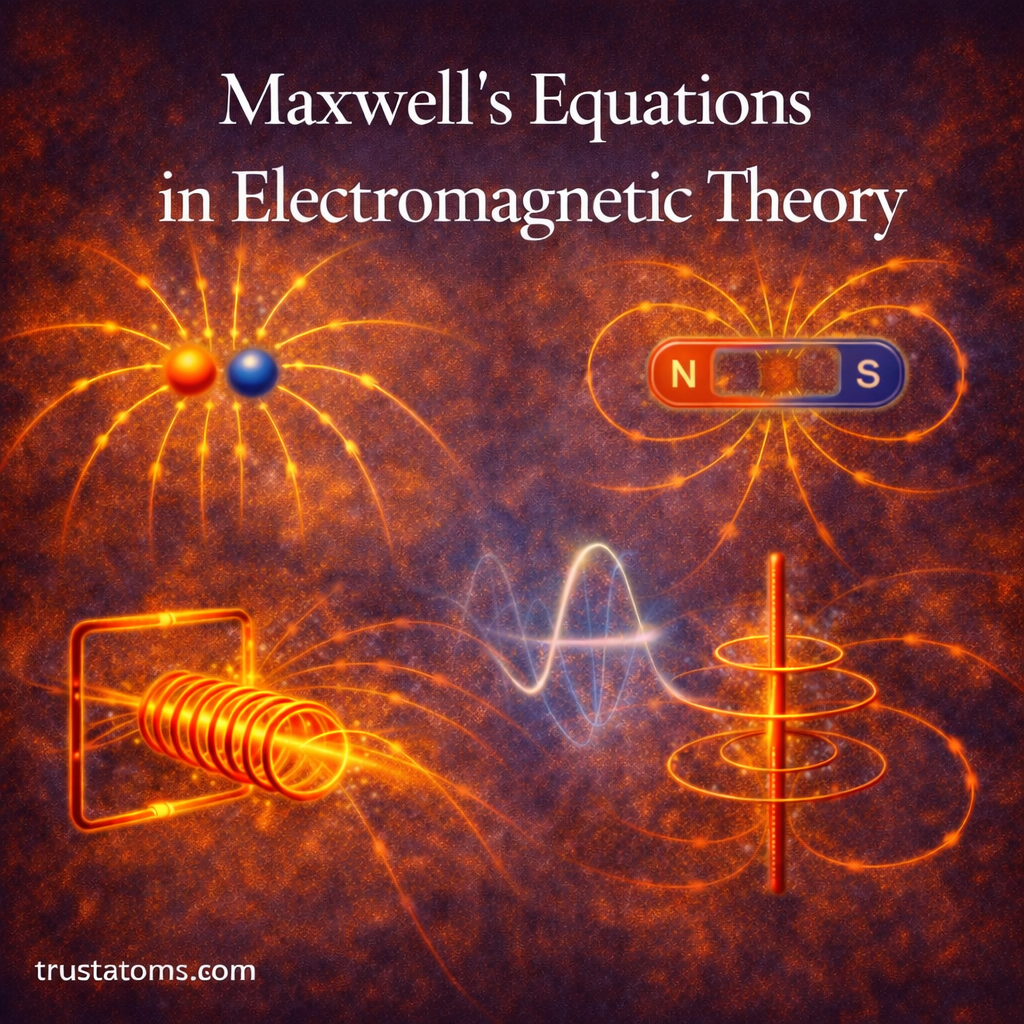
Maxwell’s Equations are the foundation of classical electromagnetism. They unify electricity, magnetism, and light into one coherent mathematical framework.
Before James Clerk Maxwell, electricity and magnetism were studied as separate phenomena. Maxwell’s work revealed that they are deeply connected — and that light itself is an electromagnetic wave.
In this guide, we’ll explore Maxwell’s Equations conceptually, understand what each equation describes, and see why they are among the most important discoveries in physics.
Why Maxwell’s Equations Matter
Maxwell’s Equations explain:
- How electric fields are generated
- How magnetic fields are generated
- How changing fields influence one another
- How electromagnetic waves propagate
They form the backbone of:
- Electrical engineering
- Telecommunications
- Optics
- Power systems
- Modern physics
Without them, there would be no radio, Wi-Fi, radar, or even a scientific understanding of light.
The Four Maxwell Equations Overview
Maxwell’s theory consists of four equations:
- Gauss’s Law (Electric Fields)
- Gauss’s Law for Magnetism
- Faraday’s Law of Induction
- Ampère–Maxwell Law
Each equation describes a different aspect of electromagnetic behavior.
Gauss’s Law (Electric Fields)
Gauss’s Law states:
Electric charges produce electric fields.
Key ideas:
- Electric flux through a closed surface depends on enclosed charge.
- Positive charges produce outward fields.
- Negative charges produce inward fields.
This equation connects electric fields directly to electric charge density.
It explains why:
- Electric fields spread outward from charges
- Conductors redistribute charge on their surfaces
- Shielding works inside conductive enclosures
Gauss’s Law for Magnetism
This equation states:
There are no isolated magnetic monopoles.
Key implications:
- Magnetic field lines form closed loops.
- Magnetic fields do not begin or end at a single point.
- North and south poles always exist together.
Unlike electric charge, which can exist independently as positive or negative, magnetic poles cannot be separated.
This symmetry difference is fundamental in electromagnetism.
Faraday’s Law of Induction
Faraday’s Law states:
Changing magnetic fields produce electric fields.
This explains:
- Electric generators
- Transformers
- Induction heating
- Wireless charging
If magnetic flux through a loop changes, an electromotive force (EMF) is induced.
This principle allows mechanical energy to become electrical energy.
Ampère–Maxwell Law
Ampère’s original law described how electric currents produce magnetic fields.
Maxwell added a crucial correction:
Changing electric fields also produce magnetic fields.
This addition was revolutionary.
It showed that:
- Electric fields and magnetic fields can generate each other
- Self-sustaining electromagnetic waves are possible
This insight led directly to the prediction of electromagnetic radiation.
How Maxwell Unified Electricity and Magnetism
Before Maxwell:
- Electric forces were described by Coulomb’s Law
- Magnetic forces were described separately
- Light was treated as a distinct phenomenon
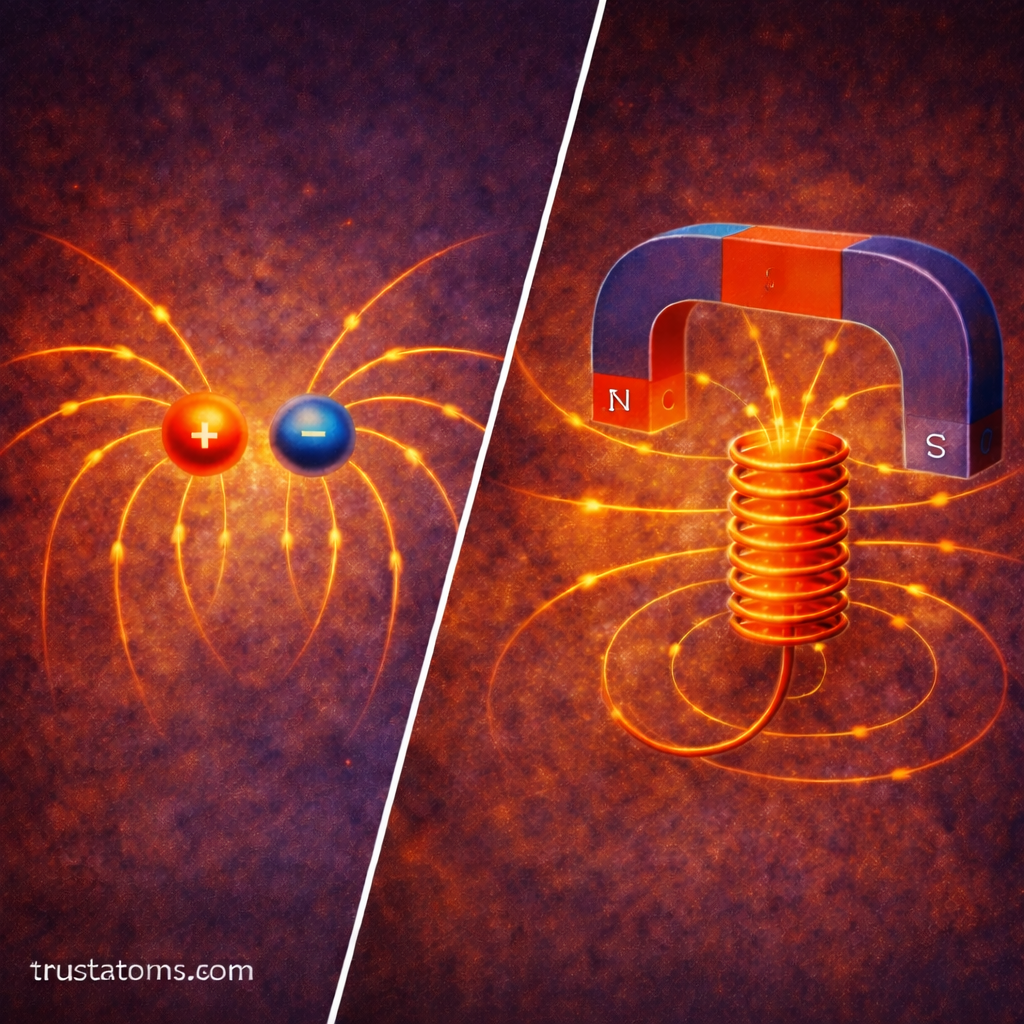
Maxwell’s equations revealed:
- Changing electric fields create magnetic fields
- Changing magnetic fields create electric fields
Together, these oscillating fields form electromagnetic waves.
When Maxwell calculated the wave speed predicted by his equations, it matched the measured speed of light.
This showed that light is an electromagnetic wave.
Electromagnetic Waves
Electromagnetic waves consist of:
- Oscillating electric fields
- Oscillating magnetic fields
- Perpendicular orientation
- Propagation through space
They require no medium.
Examples include:
- Radio waves
- Microwaves
- Infrared radiation
- Visible light
- Ultraviolet radiation
- X-rays
- Gamma rays
All are governed by Maxwell’s Equations.
Maxwell’s Equations and Modern Technology
Nearly all modern electrical technology depends on Maxwell’s framework.
Applications include:
- Power transmission
- Antenna design
- Fiber optics
- Radar systems
- Satellite communication
- MRI machines
- Wireless networks
Even advanced topics like quantum electrodynamics build upon these classical foundations.
Differential and Integral Forms
Maxwell’s Equations can be written in:
- Integral form (global perspective)
- Differential form (local field behavior)
The differential form describes how fields vary at each point in space.
The integral form describes how fields behave over entire surfaces or volumes.
Both perspectives describe the same physical laws.
The Concept of Field
One of Maxwell’s greatest contributions was strengthening the concept of a field.
Instead of forces acting instantly at a distance:
- Fields exist throughout space
- Charges and currents influence nearby fields
- Fields propagate changes at finite speed
This replaced older action-at-a-distance models and laid groundwork for modern physics.
Maxwell’s Equations and Relativity
Later developments showed that Maxwell’s Equations are consistent with special relativity.
In fact:
- The constant speed of light in Maxwell’s theory inspired Einstein’s work.
- Electric and magnetic fields transform into one another under relative motion.
This deepened the connection between electromagnetism and spacetime structure.
Common Misconceptions
- Electricity and magnetism are separate forces (they are unified).
- Magnetic fields require permanent magnets only (currents and changing electric fields also generate them).
- Light is unrelated to electromagnetism (it is electromagnetic radiation).
- Maxwell’s Equations are only theoretical (they power everyday technology).
Understanding their unity clarifies many physical phenomena.
Why Maxwell’s Equations Are Profound
Maxwell’s work achieved something extraordinary:
It unified previously separate phenomena under one mathematical framework.
Few scientific achievements compare in scope.
Maxwell’s Equations:
- Predict light
- Explain electromagnetic waves
- Describe field interactions
- Guide engineering design
- Connect to relativity
They represent one of the great intellectual triumphs in science.
Final Thoughts
Maxwell’s Equations form the backbone of electromagnetic theory.
They show that:
- Charges create electric fields
- Currents create magnetic fields
- Changing fields create each other
- Light is an electromagnetic wave
From radio transmission to fiber optics, from generators to medical imaging, these equations shape the modern world.
Understanding Maxwell’s Equations is not just about physics — it is about understanding how energy, light, and communication work at a fundamental level.