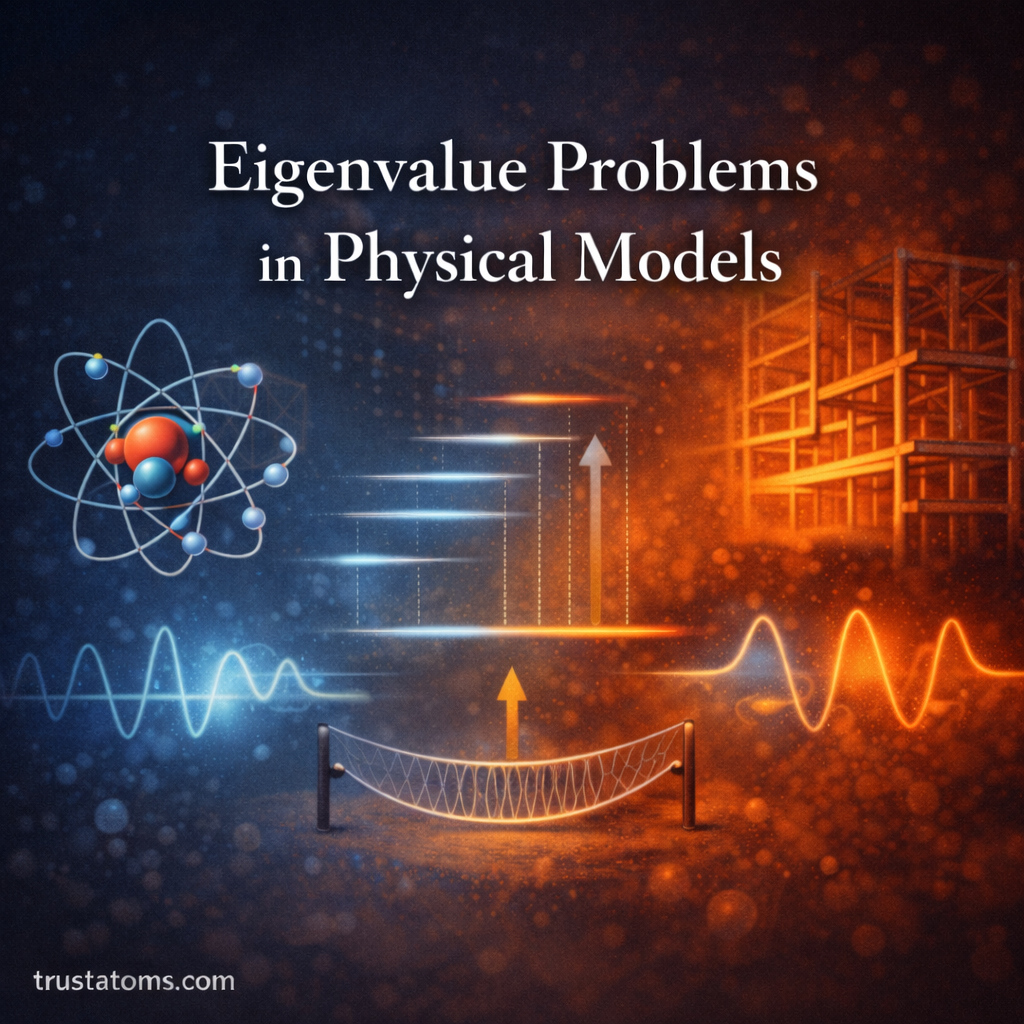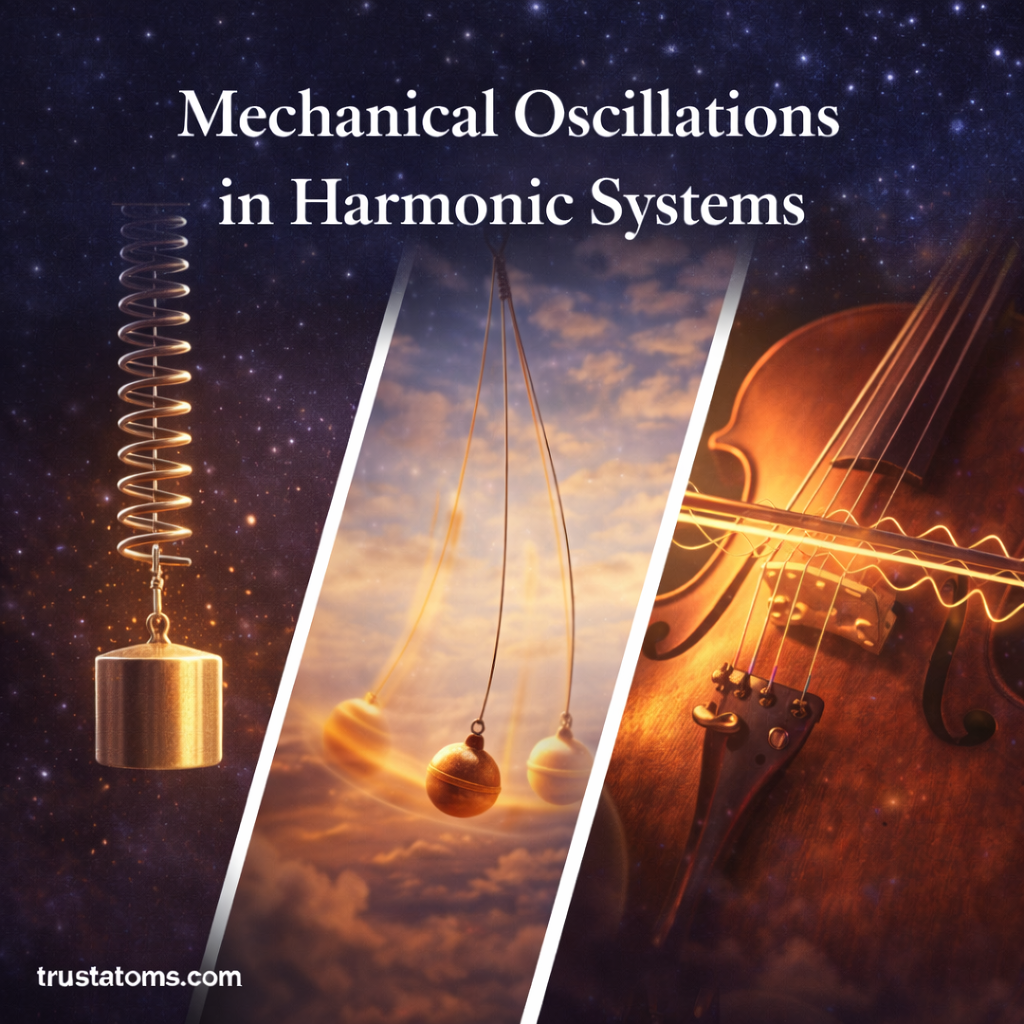
Mechanical oscillations are everywhere in physics. From a swinging pendulum to a vibrating guitar string, many systems move back and forth around an equilibrium position. When this motion follows a predictable and restoring pattern, it is called harmonic motion.
Mechanical oscillations in harmonic systems are fundamental to understanding waves, sound, energy transfer, and even atomic behavior. In this guide, we’ll break down how harmonic systems work and why they are so important in physics and engineering.
What Is Mechanical Oscillation?
Mechanical oscillation is repetitive motion around a stable equilibrium point.
Key features of oscillatory motion:
- The object moves back and forth.
- There is a restoring force pulling it toward equilibrium.
- The motion repeats in cycles.
Examples include:
- A mass attached to a spring
- A swinging pendulum
- A vibrating tuning fork
- A child on a playground swing
Oscillations occur whenever a system is displaced from equilibrium and a restoring force acts to return it.
What Is a Harmonic System?
A harmonic system is one in which the restoring force is proportional to the displacement from equilibrium.
In simple terms:
- The farther the object moves from equilibrium,
- The stronger the restoring force becomes,
- And it always points back toward equilibrium.
This proportional relationship creates smooth, predictable motion known as simple harmonic motion (SHM).
Simple Harmonic Motion (SHM)
Simple harmonic motion is a specific type of oscillatory motion with consistent mathematical behavior.
Characteristics of SHM:
- The restoring force is directly proportional to displacement.
- Acceleration is greatest at maximum displacement.
- Velocity is greatest at equilibrium.
- The motion is periodic and repeats regularly.
Systems that approximate SHM:
- Ideal mass-spring systems
- Small-angle pendulums
- Certain molecular vibrations
SHM provides a model for many real-world oscillations.
Key Quantities in Harmonic Motion
To understand mechanical oscillations, several important quantities are used.
1. Amplitude
- Maximum displacement from equilibrium.
- Determines how “large” the oscillation is.
- Greater amplitude means more stored energy.
2. Period
- Time required for one complete cycle.
- Measured in seconds.
3. Frequency
- Number of cycles per second.
- Measured in hertz (Hz).
- Frequency is the inverse of period.
4. Angular Frequency
- Describes how rapidly the system oscillates.
- Related to system properties like mass and stiffness.
These quantities describe how fast and how far the system moves.
Energy in Harmonic Systems
Mechanical oscillations involve continuous energy exchange between:
- Kinetic energy (due to motion)
- Potential energy (due to position)
In an ideal harmonic system:
- Total mechanical energy remains constant.
- Energy shifts back and forth between forms.
- No energy is lost.
For example, in a spring system:
- At maximum stretch → maximum potential energy.
- At equilibrium → maximum kinetic energy.
This energy exchange is smooth and repetitive.
The Mass–Spring System
A classic example of harmonic motion is a mass attached to a spring.
When displaced:
- The spring exerts a restoring force.
- The mass accelerates toward equilibrium.
- It overshoots due to inertia.
- The cycle repeats.
Important observations:
- Heavier masses oscillate more slowly.
- Stiffer springs oscillate more quickly.
- The motion continues indefinitely in an ideal system.
This simple setup models countless mechanical and engineering systems.
The Simple Pendulum
Another classic harmonic system is the pendulum.
For small angles:
- The restoring force is approximately proportional to displacement.
- The motion approximates simple harmonic motion.
- The period depends mainly on length and gravity.
Longer pendulums swing more slowly.
Pendulums are used in:
- Clocks
- Seismic instruments
- Motion studies
They demonstrate the principles of periodic motion clearly.
Damped Oscillations

Real systems are not perfectly conservative.
In damped oscillations:
- Energy is gradually lost.
- Amplitude decreases over time.
- Motion eventually stops.
Damping is caused by:
- Friction
- Air resistance
- Internal material resistance
Types of damping:
- Light damping → oscillations slowly decrease.
- Critical damping → system returns to equilibrium quickly without oscillating.
- Heavy damping → slow return without oscillation.
Damping is essential in designing stable systems.
Forced Oscillations and Resonance
When an external periodic force acts on a system, forced oscillations occur.
If the driving frequency matches the system’s natural frequency:
- Amplitude increases dramatically.
- Resonance occurs.
Resonance can be:
- Useful (musical instruments, radio tuning)
- Dangerous (structural failure in bridges)
Engineers carefully design systems to control resonance effects.
Real-World Applications
Mechanical oscillations are fundamental in:
- Sound and acoustics
- Earthquake engineering
- Automotive suspension systems
- Timekeeping devices
- Electrical circuits (analogous oscillations)
- Structural vibration analysis
Understanding harmonic systems allows engineers to:
- Prevent unwanted vibrations.
- Design stable machinery.
- Predict structural behavior.
- Optimize performance.
Common Misconceptions
Students often assume:
- All oscillations are harmonic.
- Oscillations require continuous input energy.
- Damping always stops motion immediately.
Clarifications:
- Only systems with proportional restoring force are harmonic.
- Ideal systems oscillate without additional energy.
- Damping reduces amplitude gradually.
Recognizing these distinctions improves conceptual understanding.
Why Mechanical Oscillations Matter
Mechanical oscillations reveal deep connections between force, motion, and energy. They form the foundation for:
- Wave motion
- Signal processing
- Vibrational analysis
- Quantum mechanical models
Oscillatory behavior appears at every scale — from bridges to atoms.
Understanding harmonic systems builds a strong base for advanced physics topics.
Key Takeaways
- Mechanical oscillations involve repetitive motion around equilibrium.
- Harmonic systems have restoring forces proportional to displacement.
- Simple harmonic motion is periodic and predictable.
- Energy shifts between kinetic and potential forms.
- Damping reduces amplitude over time.
- Resonance occurs when driving frequency matches natural frequency.
- Oscillations play a central role in engineering and physics.
Final Thoughts
Mechanical oscillations in harmonic systems provide one of the clearest demonstrations of how force and energy interact over time. Whether in a swinging pendulum, a vibrating string, or an engineered suspension system, harmonic motion connects theory with real-world application.
By understanding oscillatory motion, we gain insight into how systems vibrate, stabilize, resonate, and respond to forces — making it one of the most powerful and widely applied concepts in physics.