Metallic bonding is the force that holds metal atoms together in solid materials. It is responsible for many of the unique properties that metals display, such as electrical conductivity, malleability, ductility, and high thermal conductivity.
Unlike ionic or covalent bonding, metallic bonding involves a shared pool of electrons that move freely throughout the structure. This special bonding system allows metals to behave differently from other types of materials and explains why metals are widely used in construction, electronics, transportation, and manufacturing.
Understanding metallic bonding helps explain how metals form stable structures and why they are so useful in everyday technology.
What Is Metallic Bonding?
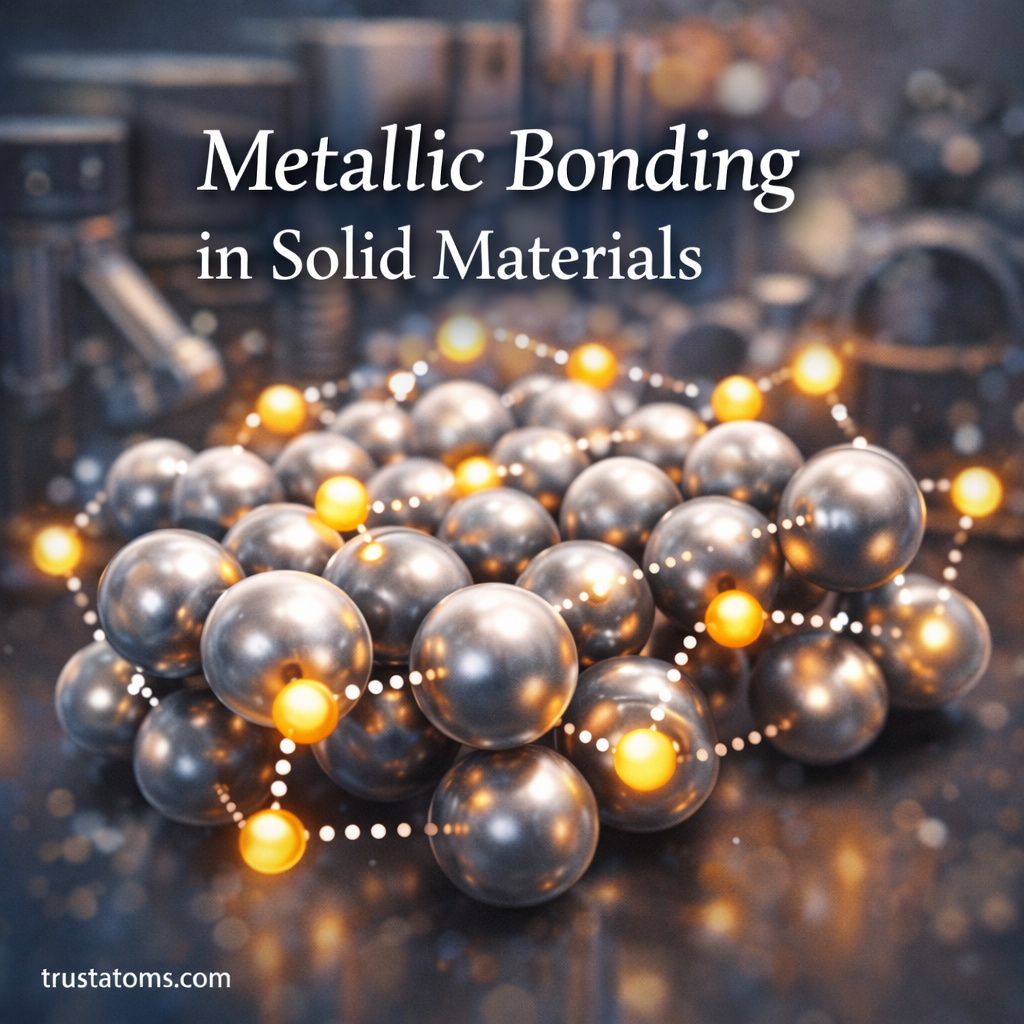
Metallic bonding occurs when metal atoms release some of their outer electrons, creating a structure of positively charged metal ions surrounded by a “sea” of mobile electrons.
These free-moving electrons are not tied to any one atom. Instead, they move throughout the entire metal lattice, binding the positively charged ions together.
This model is often called the electron sea model.
In simple terms:
- Metal atoms lose some valence electrons
- The atoms become positive ions
- Electrons move freely through the structure
- Electrostatic attraction holds the structure together
This interaction forms the strong metallic bond.
The Structure of Metals
In solid metals, atoms arrange themselves into regular repeating patterns called crystal lattices.
These structures maximize stability and bonding efficiency.
Common metallic lattice structures include:
Body-Centered Cubic (BCC)
In this arrangement:
- Atoms occupy each corner of a cube
- One atom sits in the center of the cube
Examples of metals with BCC structure:
- Iron (at certain temperatures)
- Chromium
- Tungsten
Face-Centered Cubic (FCC)
In this structure:
- Atoms occupy the cube corners
- Additional atoms are located in the center of each face
Examples include:
- Aluminum
- Copper
- Gold
- Silver
Hexagonal Close-Packed (HCP)
This structure consists of tightly packed hexagonal layers of atoms.
Examples include:
- Magnesium
- Titanium
- Zinc
The arrangement of atoms in these structures influences the mechanical and physical properties of metals.
The Electron Sea Model
The electron sea model explains how metallic bonding works at the atomic level.
In this model:
- Metal ions remain fixed in a lattice
- Valence electrons move freely between atoms
- These electrons form a shared electron cloud
This mobile electron system creates a strong attraction between the positively charged ions and the negatively charged electrons.
Key Characteristics of the Electron Sea
The electron sea model explains several metallic behaviors:
- Electrons can flow easily through the material
- The bond is non-directional
- Atoms can shift without breaking the bonding network
Because electrons are free to move, metallic bonds behave very differently from covalent or ionic bonds.
Why Metals Conduct Electricity

One of the most important consequences of metallic bonding is electrical conductivity.
Because electrons are free to move throughout the metal lattice, they can carry electrical charge easily.
When an electric field is applied:
- Free electrons begin moving in one direction.
- The movement of electrons creates an electric current.
- Energy travels through the material.
Metals such as copper, silver, and aluminum are excellent electrical conductors because their electrons move with minimal resistance.
This property makes metals essential for electrical wiring, circuits, and electronic components.
Thermal Conductivity in Metals
Metals also conduct heat very efficiently.
This occurs through two mechanisms:
- Movement of free electrons
- Vibrations of atoms in the lattice
Free electrons transfer kinetic energy rapidly across the structure. As a result, heat spreads quickly through the material.
This explains why metals like aluminum and copper are commonly used in:
- Cooking utensils
- Heat exchangers
- Radiators
- Cooling systems
Malleability and Ductility
Another defining property of metals is their ability to be shaped without breaking.
Malleability
Malleability refers to a metal’s ability to be hammered or rolled into thin sheets.
Examples include:
- Aluminum foil
- Gold leaf
- Metal panels
Ductility
Ductility is the ability of metals to be stretched into wires.
Examples include:
- Copper electrical wiring
- Steel cables
- Aluminum power lines
These properties occur because metallic bonding is non-directional.
When layers of atoms slide past each other:
- The electron sea continues holding the ions together
- The structure remains stable
In contrast, ionic crystals would fracture if their atomic layers shifted.
Strength of Metallic Bonds
The strength of metallic bonding depends on several factors.
Number of Valence Electrons
Metals that contribute more electrons to the electron sea often form stronger bonds.
For example:
- Transition metals typically have stronger bonding than alkali metals.
Atomic Size
Smaller metal atoms allow electrons to interact more closely with ions, strengthening the bond.
Crystal Structure
Certain lattice arrangements allow tighter packing of atoms, which can increase bonding strength.
These factors explain why different metals have varying hardness, melting points, and mechanical properties.
Metallic Bonding in Alloys
Many useful materials are not pure metals but alloys, which are mixtures of metals or metals combined with other elements.
Alloys form when atoms of different elements occupy positions within a metallic lattice.
There are two main types of alloys.
Substitutional Alloys
In substitutional alloys:
- Atoms of one metal replace atoms of another metal.
Example:
- Brass (copper and zinc)
Interstitial Alloys
In interstitial alloys:
- Small atoms fit into spaces between metal atoms.
Example:
- Steel (iron with carbon atoms)
Alloys often have improved properties compared to pure metals, including:
- Increased strength
- Better corrosion resistance
- Enhanced durability
Examples of Metallic Bonding in Everyday Materials
Metallic bonding is responsible for the structure and behavior of many familiar materials.
Common examples include:
- Iron in construction beams
- Copper wiring in electrical systems
- Aluminum in aircraft and packaging
- Steel used in buildings and machinery
- Gold and silver in electronics and jewelry
These materials rely on metallic bonding to maintain strength while allowing flexibility and conductivity.
Metallic Bonding vs Other Types of Bonding
Metallic bonding differs significantly from other bonding types.
Metallic Bonding
- Electrons move freely
- Bonds are non-directional
- Excellent electrical and thermal conductivity
Covalent Bonding
- Electrons shared between specific atoms
- Directional bonds
- Common in nonmetal molecules
Ionic Bonding
- Electrons transferred between atoms
- Positive and negative ions form crystal structures
- Often brittle solids
Because of these differences, metals behave in ways that nonmetal materials cannot.
Why Metallic Bonding Matters
Metallic bonding is essential to modern technology and engineering.
It explains why metals can:
- Conduct electricity
- Transfer heat efficiently
- Be shaped into useful forms
- Maintain structural strength
Engineers and material scientists rely on understanding metallic bonding when designing materials for:
- Electronics
- Transportation
- Construction
- Energy systems
- Aerospace applications
By controlling metal composition and structure, scientists can develop stronger, lighter, and more durable materials.
Final Thoughts
Metallic bonding is the fundamental force that holds metal atoms together in solid materials. Through the interaction of positively charged ions and freely moving electrons, metals gain their distinctive combination of strength, flexibility, and conductivity.
From electrical wiring to skyscrapers and aircraft, metallic bonding plays a crucial role in shaping the materials that support modern society. Understanding this type of bonding provides insight into how metals behave and why they remain essential in science, technology, and industry.