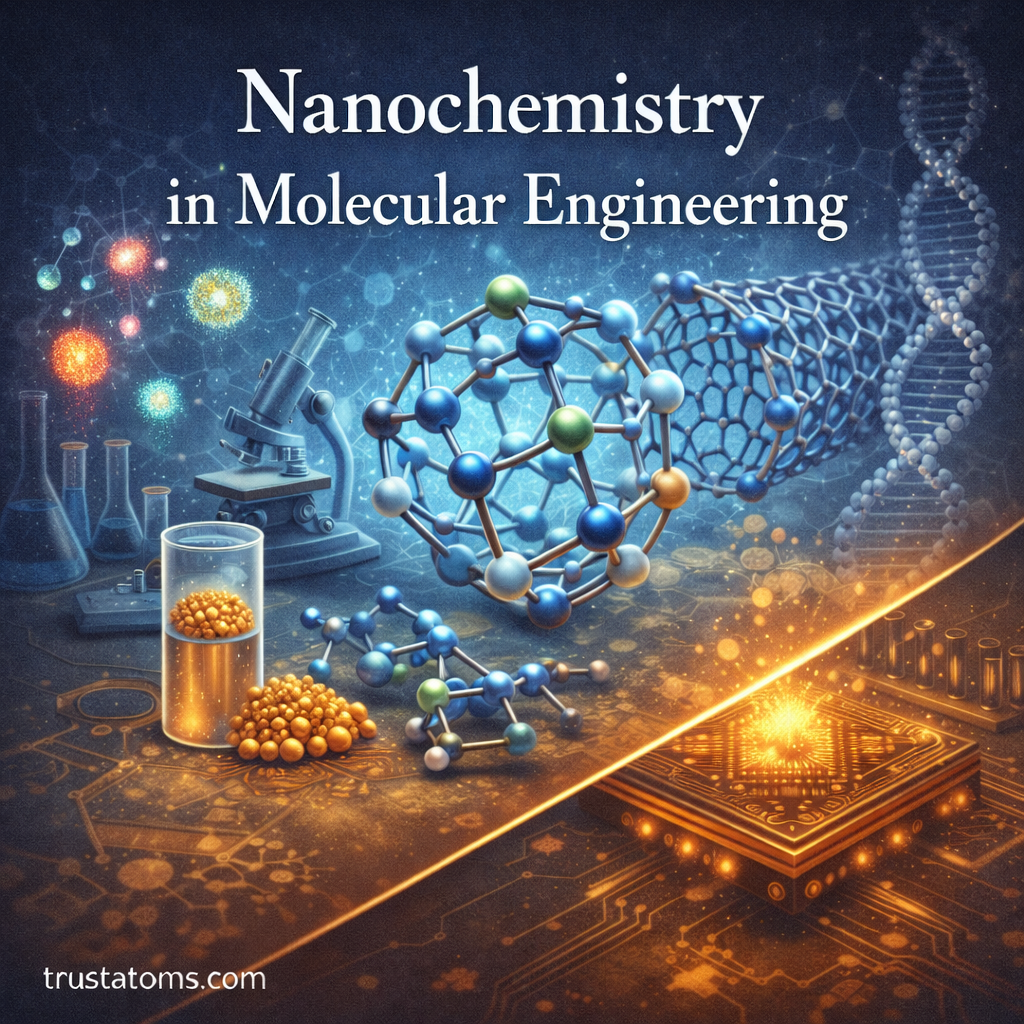
Nanochemistry is a branch of chemistry that focuses on the design, synthesis, and manipulation of materials at the nanoscale. At this extremely small scale—typically between 1 and 100 nanometers—materials often display unique chemical and physical properties that differ significantly from their bulk counterparts.
Molecular engineering uses these nanoscale principles to create precisely designed molecules and structures that perform specific functions. By controlling atoms and molecular arrangements, scientists can engineer materials with new capabilities in electronics, medicine, energy, and advanced manufacturing.
Nanochemistry has become a major driver of modern technological innovation, enabling breakthroughs that were not possible with traditional materials and chemical processes.
What Is Nanochemistry?
Nanochemistry studies chemical systems that exist at the nanoscale. At this scale, individual atoms and small clusters of molecules become important in determining a material’s behavior.
A nanometer is one billionth of a meter. For comparison:
- A human hair is roughly 80,000–100,000 nanometers wide
- A red blood cell is about 7,000 nanometers across
- Many engineered nanoparticles are smaller than 100 nanometers
Because materials at this scale have extremely high surface area relative to their size, they often exhibit unusual electrical, optical, or catalytic properties.
Nanochemistry explores how these properties can be controlled through molecular design.
Molecular Engineering and Nanoscale Design
Molecular engineering involves designing molecules and nanoscale structures with specific functions. Scientists use chemical synthesis techniques to arrange atoms in ways that create materials with targeted performance characteristics.
This approach allows researchers to:
- Build nanoscale devices
- Design functional materials
- Control chemical reactivity
- Improve energy storage materials
- Create specialized biomedical compounds
Precise molecular control is essential for producing consistent nanoscale materials with predictable properties.
Unique Properties of Nanomaterials
Materials behave differently at the nanoscale compared to larger structures. These differences arise from quantum effects and increased surface interactions.
Key Nanoscale Properties
Nanomaterials often exhibit:
- Increased chemical reactivity
- Enhanced catalytic activity
- Improved electrical conductivity
- Unique optical properties
- Greater mechanical strength
These characteristics allow nanomaterials to perform functions that traditional materials cannot easily achieve.
For example, gold nanoparticles can display different colors depending on their size due to changes in how they interact with light.
Types of Nanomaterials
Nanochemistry includes several major categories of nanoscale materials used in molecular engineering.
Nanoparticles
Nanoparticles are extremely small particles made of metals, ceramics, or polymers.
Common examples include:
- Gold nanoparticles
- Silver nanoparticles
- Iron oxide nanoparticles
- Polymer nanoparticles
These particles are often used in catalysis, drug delivery, imaging technologies, and environmental applications.
Carbon Nanostructures
Carbon-based nanomaterials are among the most widely studied nanoscale materials.
Examples include:
- Carbon nanotubes
- Graphene sheets
- Fullerenes (carbon cages)
These structures are known for exceptional strength, conductivity, and thermal stability.
Carbon nanostructures are used in:
- Electronics
- Advanced composites
- Energy storage devices
- Nanodevices
Quantum Dots
Quantum dots are nanoscale semiconductor particles that emit light when excited.
Their optical properties can be tuned by changing their size. Smaller quantum dots emit shorter wavelengths of light, while larger dots emit longer wavelengths.
Quantum dots are used in:
- Display technologies
- Biological imaging
- Solar cells
- Optical sensors
Their tunable light emission makes them useful in many advanced optical applications.
Synthesis Methods in Nanochemistry
Creating nanomaterials requires precise chemical synthesis techniques. Scientists must carefully control reaction conditions to produce particles with consistent size and structure.
Common Nanomaterial Synthesis Methods
Researchers often use:
- Chemical reduction reactions
- Sol–gel synthesis
- Hydrothermal synthesis
- Chemical vapor deposition
- Self-assembly processes
Each method provides different control over particle size, shape, and chemical composition.
Controlling these factors is essential because small changes in nanomaterial size can significantly alter their properties.
Self-Assembly in Molecular Engineering
Self-assembly is a key concept in nanochemistry. It refers to the spontaneous organization of molecules into structured arrangements without external manipulation.
Self-assembly occurs through interactions such as:
- Hydrogen bonding
- Electrostatic attraction
- Hydrophobic interactions
- Van der Waals forces
By designing molecules that naturally assemble into useful structures, scientists can create complex nanoscale systems efficiently.
Self-assembled nanostructures are used in materials science, nanodevices, and biological engineering.
Nanochemistry in Medicine
Nanochemistry has opened new possibilities in medical technology and biomedical research.
Medical Applications of Nanomaterials
Examples include:
- Targeted drug delivery systems
- Cancer treatment technologies
- Medical imaging agents
- Antibacterial coatings
- Tissue engineering materials
Nanoparticles can be engineered to deliver drugs directly to specific cells or tissues, reducing side effects and improving treatment effectiveness.
Nanotechnology is also improving diagnostic tools by enabling highly sensitive detection of biological molecules.
Nanochemistry in Energy Systems

Energy technology is another major field benefiting from nanochemistry.
Advanced nanomaterials improve energy generation, storage, and efficiency.
Energy Applications of Nanomaterials
Important examples include:
- Nanostructured battery electrodes
- Catalysts for hydrogen production
- Improved solar cell materials
- Supercapacitor components
- Energy-efficient coatings
Nanostructured materials can increase surface area and improve reaction efficiency, which is especially useful in energy storage systems.
Environmental Applications of Nanochemistry
Nanotechnology is also being applied to environmental protection and pollution control.
Environmental Uses of Nanomaterials
Researchers are developing nanomaterials for:
- Water purification systems
- Air filtration technologies
- Environmental sensors
- Oil spill cleanup materials
- Catalytic pollutant removal
These technologies help detect and remove contaminants more efficiently than traditional methods.
Challenges and Safety Considerations
Despite its many advantages, nanochemistry also presents challenges.
Because nanomaterials behave differently than larger materials, scientists must carefully study their environmental and biological effects.
Important Considerations
Researchers must address:
- Nanoparticle toxicity
- Environmental impact
- Safe manufacturing practices
- Long-term material stability
- Responsible nanotechnology regulation
Ongoing research helps ensure that nanotechnology develops safely and sustainably.
The Future of Nanochemistry
Nanochemistry continues to evolve as scientists discover new ways to control matter at the molecular level.
Emerging research areas include:
- Molecular nanomachines
- Advanced nanomedicine
- Smart nanomaterials
- Nanoelectronics
- Artificial molecular systems
These innovations could lead to revolutionary advances in computing, healthcare, and materials science.
Final Thoughts
Nanochemistry has transformed molecular engineering by allowing scientists to design materials and systems at the scale of individual molecules and atoms. Through precise nanoscale control, researchers can create materials with exceptional properties and entirely new capabilities.
As nanotechnology continues to develop, nanochemistry will remain central to breakthroughs in medicine, energy, electronics, and environmental science—helping shape the future of advanced scientific innovation.