Newton’s First Law of Motion is one of the most important principles in physics. It explains why objects stay still, why moving objects keep moving, and why forces are needed to change motion.
Often called the Law of Inertia, this principle forms the foundation of classical mechanics and helps us understand everything from car safety to planetary motion.
In this guide, we’ll break down Newton’s First Law in simple terms, explore real-world examples, and explain why it matters.
What Is Newton’s First Law of Motion?
Newton’s First Law states:
An object at rest remains at rest, and an object in motion remains in motion at a constant velocity unless acted upon by a net external force.
Let’s simplify that.
- Objects naturally resist changes in motion.
- Motion only changes when a force acts on the object.
- Constant velocity means constant speed and direction.
This law tells us that force is required to change motion — not to maintain it.
Who Was Isaac Newton?
Newton’s First Law was formulated by Sir Isaac Newton in 1687 in his work Philosophiæ Naturalis Principia Mathematica.
Newton built upon earlier ideas from Galileo, who observed that objects in motion tend to stay in motion when friction is reduced.
Newton formalized this idea into a universal law of motion.
Understanding Inertia
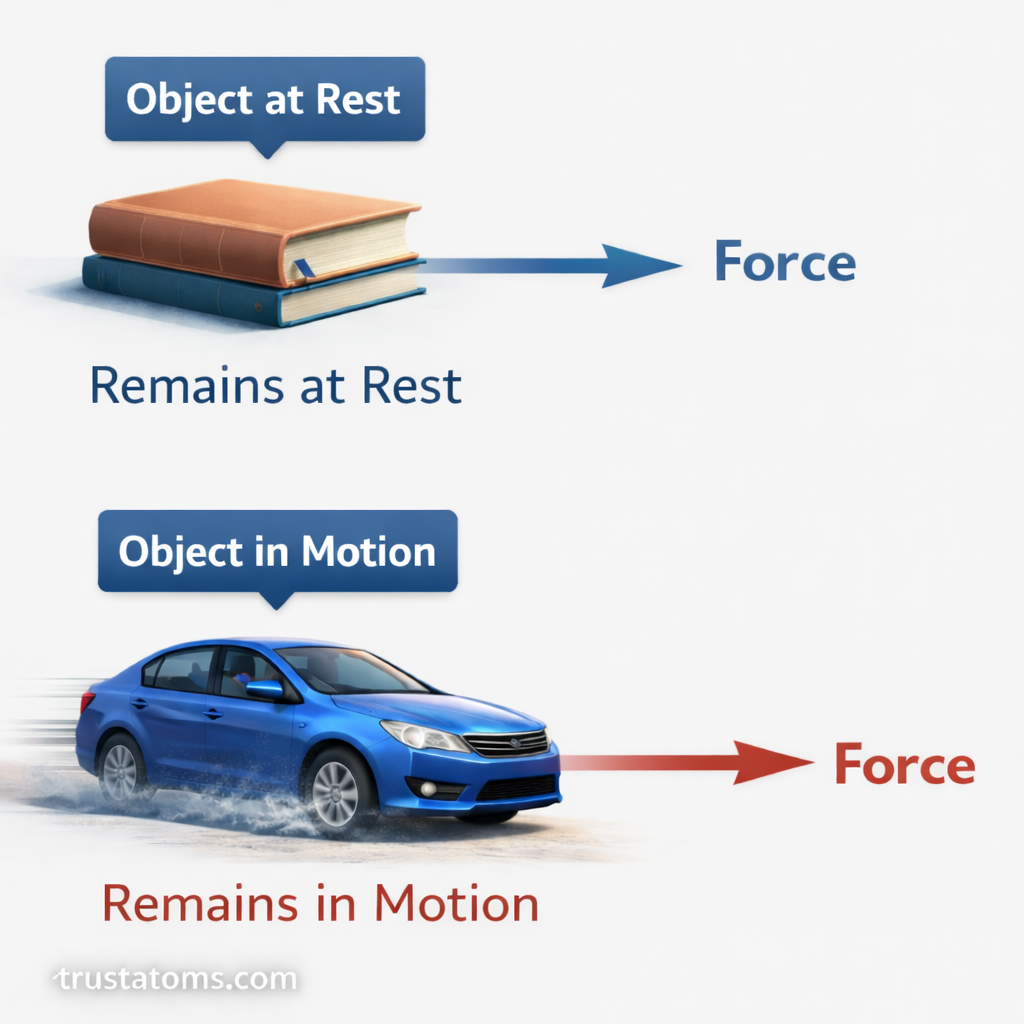
The First Law is also known as the Law of Inertia.
Inertia is the tendency of an object to resist changes in its state of motion.
There are three key ideas:
- Inertia of rest – objects at rest stay at rest.
- Inertia of motion – moving objects keep moving.
- Inertia of direction – objects resist changes in direction.
The more mass an object has, the more inertia it has.
For example:
- A bowling ball is harder to stop than a tennis ball.
- A truck requires more force to accelerate than a bicycle.
What Is a Net External Force?
A net external force is the overall force acting on an object after all forces are combined.
If forces are balanced:
- The net force equals zero.
- Motion does not change.
If forces are unbalanced:
- The net force is not zero.
- The object accelerates (changes velocity).
Acceleration includes:
- Speeding up
- Slowing down
- Changing direction
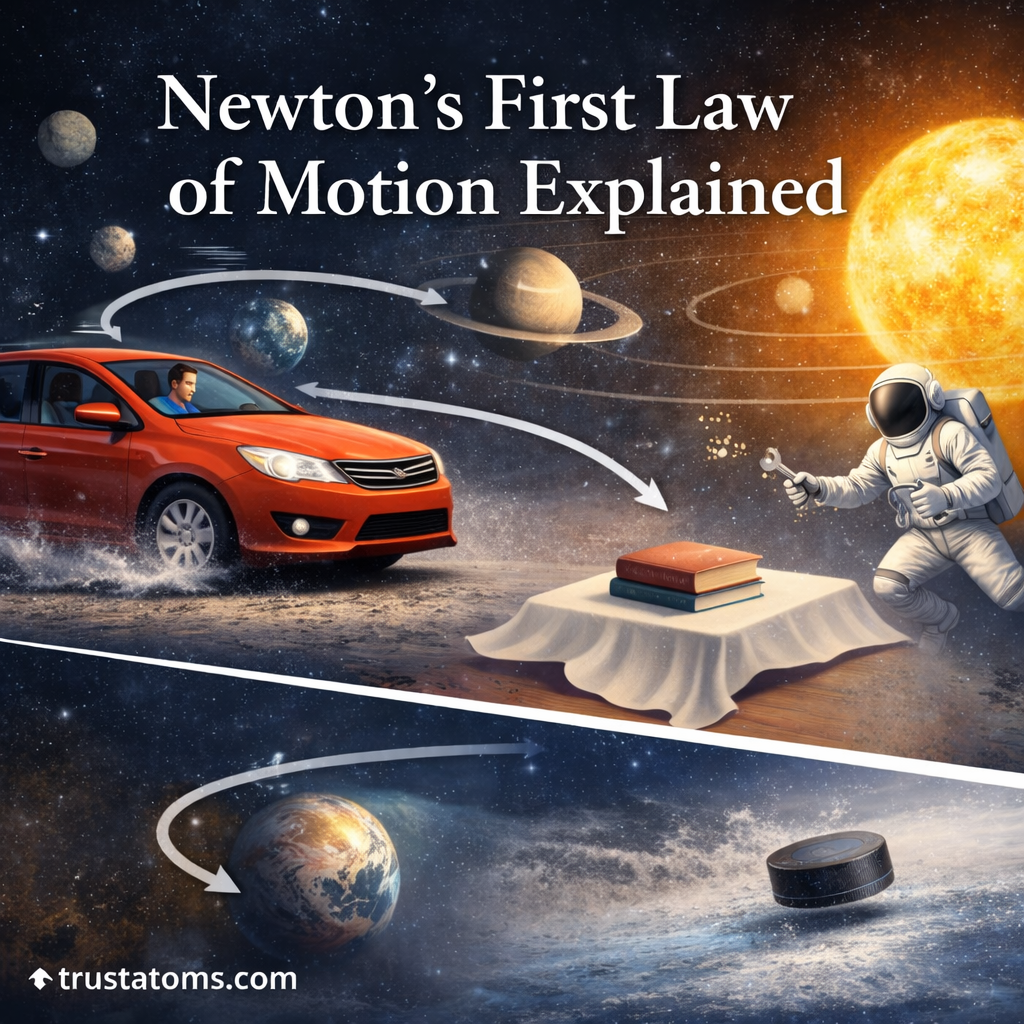
Everyday Examples of Newton’s First Law
Newton’s First Law explains many daily experiences.
1. Car Braking
When a car suddenly stops, passengers move forward.
Why?
Their bodies were in motion with the car and continue moving due to inertia until the seatbelt applies a force to stop them.
2. Tablecloth Trick
When a tablecloth is pulled quickly from under dishes, the dishes remain nearly still.
The dishes resist motion because of inertia.
3. A Book on a Table
A book sitting on a table remains at rest until someone applies a force to move it.
Gravity and the table’s support force are balanced, so there is no net force.
4. A Hockey Puck on Ice
A puck slides across ice for a long distance because friction is low.
Without friction, it would continue moving indefinitely.
Motion in Space
Newton’s First Law becomes even clearer in space.
In outer space, there is very little friction.
If an astronaut pushes a tool, it continues moving at constant speed until another force acts on it.
Similarly, planets remain in orbit because:
- Inertia keeps them moving forward.
- Gravity continuously changes their direction.
Without inertia, orbital motion would not be possible.
Why Objects Eventually Stop on Earth
A common misunderstanding is that moving objects naturally slow down on their own.
In reality, objects stop because of opposing forces such as:
- Friction
- Air resistance
- Contact with surfaces
If these forces were removed, motion would continue.
Newton’s First Law shows that stopping requires force — just like starting does.
How Newton’s First Law Connects to the Other Laws
Newton’s Three Laws of Motion work together:
- First Law – Describes what happens when net force is zero.
- Second Law – Explains how force causes acceleration (F = ma).
- Third Law – States that every action has an equal and opposite reaction.
The First Law sets the baseline condition: motion does not change unless a force acts.
Why Newton’s First Law Matters
Understanding Newton’s First Law helps explain:
- Vehicle safety systems
- Rocket launches
- Engineering design
- Sports mechanics
- Planetary motion
- Structural stability
It also helps build a foundation for more advanced physics concepts.
Without this law, we would not understand how forces interact with matter.
Common Misconceptions
“Force Is Needed to Keep Something Moving”
Not true.
Force is needed to change motion, not maintain constant motion.
“Heavier Objects Fall Faster Because of Inertia”
In the absence of air resistance, objects fall at the same rate regardless of mass.
“Inertia Is a Force”
Inertia is a property of matter, not a force itself.
Final Thoughts
Newton’s First Law of Motion explains why objects resist changes in motion and why forces are required to alter velocity.
It describes a simple but powerful idea:
Motion stays consistent unless something changes it.
From car rides to space travel, this law shapes the physical world around us.
Understanding it gives you a clearer view of how motion truly works.