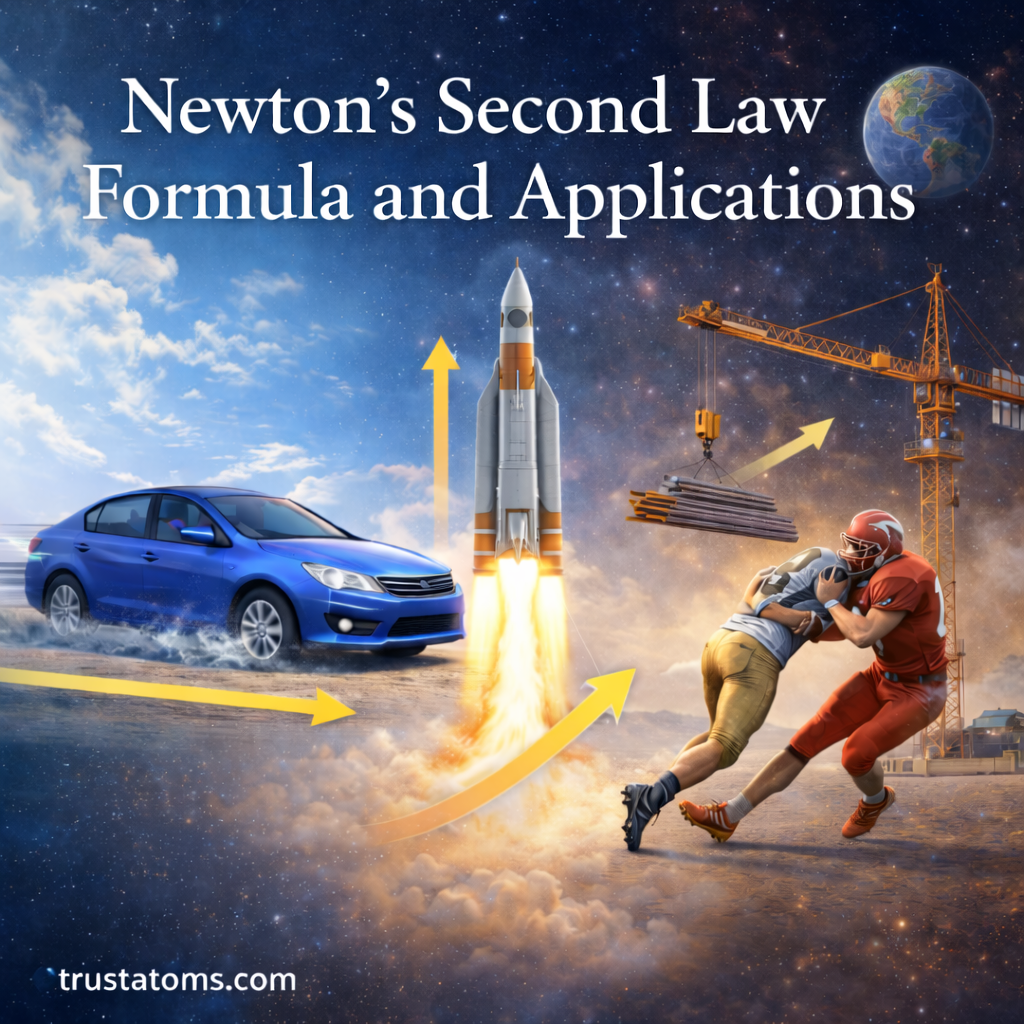
Newton’s Second Law of Motion explains how force, mass, and acceleration are connected. It tells us exactly how much an object will accelerate when a certain force is applied.
This law is one of the most important formulas in physics because it allows us to calculate motion. From cars speeding up to rockets launching into space, Newton’s Second Law helps engineers and scientists predict how objects will behave.
In this guide, we’ll break down the formula, explain each variable, and explore real-world applications.
What Is Newton’s Second Law?
Newton’s Second Law states:
The acceleration of an object is directly proportional to the net force acting on it and inversely proportional to its mass.
In simpler terms:
- More force → more acceleration
- More mass → less acceleration
- No net force → no acceleration
This law explains how motion changes when forces are applied.
The Formula: F = ma
The mathematical form of Newton’s Second Law is:
F = ma
Where:
- F = Net force (measured in newtons, N)
- m = Mass (measured in kilograms, kg)
- a = Acceleration (measured in meters per second squared, m/s²)
This formula means:
Force equals mass multiplied by acceleration.
Understanding Each Variable
Force (F)
Force is a push or pull acting on an object.
Examples include:
- Pushing a shopping cart
- Gravity pulling an object downward
- A car engine propelling a vehicle forward
Force is measured in newtons (N).
One newton is the force required to accelerate a 1 kg mass at 1 m/s².
Mass (m)
Mass measures how much matter an object contains.
Key points:
- Measured in kilograms (kg)
- Does not change with location
- Determines inertia (resistance to acceleration)
Heavier objects require more force to accelerate.
Acceleration (a)
Acceleration is the rate at which velocity changes.
It includes:
- Speeding up
- Slowing down
- Changing direction
Measured in meters per second squared (m/s²).
How the Formula Works
Let’s look at a simple example.
If you apply 10 newtons of force to a 2 kg object:
a = F / m
a = 10 / 2
a = 5 m/s²
The object accelerates at 5 meters per second squared.
If the mass increases to 5 kg:
a = 10 / 5
a = 2 m/s²
The acceleration decreases.
This shows the inverse relationship between mass and acceleration.
Real-World Applications of Newton’s Second Law
Newton’s Second Law is used everywhere in science and engineering.
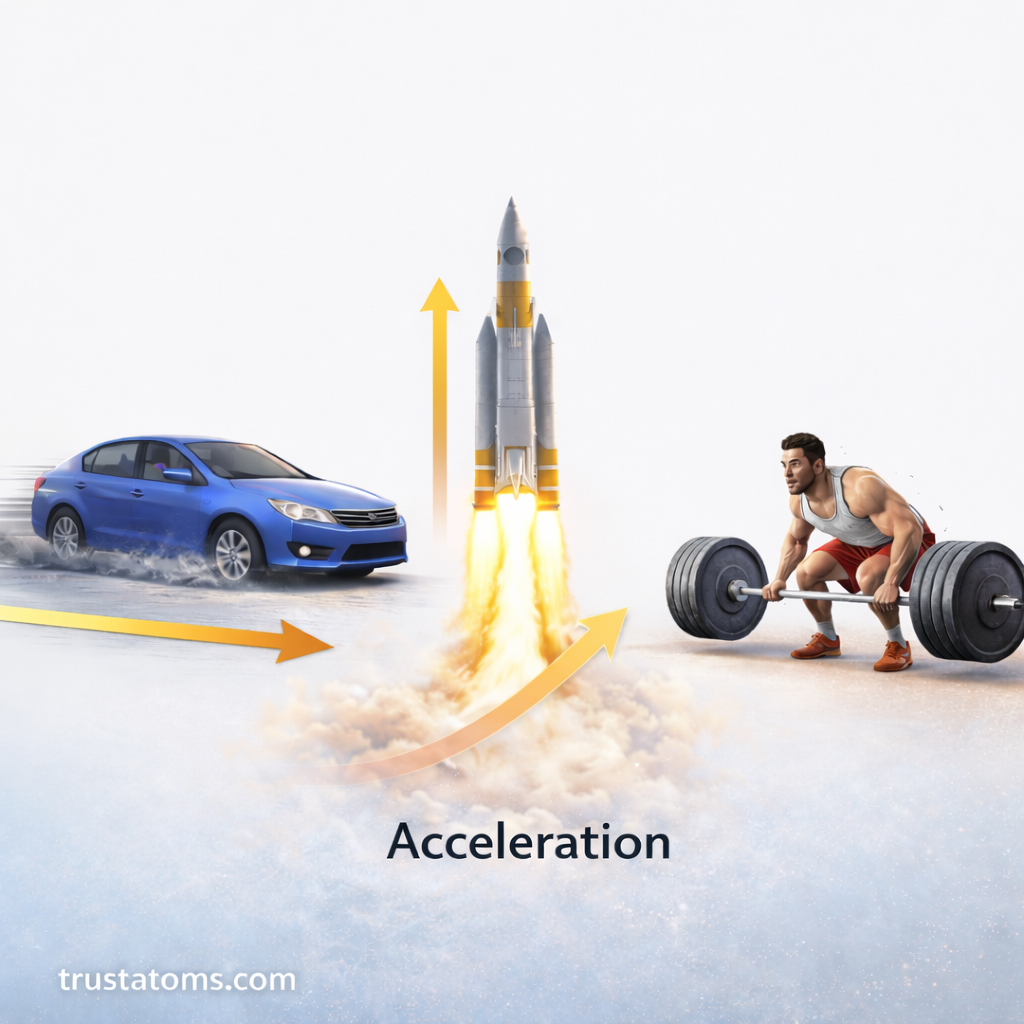
1. Vehicle Acceleration
When you press the gas pedal:
- The engine produces force.
- The car accelerates forward.
Heavier vehicles require more force to achieve the same acceleration as lighter ones.
2. Rocket Launches
Rockets must generate enormous force to overcome gravity.
According to F = ma:
- The greater the rocket’s mass, the more thrust required.
- As fuel burns and mass decreases, acceleration increases.
This is why rockets accelerate faster as they rise.
3. Sports Performance
Athletes apply force to change motion.
Examples:
- A soccer player kicking a ball
- A baseball pitcher throwing a fastball
- A weightlifter lifting a barbell
More force leads to greater acceleration.
4. Safety Engineering
Car manufacturers use Newton’s Second Law to design:
- Airbags
- Seatbelts
- Crumple zones
By controlling acceleration during collisions, engineers reduce the force experienced by passengers.
5. Construction and Structural Design
Engineers calculate forces acting on buildings, bridges, and cranes to ensure stability and safety.
Understanding mass and acceleration prevents structural failure.
Relationship to Newton’s First and Third Laws
Newton’s Three Laws work together:
- First Law – Explains what happens when net force is zero.
- Second Law – Calculates motion when net force is not zero.
- Third Law – Describes action-reaction force pairs.
The Second Law provides the mathematical tool for predicting acceleration.
Common Misconceptions
“Force Always Means Movement”
Not necessarily.
If forces are balanced, acceleration is zero.
“Heavier Objects Fall Faster”
In the absence of air resistance, all objects fall at the same rate because gravitational acceleration is constant.
“Acceleration Only Means Speeding Up”
Acceleration includes:
- Slowing down
- Turning
- Changing direction
Any change in velocity counts.
Why Newton’s Second Law Matters
Newton’s Second Law allows scientists and engineers to:
- Predict motion
- Design vehicles and machines
- Calculate safe structures
- Understand planetary dynamics
- Improve athletic performance
Without this law, modern technology would not exist.
It transforms motion from a concept into a measurable, predictable system.
Final Thoughts
Newton’s Second Law of Motion, expressed as F = ma, connects force, mass, and acceleration in a clear mathematical relationship.
More force produces more acceleration.
More mass reduces acceleration.
This simple formula explains how motion changes in nearly every physical system.
From pushing a cart to launching a rocket, Newton’s Second Law governs how objects move through the universe.