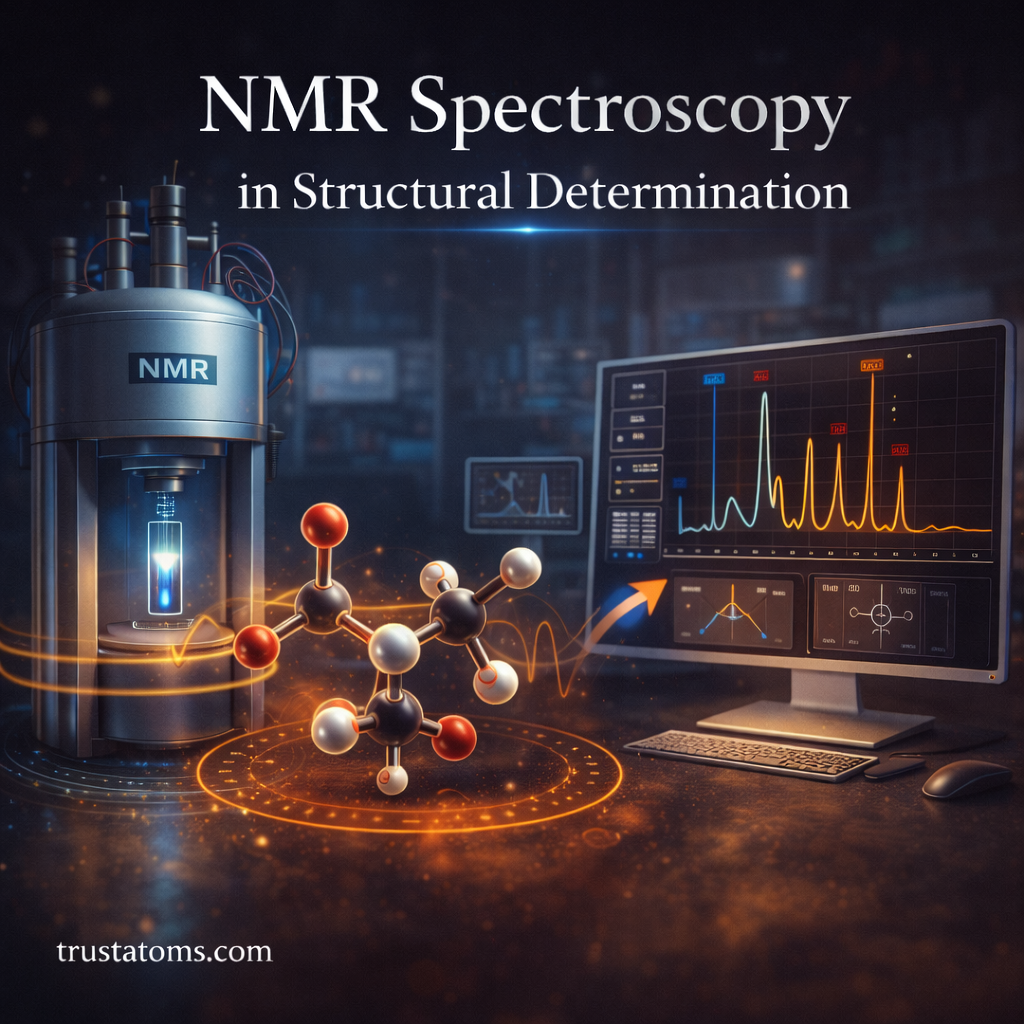
Nuclear Magnetic Resonance (NMR) spectroscopy is one of the most powerful tools chemists use to determine the structure of molecules. By analyzing how atomic nuclei behave in strong magnetic fields, scientists can uncover detailed information about how atoms are connected within a compound.
Unlike many analytical techniques that only identify elements, NMR spectroscopy reveals how atoms are arranged in a molecule. This makes it essential in organic chemistry, pharmaceutical research, and biochemical studies.
This guide explains how NMR spectroscopy works, how it helps determine molecular structures, and why it is such an important technique in modern chemical analysis.
What Is NMR Spectroscopy?
NMR spectroscopy is an analytical technique that studies how atomic nuclei interact with magnetic fields and radio-frequency radiation.
Certain nuclei behave like tiny magnets because they possess a property called nuclear spin. When placed in a strong magnetic field, these nuclei align with the field and can absorb radio-frequency energy.
When this energy is absorbed and then released, the resulting signals are detected and transformed into an NMR spectrum.
These signals provide valuable information about:
- The types of atoms present
- The chemical environment surrounding each atom
- The arrangement of atoms within the molecule
The Basic Principle Behind NMR
NMR spectroscopy relies on the behavior of specific atomic nuclei when placed in a strong magnetic field.
The process works in several stages:
- A strong magnetic field aligns certain atomic nuclei.
- Radio-frequency energy is applied to the sample.
- Nuclei absorb energy and shift to a higher energy state.
- When the energy source is removed, nuclei release energy.
- The released signals are detected and converted into a spectrum.
The exact frequency at which a nucleus absorbs energy depends on its chemical environment, which is what allows scientists to distinguish different parts of a molecule.
Nuclei Commonly Studied in NMR
Not all atomic nuclei are suitable for NMR spectroscopy. Only nuclei with nuclear spin can be detected effectively.
Some of the most commonly studied nuclei include:
- Hydrogen (¹H) – used in proton NMR
- Carbon (¹³C) – used in carbon NMR
- Fluorine (¹⁹F)
- Phosphorus (³¹P)
Among these, proton NMR and carbon NMR are the most widely used techniques in organic chemistry.
Understanding an NMR Spectrum
An NMR spectrum is a graphical representation of how atomic nuclei respond to radio-frequency radiation in a magnetic field.
The spectrum typically includes several important features:
- Chemical shift
- Signal intensity
- Signal splitting patterns
These features provide clues about the molecular structure.
Chemical Shift
The chemical shift indicates the position of a signal in the NMR spectrum.
It reflects how strongly the surrounding electrons shield a nucleus from the external magnetic field.
Different chemical environments cause nuclei to absorb energy at slightly different frequencies.
By analyzing chemical shifts, chemists can determine:
- The type of atom being observed
- Nearby atoms or functional groups
- The molecular environment surrounding the nucleus
Signal Intensity
Signal intensity corresponds to the number of equivalent nuclei producing a signal.
For example, if several hydrogen atoms exist in the same chemical environment, they will contribute to a stronger signal.
This information helps chemists determine how many atoms are present in each part of a molecule.
Signal Splitting (Spin-Spin Coupling)
NMR signals are often split into multiple peaks due to interactions between neighboring nuclei.
This phenomenon is called spin-spin coupling.
The splitting pattern helps reveal how many neighboring atoms are present.
For example:
- A signal split into two peaks suggests one neighboring nucleus
- Three peaks suggest two neighbors
- Four peaks suggest three neighbors
These patterns provide critical clues for determining molecular structure.
Types of NMR Spectroscopy
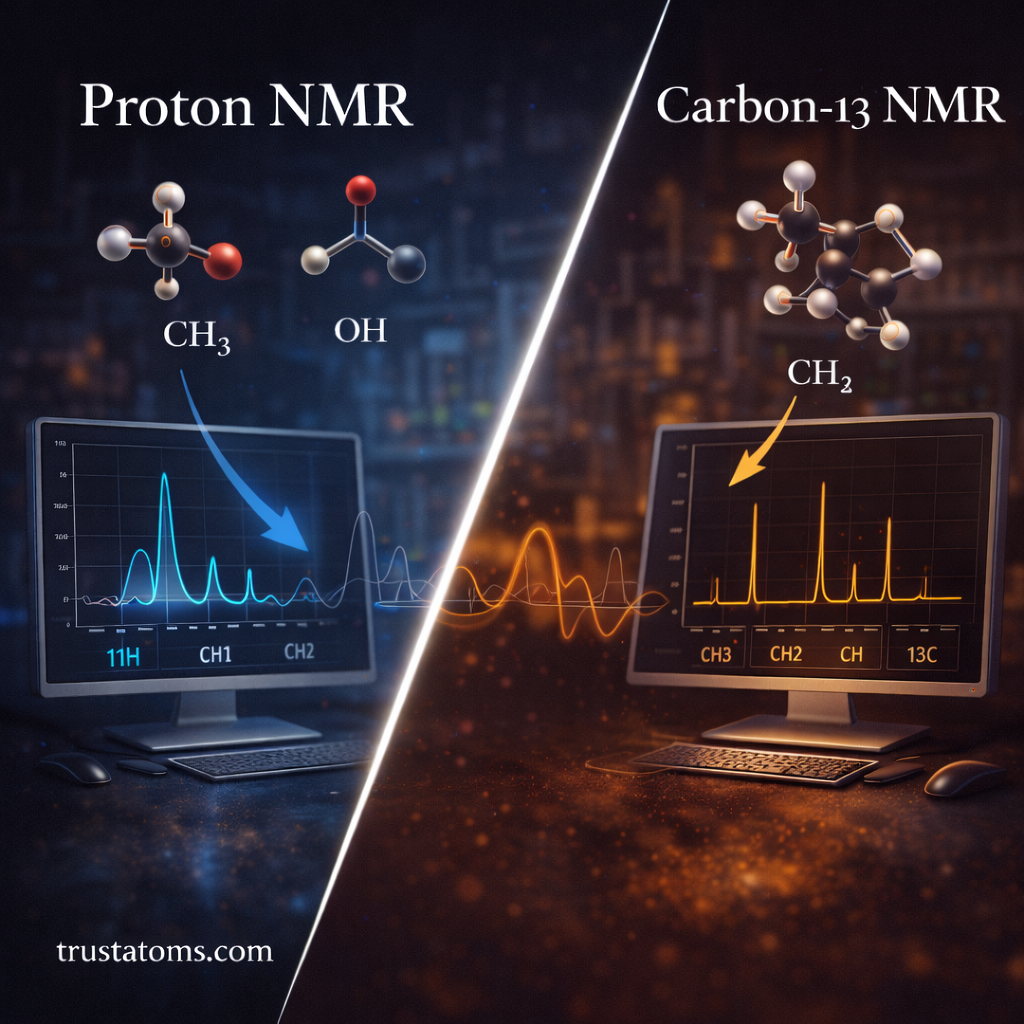
Several forms of NMR spectroscopy are used to analyze molecules.
Proton NMR (¹H NMR)
Proton NMR focuses on hydrogen atoms within molecules.
Because hydrogen atoms are common in organic compounds, proton NMR provides a detailed map of hydrogen environments.
Scientists use proton NMR to:
- Identify hydrogen-containing functional groups
- Determine hydrogen connectivity
- Analyze organic molecules
Carbon-13 NMR (¹³C NMR)
Carbon-13 NMR analyzes carbon atoms within molecules.
Although carbon-13 is less abundant than carbon-12, it produces useful NMR signals.
This technique helps chemists determine:
- The number of unique carbon atoms
- Carbon environments within a molecule
- The framework of carbon-based structures
Two-Dimensional NMR
Advanced NMR methods use two-dimensional spectra to reveal more complex molecular information.
Examples include:
- COSY (Correlation Spectroscopy)
- HSQC (Heteronuclear Single Quantum Coherence)
- HMBC (Heteronuclear Multiple Bond Correlation)
These techniques show relationships between atoms, allowing scientists to map complex molecular structures.
Applications of NMR Spectroscopy
NMR spectroscopy is used across many areas of chemistry and science.
Organic Chemistry
Chemists use NMR to determine the structure of newly synthesized compounds and confirm the identity of organic molecules.
Pharmaceutical Research
Drug development relies heavily on NMR spectroscopy.
Applications include:
- Confirming drug structures
- Studying drug interactions
- Detecting impurities in pharmaceutical compounds
Biochemistry and Molecular Biology
NMR spectroscopy can analyze large biological molecules such as proteins and nucleic acids.
Researchers use it to study:
- Protein folding
- Molecular interactions
- Biological structure and function
Materials Science
Scientists use NMR to study polymers, plastics, and advanced materials.
It helps reveal structural details that influence material properties.
Advantages of NMR Spectroscopy
NMR spectroscopy provides several major benefits for chemical analysis.
Key advantages include:
- Detailed structural information
- Non-destructive sample analysis
- High accuracy in identifying molecular structures
- Ability to analyze complex molecules
- Reproducible and reliable results
Because of these strengths, NMR is considered one of the most important analytical techniques in chemistry.
Limitations of NMR Spectroscopy
Despite its power, NMR spectroscopy also has some limitations.
These may include:
- Expensive equipment and maintenance
- Requirement for specialized training
- Lower sensitivity for certain nuclei
- Need for relatively pure samples
However, improvements in technology continue to make NMR more accessible and powerful.
The Future of NMR Spectroscopy
Advances in magnetic technology and computing are expanding the capabilities of NMR spectroscopy.
Emerging developments include:
- Higher magnetic field strengths
- Faster data processing
- Portable NMR instruments
- Integration with machine learning for spectral interpretation
These innovations will allow scientists to analyze molecular structures faster and with greater precision.
Final Thoughts
NMR spectroscopy is one of the most powerful techniques available for determining molecular structure. By analyzing how atomic nuclei respond to magnetic fields and radio-frequency radiation, scientists can uncover detailed information about the arrangement of atoms within a molecule.
From organic chemistry and pharmaceutical development to biochemistry and materials science, NMR spectroscopy remains an essential tool for understanding the molecular world.