Non-Euclidean geometry is one of the most profound ideas in modern physics. It reshaped our understanding of space, time, and gravity — and became the mathematical foundation of Einstein’s theory of relativity.
For centuries, geometry was based on Euclid’s rules: parallel lines never meet, triangles add up to 180 degrees, and space is flat. But relativity revealed something extraordinary — space and time are curved.
In this guide, we’ll explore what non-Euclidean geometry is, how it differs from classical geometry, and why it is essential for understanding relativity.
What Is Euclidean Geometry?
Euclidean geometry is the geometry taught in most schools. It describes flat space and is based on five fundamental postulates laid out by Euclid.
Key features include:
- Parallel lines never intersect
- The angles of a triangle sum to 180°
- The shortest distance between two points is a straight line
This geometry works extremely well for everyday experiences and small-scale physics.
But on cosmic scales, things change.
What Is Non-Euclidean Geometry?
Non-Euclidean geometry describes curved spaces where Euclid’s parallel postulate does not hold.
There are two main types:
1. Spherical Geometry
- Space curves positively
- Parallel lines can eventually meet
- Triangle angles add up to more than 180°
Example: The surface of Earth.
2. Hyperbolic Geometry
- Space curves negatively
- Parallel lines diverge
- Triangle angles add up to less than 180°
These geometries were once considered mathematical curiosities. Relativity showed they describe physical reality.
Why Relativity Requires Curved Geometry
In Newtonian physics, gravity is a force acting at a distance.
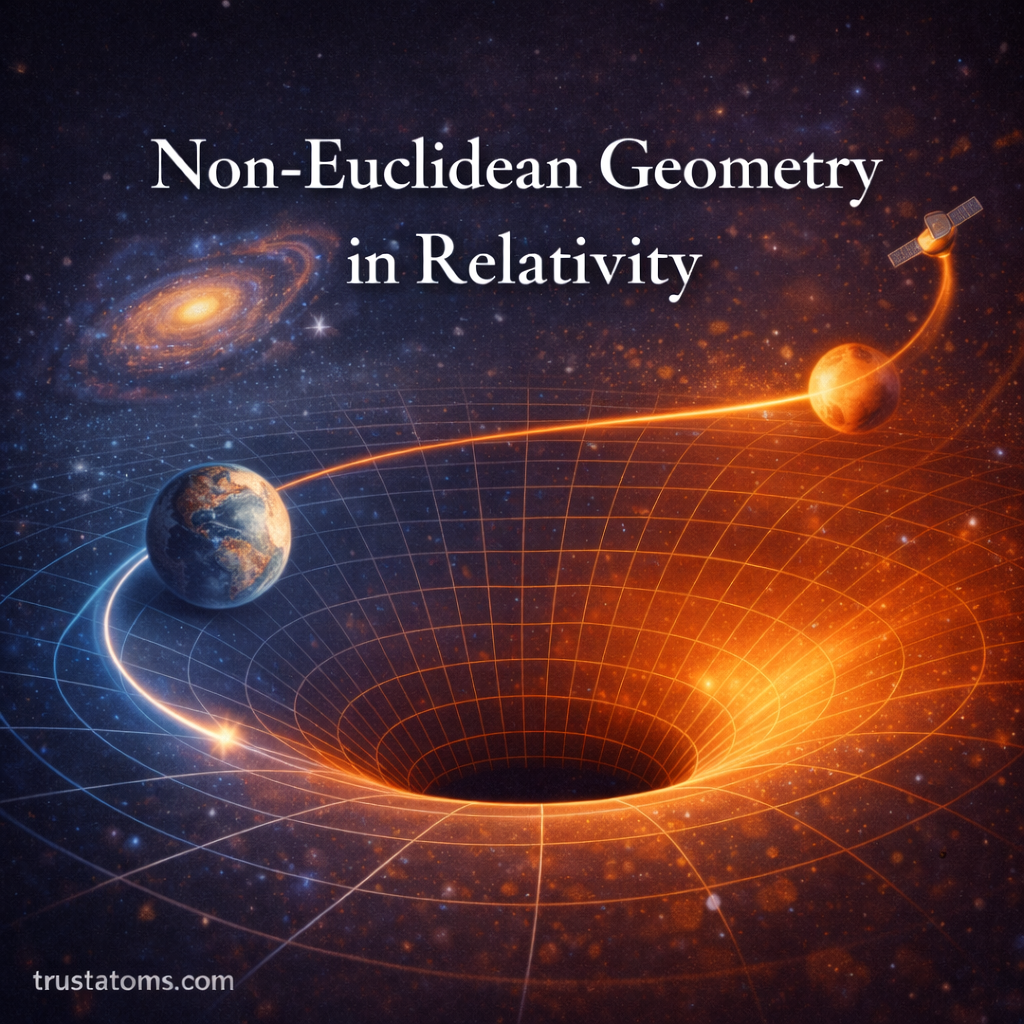
In Einstein’s general relativity, gravity is not a force at all. Instead:
- Massive objects curve spacetime
- Objects move along curved paths
- Geometry replaces force
This idea requires non-Euclidean geometry because flat space cannot account for gravitational effects such as:
- Planetary orbits
- Light bending around stars
- Black holes
- Gravitational time dilation
Spacetime: A Four-Dimensional Geometry
Relativity combines space and time into a single structure called spacetime.
Spacetime has four dimensions:
- Three spatial dimensions
- One time dimension
Mass and energy distort this four-dimensional fabric.
In curved spacetime:
- Straight lines become geodesics
- Objects follow the curvature
- Time itself can stretch or contract
Non-Euclidean geometry provides the mathematical framework to describe these distortions.
Geodesics: The Straight Lines of Curved Space
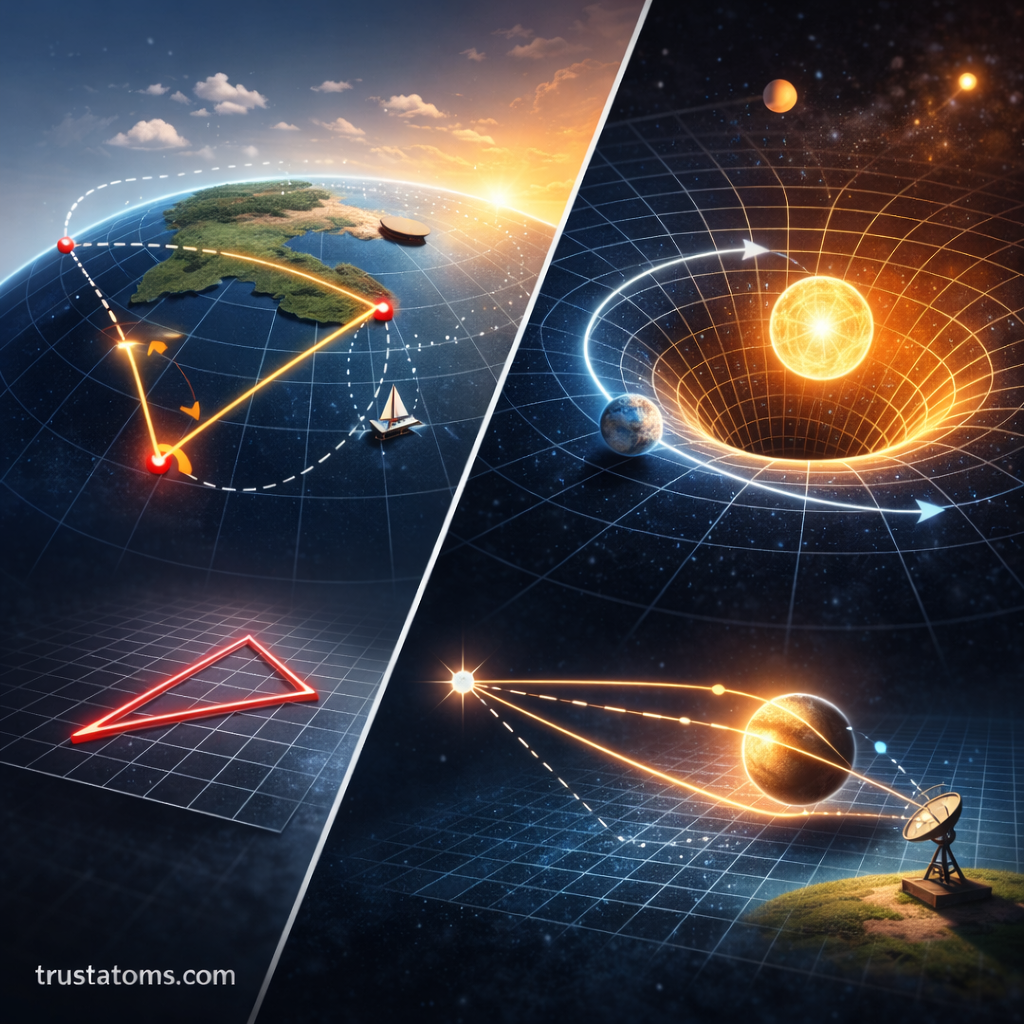
In curved geometry, the concept of a straight line changes.
A geodesic is:
- The shortest path between two points in curved space
- The natural path an object follows
Examples:
- Airplanes follow curved routes over Earth (great circles)
- Planets follow curved paths in spacetime
In general relativity, free-falling objects move along spacetime geodesics.
Einstein’s Field Equations and Curvature
Einstein’s field equations connect geometry with physics.
In simple conceptual terms:
- Matter tells spacetime how to curve
- Curved spacetime tells matter how to move
The equations describe how:
- Mass and energy influence curvature
- Curvature affects motion
- Spacetime responds dynamically
These relationships rely entirely on non-Euclidean geometry.
Observable Evidence of Curved Spacetime
Non-Euclidean geometry is not just theoretical. It has measurable consequences.
1. Bending of Light
Light passing near a massive object curves. This phenomenon is known as gravitational lensing.
2. Time Dilation
Clocks run slower in stronger gravitational fields.
3. Black Holes
Extreme curvature leads to regions where spacetime becomes so distorted that not even light can escape.
4. Gravitational Waves
Ripples in spacetime propagate through the universe when massive objects accelerate.
All of these phenomena confirm that spacetime is not flat.
From Flat Space to Curved Universe
On small scales, space appears nearly flat.
However, on large cosmic scales:
- Galaxies warp spacetime
- The universe may have overall curvature
- Cosmology depends on geometric structure
Modern cosmology studies whether the universe is:
- Flat
- Positively curved
- Negatively curved
Observations suggest the universe is very close to flat — but this is still a geometric question rooted in non-Euclidean theory.
Conceptual Shift: Geometry Becomes Physics
Before relativity, geometry described space passively.
After Einstein:
- Geometry became dynamic
- Spacetime could stretch and bend
- Mathematics directly described physical reality
This was one of the greatest conceptual revolutions in science.
Non-Euclidean geometry moved from abstract mathematics to the core of gravitational physics.
Why Non-Euclidean Geometry Matters Today
Understanding non-Euclidean geometry is essential for:
- Astrophysics
- Black hole research
- Cosmology
- Gravitational wave science
- Satellite navigation systems (like GPS, which accounts for relativistic effects)
Without curved geometry, modern physics would collapse back into incomplete models.
Final Thoughts
Non-Euclidean geometry transformed our understanding of the universe. What once seemed like abstract mathematical speculation became the language of gravity and spacetime.
Relativity showed that space is not rigid and flat — it bends, stretches, and evolves. Massive objects curve spacetime, and objects follow that curvature naturally.
In the end, non-Euclidean geometry reveals a profound truth: the structure of the universe is not just physical — it is geometric.