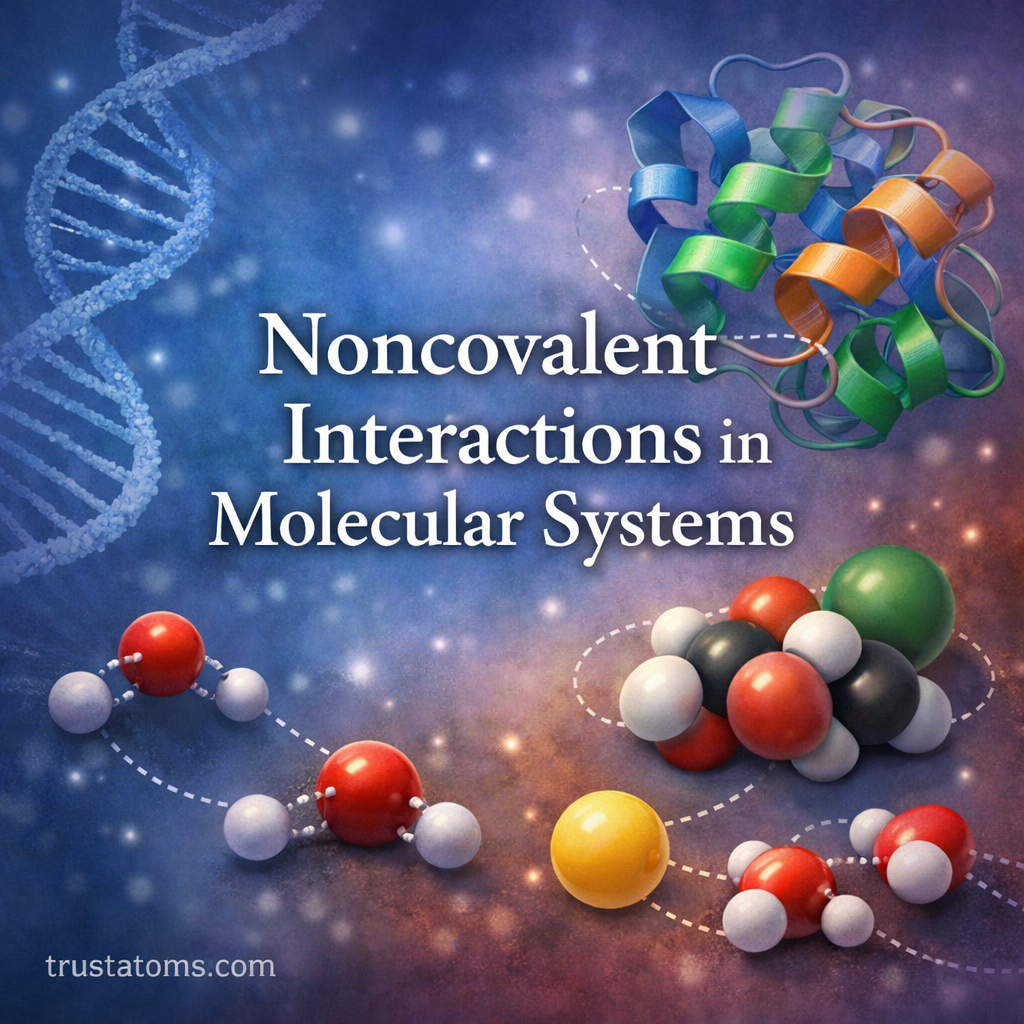
Noncovalent interactions are weak forces that occur between molecules or different parts of a molecule without the sharing of electrons that defines covalent bonds. Although individually weaker than covalent or ionic bonds, these interactions play a crucial role in chemistry, biology, and materials science.
From the folding of proteins to the structure of DNA and the behavior of liquids, noncovalent forces determine how molecules recognize, attract, and organize themselves. Understanding these interactions helps scientists explain everything from drug binding to the properties of everyday materials.
What Are Noncovalent Interactions?
Noncovalent interactions are intermolecular forces that arise from electrostatic attractions between molecules or atoms. Unlike covalent bonds, which involve the sharing of electrons, noncovalent forces depend on partial charges, temporary dipoles, and molecular geometry.
Key characteristics of noncovalent interactions include:
- They are weaker than covalent and ionic bonds.
- They are usually reversible.
- Multiple interactions often work together to stabilize molecular structures.
- They are essential for molecular recognition and self-assembly.
Even though a single interaction may be weak, the combined effect of many noncovalent interactions can create highly stable systems.
Major Types of Noncovalent Interactions
Several different forces fall under the category of noncovalent interactions. Each type arises from different electrostatic or structural effects.
Hydrogen Bonding
Hydrogen bonding occurs when a hydrogen atom bonded to a highly electronegative atom—typically oxygen, nitrogen, or fluorine—interacts with another electronegative atom.
Important features of hydrogen bonds include:
- Directional attraction between molecules
- Moderate strength compared to other noncovalent forces
- Critical roles in biological molecules
Examples include:
- The pairing of bases in DNA
- The structure of proteins
- The high boiling point of water
Hydrogen bonds are among the most important noncovalent interactions in biological chemistry.
Dipole–Dipole Interactions
Dipole–dipole interactions occur between molecules that have permanent dipoles. In these molecules, electrons are distributed unevenly, creating partial positive and partial negative regions.
Characteristics of dipole–dipole interactions:
- Occur between polar molecules
- Depend on molecular orientation
- Stronger than dispersion forces but weaker than hydrogen bonds
A common example is the attraction between molecules such as hydrogen chloride (HCl), where the positive end of one molecule aligns with the negative end of another.
London Dispersion Forces
London dispersion forces are the weakest type of noncovalent interaction. They arise from temporary fluctuations in electron distribution within atoms or molecules.
Key properties include:
- Present in all atoms and molecules
- Become stronger as molecular size increases
- Important for nonpolar substances
Even noble gases experience dispersion forces, which allow them to condense into liquids at low temperatures.
Although weak individually, dispersion forces can significantly influence the behavior of large molecules and materials.
Ion–Dipole Interactions
Ion–dipole interactions occur between a charged ion and a polar molecule. These interactions are particularly important in solutions.
Common examples include:
- The interaction between sodium ions and water molecules
- Dissolution of salts in polar solvents
These forces help stabilize ions in solution and play a key role in chemical processes such as solvation and electrolyte behavior.
Why Noncovalent Interactions Matter
Noncovalent interactions govern many fundamental processes in chemistry and biology. They determine how molecules organize and how chemical systems behave.
Some important roles include:
- Stabilizing the three-dimensional structure of proteins
- Holding together the double helix of DNA
- Controlling enzyme–substrate recognition
- Influencing the physical properties of liquids and solids
- Guiding molecular self-assembly
Without noncovalent interactions, complex biological systems and advanced materials would not be possible.
Noncovalent Interactions in Biological Systems
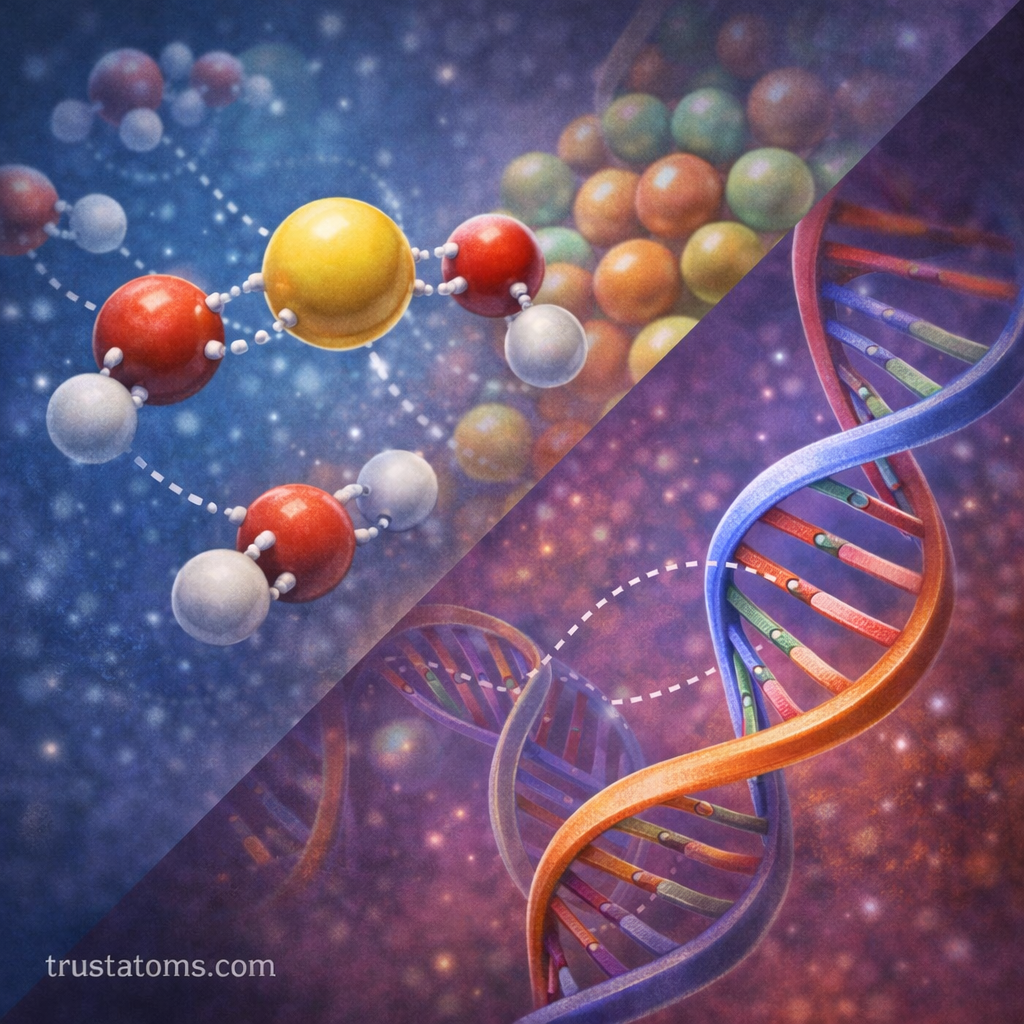
Living organisms rely heavily on noncovalent forces to maintain structure and function.
Protein Folding
Proteins fold into specific shapes that allow them to perform biological functions. Noncovalent interactions stabilize these structures through:
- Hydrogen bonding
- Hydrophobic interactions
- Van der Waals attractions
- Electrostatic interactions
The delicate balance between these forces determines the final protein structure.
DNA Structure
DNA’s famous double helix is stabilized by noncovalent interactions. Hydrogen bonds hold complementary base pairs together, while stacking interactions between bases provide additional stability.
These interactions allow DNA to remain stable while still being flexible enough to replicate and repair.
Molecular Recognition
Cells depend on molecular recognition to carry out biological processes. Enzymes, receptors, and antibodies recognize specific molecules through noncovalent interactions.
These interactions allow molecules to bind temporarily and selectively, enabling precise biological control.
Noncovalent Interactions in Materials Science
Beyond biology, noncovalent interactions also influence the properties of synthetic materials.
Scientists use these forces to design advanced systems such as:
- Self-assembling nanomaterials
- Molecular sensors
- Drug delivery systems
- Supramolecular polymers
Because noncovalent interactions are reversible and tunable, they are useful for creating materials that respond to environmental changes.
Factors That Influence Noncovalent Interactions
The strength and behavior of noncovalent interactions depend on several factors.
Molecular Shape
The arrangement of atoms affects how molecules approach and interact with each other.
Distance Between Molecules
Noncovalent interactions weaken rapidly as the distance between molecules increases.
Temperature
Higher temperatures increase molecular motion, which can weaken or disrupt noncovalent interactions.
Solvent Environment
The surrounding medium can strengthen or weaken interactions depending on polarity and chemical compatibility.
Understanding these factors helps chemists control molecular interactions in both natural and synthetic systems.
How Multiple Interactions Work Together
In most real molecular systems, several types of noncovalent interactions occur simultaneously. This cooperative behavior is often more important than any single interaction.
For example:
- A protein may use hydrogen bonds to stabilize its backbone structure.
- Hydrophobic interactions may cluster nonpolar regions.
- Electrostatic interactions may help align charged residues.
Together, these forces create complex and highly organized molecular structures.
Final Thoughts
Noncovalent interactions may be weaker than covalent bonds, but their importance in chemistry cannot be overstated. These forces allow molecules to interact, assemble, and function in dynamic environments.
From biological systems to modern materials science, noncovalent interactions provide the subtle yet powerful forces that shape molecular behavior. By understanding these interactions, scientists can better explain natural processes and design new technologies that rely on molecular organization.