Most introductory physics problems assume something comforting:
Small inputs produce small outputs.
Push a pendulum gently, and it swings gently. Stretch a spring slightly, and it responds proportionally.
But many real-world mechanical systems do not behave this way.
When forces, motion, or energy interactions stop following simple proportional rules, we enter the world of nonlinear dynamics — a field that explains complex motion, chaos, instability, and surprising behavior in mechanical systems.
In this guide, we’ll explore what nonlinear dynamics means, how it differs from linear motion, and why it matters in engineering and physics.
What Is Nonlinear Dynamics?
A system is nonlinear when its output is not directly proportional to its input.
In linear systems:
- Doubling the input doubles the output.
- Effects scale predictably.
- Equations are easier to solve.
In nonlinear systems:
- Small changes can cause large effects.
- Behavior may shift suddenly.
- Solutions can become complex or chaotic.
Nonlinear dynamics studies how such systems evolve over time.
Linear vs Nonlinear Mechanical Systems
Understanding the difference starts with examples.
Linear System Example
A simple spring obeying Hooke’s Law:
- Force is proportional to displacement.
- Motion follows predictable oscillations.
- Graphs form smooth sine waves.
Nonlinear System Example
A pendulum swinging at large angles:
- Motion no longer follows simple harmonic equations.
- Period changes with amplitude.
- Behavior becomes harder to predict.
The difference lies in how the restoring forces behave as displacement increases.
Sources of Nonlinearity in Mechanical Systems
Nonlinear behavior can arise from several physical causes.
Large Displacements
When motion becomes large, approximations break down.
Friction and Damping
Real-world friction is rarely perfectly proportional to velocity.
Geometric Constraints
Complex structures bend or twist in nonlinear ways.
Material Properties
Materials may deform differently under increasing stress.
Examples include:
- Rubber stretching
- Metal yielding
- Structural buckling
The Nonlinear Pendulum
One of the most famous nonlinear systems is the pendulum.
At small angles:
- Motion approximates simple harmonic oscillation.
At large angles:
- The restoring force depends on the sine of the angle.
- The period changes.
- Motion becomes nonlinear.
This transition shows how a system can move from simple to complex behavior.
Phase Space and Nonlinear Motion
To analyze nonlinear systems, physicists use phase space.
Phase space plots:
- Position
- Velocity
Instead of just tracking motion over time, phase space reveals patterns in system behavior.
In linear systems:
- Trajectories form simple closed loops.
In nonlinear systems:
- Trajectories can twist, stretch, or spiral.
- Complex structures may emerge.
Chaos in Mechanical Systems
One of the most fascinating outcomes of nonlinear dynamics is chaos.
Chaos does not mean randomness.
It means:
- Extreme sensitivity to initial conditions.
- Small differences grow exponentially.
- Long-term prediction becomes nearly impossible.
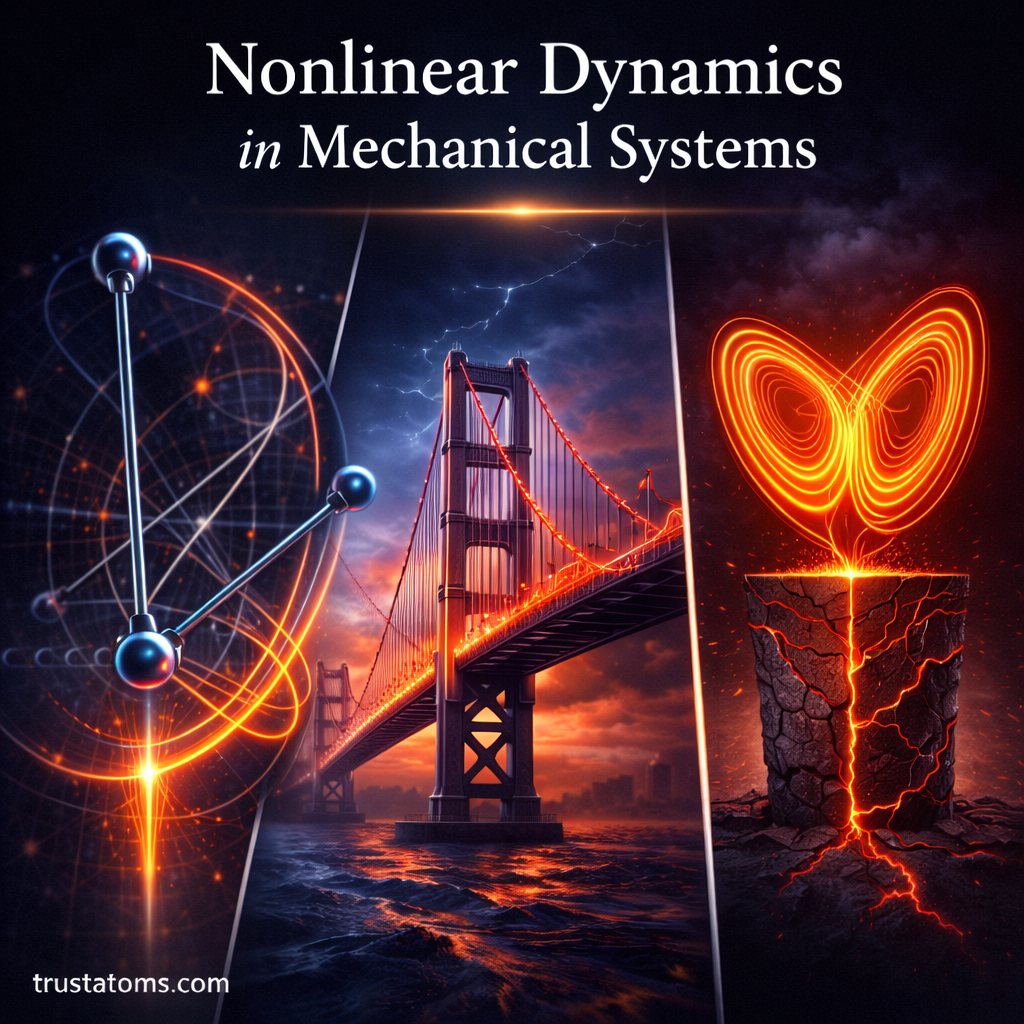
A classic example is the double pendulum.
If two pendulums are connected:
- Slight differences in starting position lead to drastically different motion.
- The system behaves unpredictably over time.
This sensitivity is often called the “butterfly effect.”
Bifurcations and Sudden Changes

Nonlinear systems can undergo bifurcations — sudden qualitative changes in behavior.
For example:
- A rotating shaft may suddenly begin vibrating.
- A bridge may shift from stable to unstable motion.
- A system may transition from steady oscillation to chaotic motion.
These changes occur when system parameters cross critical thresholds.
Real-World Examples of Nonlinear Dynamics
Nonlinear mechanical behavior appears everywhere.
Engineering Structures
- Aircraft wings under load
- Suspension bridges in wind
- Vehicle suspension systems
Machinery
- Rotating turbines
- Engine vibrations
- Gear interactions
Natural Systems
- Earthquake fault motion
- Ocean wave interactions
- Biomechanical joint motion
Many mechanical failures occur due to nonlinear instability.
Why Nonlinear Systems Are Hard to Solve
Linear equations:
- Often have exact solutions.
- Can be solved analytically.
Nonlinear equations:
- Rarely have exact solutions.
- Often require numerical simulations.
- Depend heavily on initial conditions.
Modern physics relies on computational modeling to analyze nonlinear systems.
Stability in Nonlinear Systems
A key question in nonlinear dynamics is stability.
A system is stable if:
- Small disturbances fade over time.
It is unstable if:
- Small disturbances grow.
Nonlinear systems can show:
- Multiple stable states.
- Oscillatory instability.
- Sudden transitions.
This is critical in designing safe mechanical systems.
Energy and Nonlinear Behavior
Energy interactions in nonlinear systems are often complex.
Instead of smooth energy exchange:
- Energy may transfer between modes.
- Oscillations may couple.
- Resonance may amplify motion.
Resonance in nonlinear systems can produce dramatic effects, including structural damage.
Applications in Modern Physics and Engineering
Nonlinear dynamics is essential in:
- Aerospace engineering
- Robotics
- Structural engineering
- Vibration control
- Mechanical design
Understanding nonlinear motion helps engineers:
- Prevent catastrophic failure.
- Predict system behavior under stress.
- Design stable control systems.
- Optimize performance.
Common Misconceptions
“Nonlinear means random.”
Nonlinear systems follow deterministic rules — they are not random.
“Nonlinear systems cannot be predicted.”
Short-term predictions are often possible. Long-term predictions may become difficult.
“Only complex machines are nonlinear.”
Even simple systems, like a swinging pendulum, become nonlinear under certain conditions.
Why Nonlinear Dynamics Matters
Nonlinear dynamics reflects how the real world actually behaves.
Perfect linear systems are often approximations.
In reality:
- Forces vary.
- Materials stretch.
- Structures bend.
- Vibrations interact.
Nonlinear analysis allows physicists and engineers to move beyond idealized equations and understand true system behavior.
It explains:
- Chaos
- Instability
- Sudden transitions
- Complex oscillations
And it reveals why small changes sometimes produce massive consequences.
Final Thoughts
Nonlinear dynamics in mechanical systems shows us that motion is not always simple or proportional.
When systems move beyond small approximations:
- Behavior becomes richer.
- Stability can shift.
- Chaos can emerge.
From double pendulums to aerospace structures, nonlinear physics governs how real mechanical systems evolve.
Understanding it is not just theoretical — it’s essential for designing safe machines, predicting structural behavior, and explaining the complexity of motion in our world.