Why do some atomic nuclei remain stable for billions of years while others decay in seconds?
The answer lies in nuclear binding energy.
Nuclear binding energy explains:
- Why energy is released in nuclear reactions
- Why some isotopes are stable
- Why stars can shine for billions of years
- Why nuclear fission and fusion produce enormous energy
Understanding binding energy is essential for nuclear physics, astrophysics, and modern energy science.
What Is Nuclear Binding Energy?
Nuclear binding energy is the energy required to completely separate a nucleus into its individual protons and neutrons.
In simple terms:
It is the energy holding the nucleus together.
If a nucleus has high binding energy:
- It is more stable
- It requires more energy to break apart
If it has low binding energy:
- It is less stable
- It can decay or split more easily
Binding energy reflects how tightly nucleons (protons and neutrons) are bound inside the nucleus.
The Strong Nuclear Force
Protons are positively charged.
They repel each other due to electromagnetic force.
So why doesn’t the nucleus fly apart?
Because of the strong nuclear force.
The strong force:
- Is extremely powerful
- Acts only over very short distances
- Binds protons and neutrons together
At very small scales, the strong force overcomes electric repulsion and creates a stable nucleus.
Mass Defect: Where the Energy Comes From
When a nucleus forms, something surprising happens.
The mass of the nucleus is slightly less than the combined mass of its individual protons and neutrons.
This missing mass is called the mass defect.
Where did it go?
It was converted into binding energy.
According to mass–energy equivalence:
- A small amount of mass converts into energy
- That energy holds the nucleus together
The greater the mass defect:
- The greater the binding energy
- The more stable the nucleus
Binding Energy per Nucleon
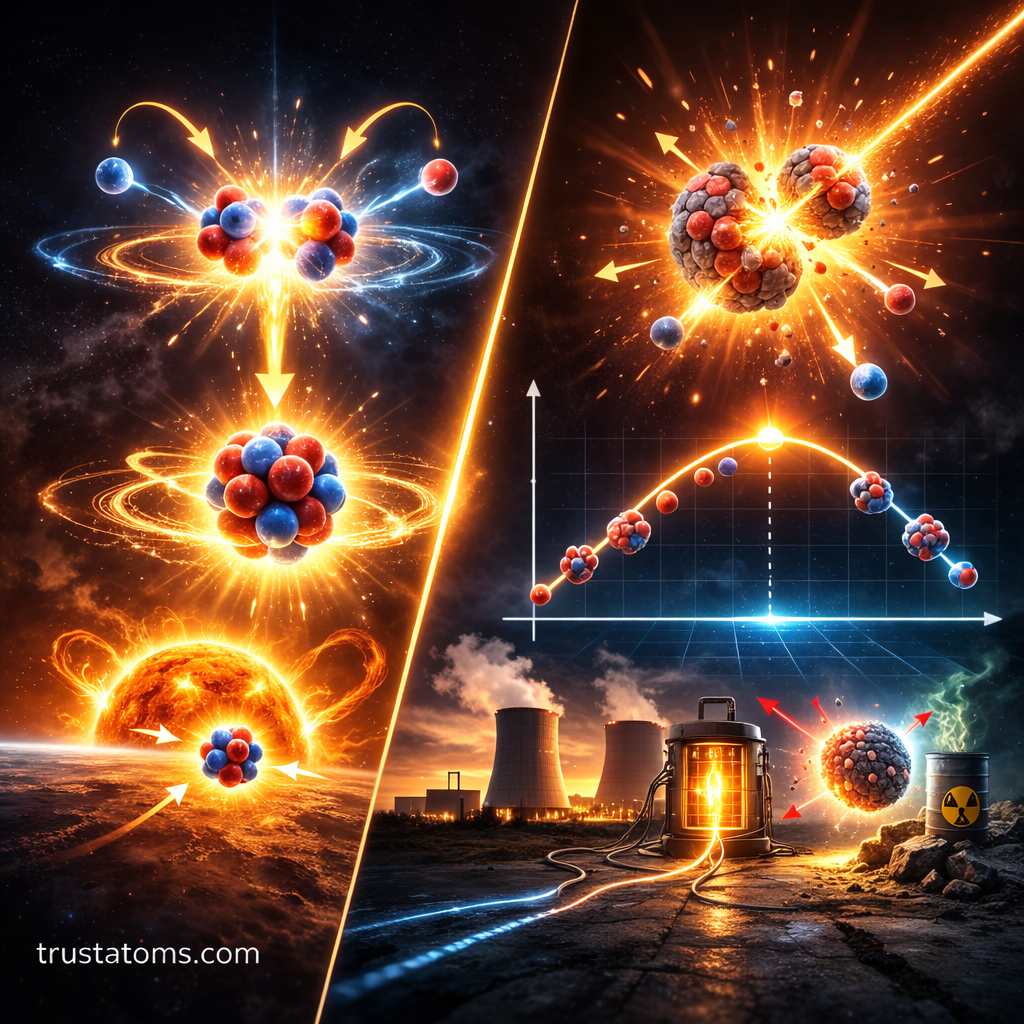
To compare stability across elements, physicists use binding energy per nucleon.
This value tells us:
- How tightly each proton or neutron is bound
- How stable the nucleus is overall
The most stable nuclei lie near iron and nickel on the periodic table.
Iron-56 has one of the highest binding energy per nucleon values.
This fact explains important cosmic processes.
Why Fusion Releases Energy
Fusion combines light nuclei into heavier ones.
For example:
- Hydrogen nuclei fuse into helium inside stars
When light nuclei combine:
- The resulting nucleus has higher binding energy per nucleon
- The total mass decreases slightly
- The lost mass becomes energy
This is why the Sun produces enormous energy.
Fusion moves elements toward greater stability.
Why Fission Releases Energy
Fission splits heavy nuclei into smaller fragments.
Heavy elements like uranium have:
- Lower binding energy per nucleon than mid-sized elements
When they split:
- The fragments move closer to the “iron peak” of stability
- Binding energy per nucleon increases
- Energy is released
Both fusion and fission release energy because they move nuclei toward higher stability.
The Stability Curve
If you plot binding energy per nucleon against atomic number, you get a curve:
- It rises quickly for light elements
- Peaks near iron
- Gradually declines for heavy elements
This curve explains:
- Why fusion powers stars
- Why very heavy elements are unstable
- Why radioactive decay occurs
Nature tends toward higher binding energy per nucleon.
Nuclear Stability and Radioactivity
Not all nuclei are stable.
Unstable nuclei may:
- Emit alpha particles
- Emit beta particles
- Emit gamma radiation
These processes occur because the nucleus seeks a more stable configuration.
Radioactive decay is a pathway toward higher binding energy and stability.
Real-World Applications
Understanding nuclear binding energy is essential in:
1. Nuclear Power Plants
Energy from fission comes directly from changes in binding energy.
2. Stellar Evolution
Stars fuse elements progressively until reaching iron.
Beyond iron:
- Fusion no longer releases energy
- Supernova explosions occur
3. Medical Isotopes
Radioactive isotopes used in imaging and cancer treatment depend on predictable stability properties.
4. Particle Physics Research
Facilities like CERN study nuclear and subatomic interactions, helping refine our understanding of fundamental forces.
Factors That Influence Nuclear Stability
Several factors determine whether a nucleus is stable:
- Proton-to-neutron ratio
- Total number of nucleons
- Shell structure within the nucleus
- Pairing effects between nucleons
Certain “magic numbers” of protons or neutrons produce especially stable configurations.
These numbers reflect quantum mechanical structure inside the nucleus.
Why Iron Is Special
Iron sits at the peak of the stability curve.
This means:
- Fusing elements lighter than iron releases energy
- Splitting elements heavier than iron releases energy
But reactions involving iron itself do not release energy through fusion or fission.
This is why massive stars collapse after forming iron cores — energy production stops.
Binding Energy and the Early Universe
In the early universe:
- Only light elements existed
- Heavier elements formed inside stars
The gradual increase in binding energy per nucleon shaped cosmic evolution.
Every atom in your body exists because nuclear processes moved matter toward greater stability.
Final Takeaways
- Nuclear binding energy is the energy holding a nucleus together.
- It arises from mass defect and the strong nuclear force.
- Higher binding energy per nucleon means greater stability.
- Fusion and fission release energy by moving nuclei toward iron-level stability.
- Nuclear stability governs radioactive decay, stellar processes, and energy production.
Binding energy reveals that atomic nuclei are not rigid structures — they are dynamic systems governed by powerful forces and deep physical laws.
Understanding it unlocks the story of stars, elements, and energy itself.