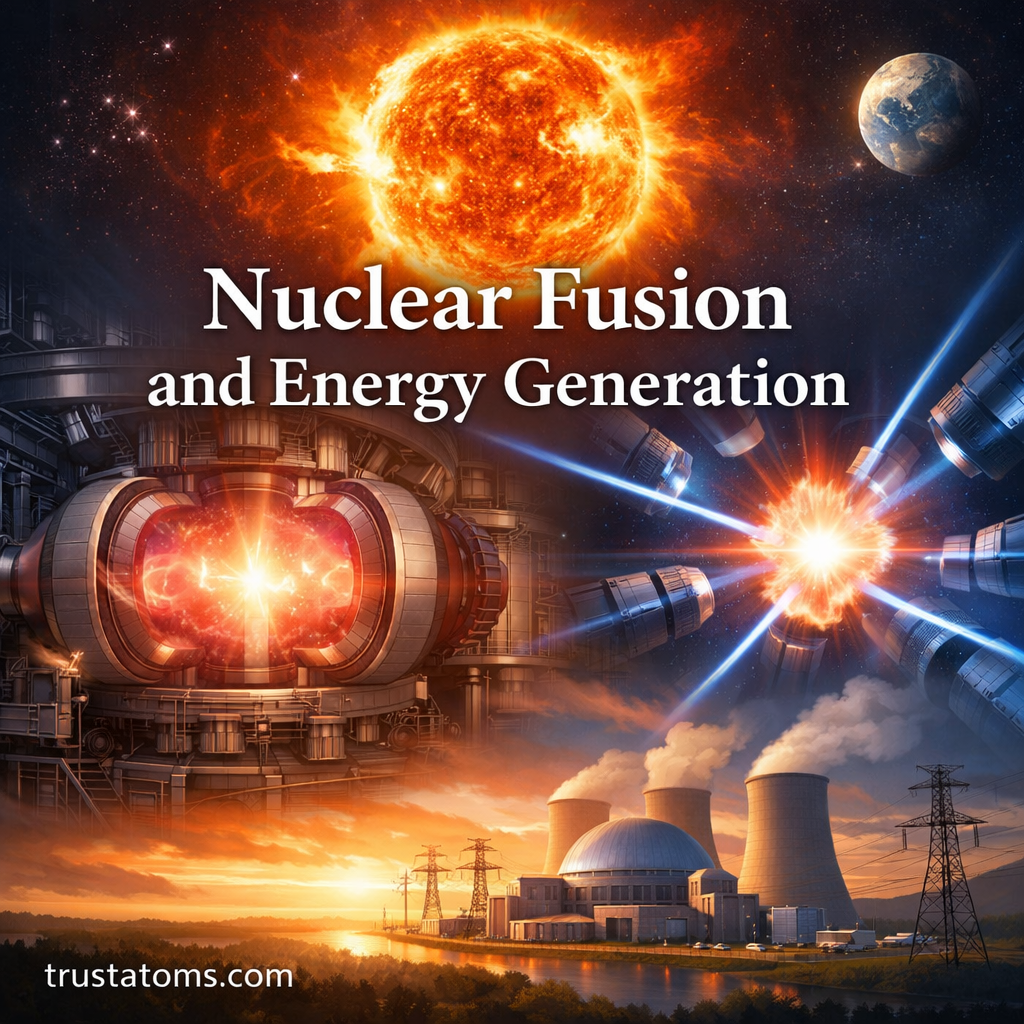
Nuclear fusion is often called the “holy grail” of clean energy. It promises virtually limitless power, minimal environmental impact, and no long-lived radioactive waste. But despite decades of research, fusion power plants are not yet supplying electricity to our homes.
So what exactly is nuclear fusion? How does it work? And why is it so difficult to harness?
Let’s break it down in clear, practical terms.
What Is Nuclear Fusion?
Nuclear fusion is the process in which two light atomic nuclei combine to form a heavier nucleus, releasing a tremendous amount of energy.
This is the same process that powers the Sun and other stars.
In simple terms:
- Light atoms (like hydrogen) collide.
- They fuse into a heavier atom (like helium).
- A small amount of mass is converted into energy.
- That energy is released as heat and radiation.
The reason energy is released comes from Einstein’s famous equation:
E = mc²
Even a tiny loss of mass (m) produces a massive amount of energy (E) because it’s multiplied by the square of the speed of light (c²).
Fusion vs. Fission: What’s the Difference?
Many people confuse nuclear fusion with nuclear fission. They are very different processes.
Nuclear Fission
- Splits heavy atoms (like uranium).
- Used in today’s nuclear power plants.
- Produces long-lived radioactive waste.
- Can lead to chain reactions.
Nuclear Fusion
- Combines light atoms (like hydrogen isotopes).
- Produces far less radioactive waste.
- No runaway chain reaction risk.
- Requires extremely high temperatures to work.
Fission is commercially viable today. Fusion is still under development.
How Nuclear Fusion Generates Energy
To understand energy generation from fusion, we need to look at the most promising reaction:
Deuterium + Tritium → Helium + Neutron + Energy
Deuterium and tritium are isotopes of hydrogen. When they fuse:
- They combine under extreme heat and pressure.
- They form helium.
- A high-energy neutron is released.
- Enormous heat is generated.
That heat can then:
- Boil water.
- Produce steam.
- Spin turbines.
- Generate electricity — just like in conventional power plants.
In other words, fusion still uses familiar turbine-based systems. The difference is how the heat is produced.
Why Fusion Requires Extreme Conditions
Fusion is difficult because atomic nuclei repel each other.
Both deuterium and tritium nuclei are positively charged. Like two magnets with the same pole, they push away from each other. To overcome that repulsion, fusion requires:
- Temperatures over 100 million degrees Celsius.
- Intense pressure.
- Precise magnetic confinement.
At these temperatures, matter becomes plasma — a superheated state where electrons are stripped from atoms.
The challenge is containing plasma without letting it touch reactor walls, which would instantly cool it down and damage equipment.
Major Fusion Reactor Designs
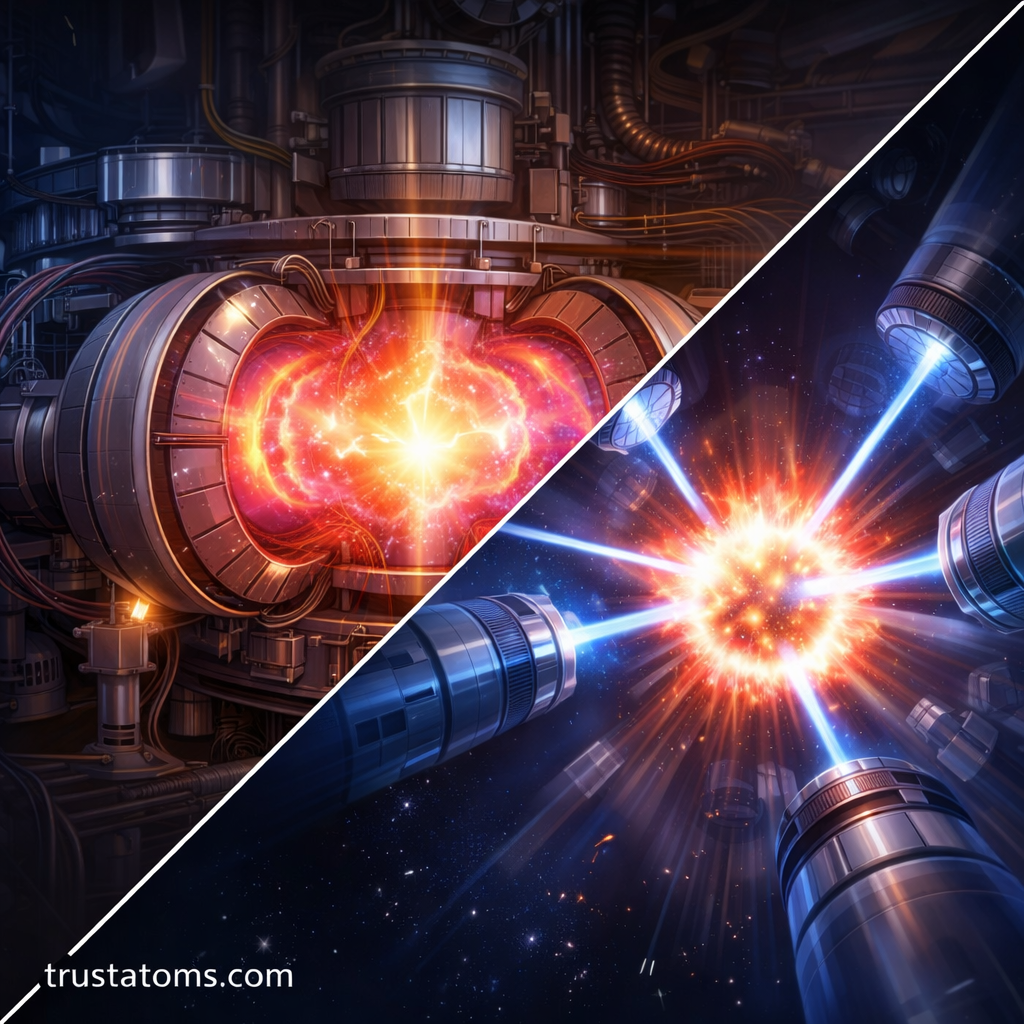
Scientists have developed two main approaches to contain plasma.
1. Magnetic Confinement (Tokamak Reactors)
Tokamaks use powerful magnetic fields to trap plasma in a donut-shaped chamber.
One of the largest fusion experiments using this design is the International Thermonuclear Experimental Reactor (ITER), currently under construction in France.
Key features:
- Strong superconducting magnets.
- Toroidal (donut-shaped) chamber.
- Continuous plasma confinement.
The goal is to produce more energy than the system consumes.
2. Inertial Confinement
This method uses high-powered lasers to compress and heat tiny fuel pellets.
The National Ignition Facility (NIF) in the United States achieved a major breakthrough by producing more energy from fusion than the laser energy delivered to the fuel target — a milestone known as “ignition.”
However, scaling this into continuous power production remains a major engineering challenge.
Advantages of Nuclear Fusion
Fusion is attractive because it offers several potential benefits:
- Abundant fuel (deuterium can be extracted from seawater).
- No carbon emissions during operation.
- Minimal long-lived radioactive waste.
- No risk of nuclear meltdown.
- Extremely high energy density.
Just one gram of fusion fuel could theoretically produce as much energy as several tons of fossil fuel.
The Challenges Holding Fusion Back
Despite its promise, fusion is one of the most complex engineering problems humanity has ever attempted.
Key challenges include:
- Sustaining plasma at extreme temperatures.
- Maintaining net positive energy output.
- Developing materials that withstand neutron bombardment.
- Managing tritium production and handling.
- Reducing construction and operational costs.
Even though breakthroughs are happening, commercial fusion power is still likely years — or decades — away.
Recent Breakthroughs in Fusion Research
Fusion research has accelerated significantly in recent years due to:
- Advances in superconducting magnet technology.
- Private sector investment.
- AI-driven plasma modeling.
- High-energy laser improvements.
Several private companies are racing to build compact fusion reactors that could reduce cost and size compared to traditional large-scale projects.
While no commercial fusion plant exists yet, progress is faster today than at any point in history.
Will Fusion Replace Fossil Fuels?
Fusion alone won’t instantly replace fossil fuels. But it could become a major part of a diversified energy system that includes:
- Solar power
- Wind energy
- Nuclear fission
- Energy storage technologies
If fusion becomes commercially viable, it could provide stable, large-scale baseload power without greenhouse gas emissions.
That would dramatically reshape global energy production.
Why Nuclear Fusion Matters for the Future
Human civilization runs on energy. As global demand rises, we need sources that are:
- Clean
- Reliable
- Scalable
- Sustainable
Fusion has the potential to meet all four criteria.
It represents more than just another power source — it’s the possibility of harnessing the same fundamental force that powers the stars.
If successfully commercialized, nuclear fusion could redefine energy security, reduce climate risks, and transform modern industry.
Final Thoughts
Nuclear fusion and energy generation remain one of science’s greatest frontiers. While significant technical challenges remain, recent breakthroughs suggest we are closer than ever to making fusion a reality.
The road ahead requires continued research, engineering innovation, and global collaboration.
But if humanity succeeds, the reward could be virtually limitless clean energy — powered by the same process that lights the universe.