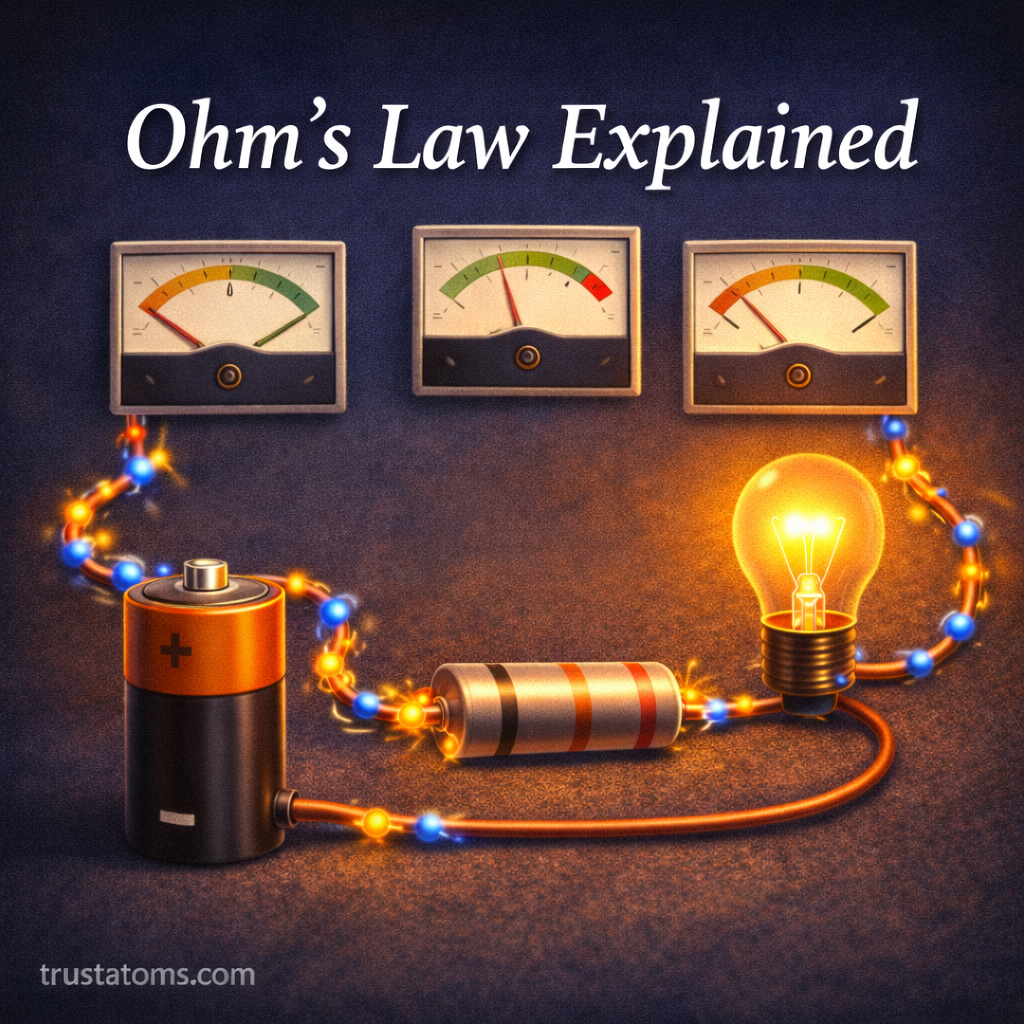
Ohm’s Law is one of the most important principles in physics and electrical science. It explains the relationship between voltage, current, and resistance in an electrical circuit.
If you understand Ohm’s Law, you understand how electricity behaves in basic circuits.
Let’s break it down clearly and simply.
What Is Ohm’s Law?
Ohm’s Law states:
The current flowing through a conductor is directly proportional to the voltage and inversely proportional to the resistance.
In simpler terms:
- More voltage → more current
- More resistance → less current
This relationship was discovered by German physicist Georg Ohm in the 1820s.
The Ohm’s Law Formula
Ohm’s Law is written as:
V = I × R
Where:
- V = voltage (volts)
- I = current (amps)
- R = resistance (ohms)
This formula connects the three fundamental electrical quantities.
Rearranging the Formula
You can rearrange Ohm’s Law depending on what you need to calculate.
To find current:
I = V / R
To find resistance:
R = V / I
These three versions form the foundation of basic circuit analysis.
Understanding the Relationship
Let’s look at how voltage, current, and resistance interact.
1. If Voltage Increases
When resistance stays the same:
- Higher voltage → higher current
Example:
If you double the voltage, the current doubles.
2. If Resistance Increases
When voltage stays the same:
- Higher resistance → lower current
Example:
If resistance doubles, the current is cut in half.
3. If Current Increases
When resistance stays the same:
- Higher current requires higher voltage.
These relationships allow engineers to design safe and efficient circuits.
A Simple Water Analogy
Ohm’s Law is often explained using a water system comparison:
- Voltage = water pressure
- Current = water flow
- Resistance = pipe width
If you increase pressure, more water flows.
If you narrow the pipe, flow decreases.
This analogy helps visualize how electrical systems behave.
Real-World Examples of Ohm’s Law
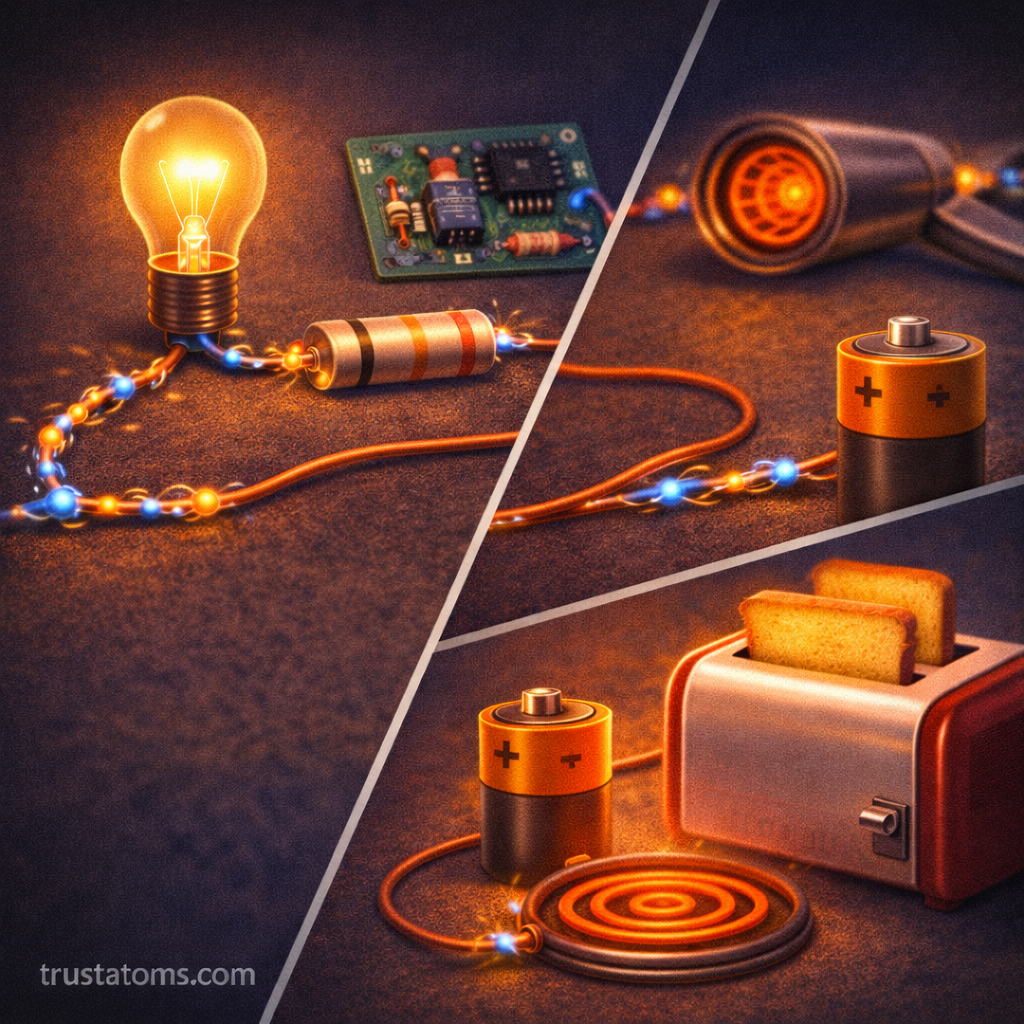
Ohm’s Law applies everywhere electricity is used.
Household Lighting
If a light bulb has high resistance:
- Less current flows.
- The bulb glows at its designed brightness.
If resistance is too low:
- Excessive current may cause overheating.
Electronic Devices
In phones, computers, and TVs:
- Resistors control current levels.
- Proper voltage ensures components don’t get damaged.
Heating Elements
In devices like:
- Toasters
- Electric heaters
- Hair dryers
Resistance converts electrical energy into heat.
Ohm’s Law helps determine how much current flows and how much heat is produced.
Why Ohm’s Law Matters
Ohm’s Law is essential because it allows us to:
- Predict how circuits will behave
- Prevent electrical overloads
- Design safe wiring systems
- Calculate power consumption
- Troubleshoot electrical problems
Without Ohm’s Law, modern electrical engineering would not be possible.
Ohm’s Law and Electrical Power
Ohm’s Law connects directly to electrical power.
Power is calculated using:
P = V × I
By combining this with Ohm’s Law, you can also write power as:
- P = I²R
- P = V² / R
These formulas show how resistance affects heat and energy use in circuits.
Common Misconceptions About Ohm’s Law
Here are a few misunderstandings:
“Ohm’s Law works for everything.”
Ohm’s Law applies to ohmic materials, where resistance remains constant.
Some components (like diodes or transistors) do not follow Ohm’s Law perfectly.
“Higher voltage is always dangerous.”
Danger depends on:
- Voltage
- Current
- Resistance of the human body
- Duration of exposure
Ohm’s Law helps explain why both voltage and resistance matter in safety.
“Resistance always wastes energy.”
Sometimes resistance is intentional — especially in heating devices.
Simple Step-by-Step Example
Imagine:
- Voltage = 12 volts
- Resistance = 6 ohms
Using Ohm’s Law:
I = V / R
I = 12 / 6
I = 2 amps
This means 2 amperes of current flow through the circuit.
Simple calculations like this are used daily in engineering and electronics.
Summary of Ohm’s Law
Ohm’s Law:
- Connects voltage, current, and resistance
- Helps predict circuit behavior
- Is foundational in electrical engineering
- Explains how devices operate safely
- Is used in everything from small electronics to power grids
It is one of the most practical and powerful tools in physics.
Final Thoughts
Ohm’s Law may look like a simple equation, but it explains the behavior of nearly every basic electrical system.
By understanding how voltage pushes current and how resistance limits it, you gain a deeper understanding of how electricity works.
Whether you’re a student learning physics or someone curious about how circuits function, mastering Ohm’s Law is a major step toward understanding the electrical world around you.