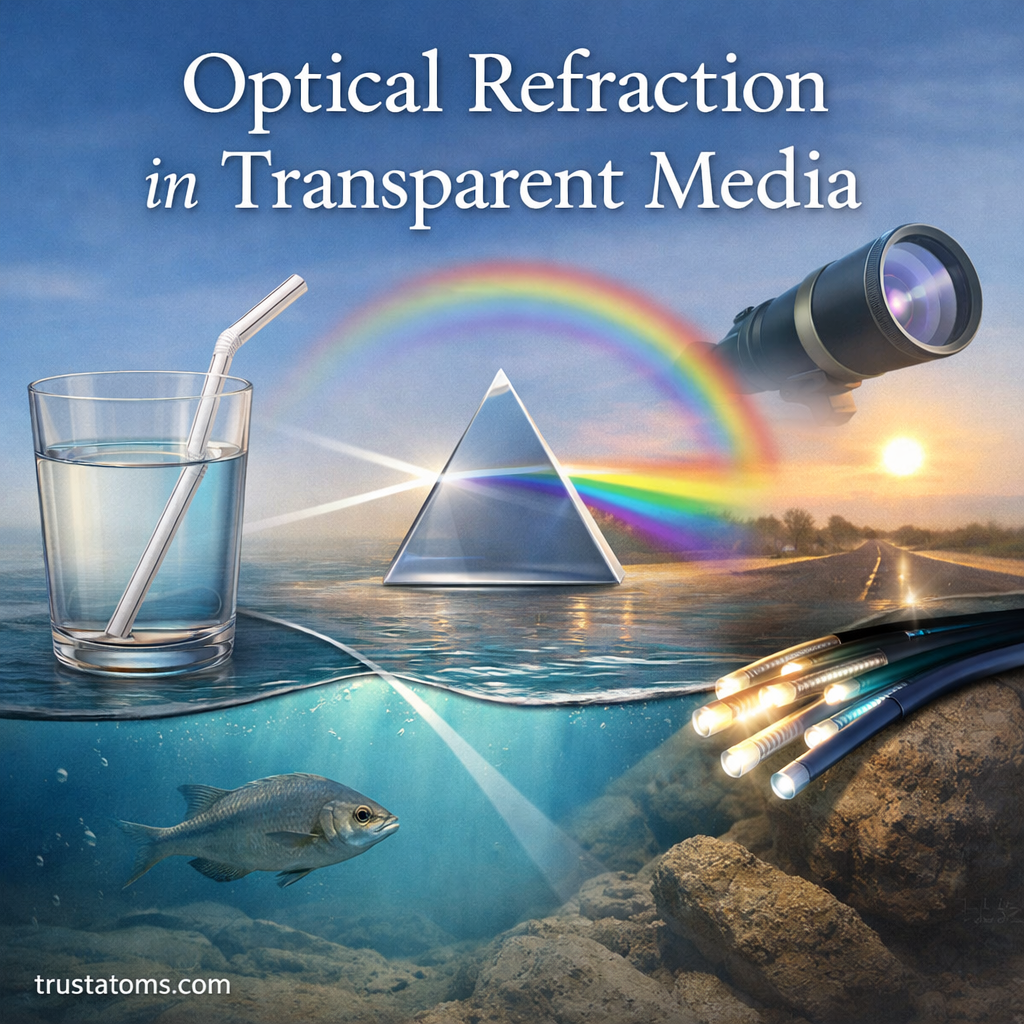
Light appears simple — it lets us see. But when light passes through water, glass, or air, it doesn’t just travel straight. It bends. This bending of light is called optical refraction, and it’s one of the most important principles in physics.
From eyeglasses and microscopes to rainbows and fiber-optic cables, refraction plays a central role in how we understand and use light.
In this guide, we’ll break down what optical refraction is, why it happens, how to calculate it, and where it shows up in everyday life.
What Is Optical Refraction?
Optical refraction is the change in direction of light when it passes from one transparent medium to another.
A transparent medium is any material that allows light to pass through it, such as:
- Air
- Water
- Glass
- Plastic
- Quartz
When light moves between materials, its speed changes. This change in speed causes the light to bend.
Why Does Light Bend?
Light travels at different speeds in different materials.
- In a vacuum, light travels at its maximum speed:
299,792,458 meters per second (c) - In air, it slows slightly
- In water, it slows more
- In glass, it slows even further
When light crosses a boundary at an angle:
- One side of the wave changes speed first
- The rest of the wave follows
- The direction shifts
This produces bending at the boundary between the two media.
If light enters a material where it slows down, it bends toward the normal (an imaginary line perpendicular to the surface).
If light enters a material where it speeds up, it bends away from the normal.
The Law of Refraction (Snell’s Law)
Refraction is mathematically described by Snell’s Law.
Snell’s Law states:
n₁ sin(θ₁) = n₂ sin(θ₂)
Where:
- n₁ = refractive index of first medium
- n₂ = refractive index of second medium
- θ₁ = angle of incidence
- θ₂ = angle of refraction
What Is Refractive Index?
The refractive index (n) measures how much a material slows down light.
It is defined as:
n = c / v
Where:
- c = speed of light in vacuum
- v = speed of light in the material
Typical refractive indices:
- Vacuum: 1.00
- Air: ~1.0003
- Water: 1.33
- Glass: 1.5 to 1.9
- Diamond: 2.42
The higher the refractive index, the more the light bends.
Example of Refraction in Water
Have you ever placed a straw in a glass of water and noticed it looks bent?
Here’s what happens:
- Light travels from water into air
- It speeds up at the boundary
- It bends away from the normal
- Your brain traces the light back in straight lines
- The straw appears shifted
The straw isn’t actually bent — your perception is altered because of refraction.
Refraction vs Reflection
It’s important not to confuse refraction with reflection.
Reflection:
- Light bounces off a surface
- Angle of incidence = angle of reflection
Refraction:
- Light passes through a boundary
- Direction changes due to speed difference
Both often happen at the same time. For example, when light hits glass:
- Some light reflects
- Some light refracts
Critical Angle and Total Internal Reflection
When light moves from a denser medium (like water or glass) to a less dense medium (like air), something special can happen.
If the angle of incidence becomes large enough:
- The refracted ray disappears
- All light reflects internally
This is called total internal reflection.
The specific angle where refraction stops is called the critical angle.
Total internal reflection is used in:
- Fiber-optic communication
- Medical endoscopes
- High-quality prisms
Dispersion: Why Rainbows Form
White light is made of multiple wavelengths (colors).
Each wavelength bends slightly differently when refracted.
This separation of light into colors is called dispersion.
In a rainbow:
- Sunlight enters water droplets
- It refracts
- It reflects inside the droplet
- It refracts again when exiting
- Colors separate into a spectrum
Red light bends less.
Violet light bends more.
Applications of Optical Refraction
Refraction is not just theoretical — it powers modern technology.
Eyeglasses and Contact Lenses
Corrective lenses bend light to focus properly on the retina.
Microscopes and Telescopes
Precision lenses use refraction to magnify distant or tiny objects.
Cameras
Camera lenses use multiple refracting surfaces to create sharp images.
Fiber-Optic Cables
Light signals travel long distances through repeated total internal reflection.
Underwater Vision
Objects appear closer and larger underwater due to refraction at the water-air boundary.
Refraction in Atmospheric Physics

Refraction also occurs in air.
Because air density changes with altitude:
- Light bends slightly as it travels through the atmosphere
- The Sun appears slightly higher than it actually is at sunrise and sunset
- Stars appear to twinkle due to shifting air layers
This is called atmospheric refraction.
Common Misconceptions
“Light always bends when entering another medium.”
Not true.
If light hits the surface at 0° (straight on), it changes speed but not direction.
“Refraction only happens in liquids.”
Refraction happens in solids, liquids, and gases — anywhere light speed changes.
“Higher refractive index means light moves faster.”
It’s the opposite.
Higher refractive index = slower light = more bending.
Step-by-Step: Solving a Refraction Problem
Let’s say light moves from air (n = 1.00) into water (n = 1.33) at an angle of 30°.
- Use Snell’s Law
1.00 × sin(30°) = 1.33 × sin(θ₂) - sin(30°) = 0.5
- 0.5 = 1.33 × sin(θ₂)
- sin(θ₂) = 0.5 / 1.33
- sin(θ₂) ≈ 0.376
- θ₂ ≈ 22°
The light bends toward the normal because it slowed down in water.
Why Optical Refraction Matters in Physics
Refraction connects multiple physics concepts:
- Wave behavior
- Speed and energy relationships
- Electromagnetic radiation
- Material properties
- Geometric optics
It also bridges theory and application — from pure physics equations to real-world technologies that power communication, medicine, and imaging.
Understanding refraction helps explain how we see, how instruments work, and how light interacts with matter at a fundamental level.
Final Thoughts
Optical refraction is one of the clearest demonstrations that light behaves predictably — yet beautifully.
A simple change in speed causes:
- Bending straws
- Corrected vision
- High-speed internet
- Magnified galaxies
- Vibrant rainbows
At its core, refraction reminds us that even invisible changes — like speed shifts in light — can dramatically alter what we perceive.
And in physics, that shift in direction opens an entire world of understanding.