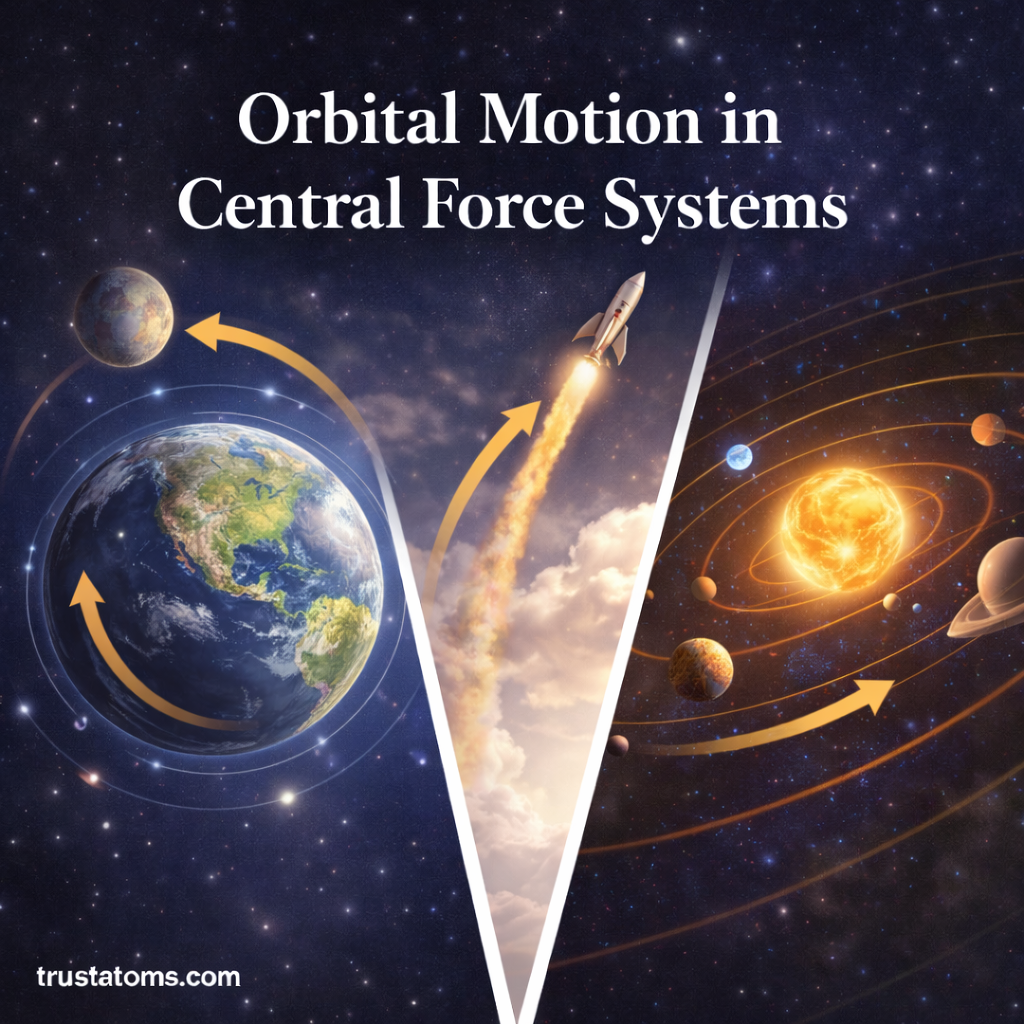
Orbital motion is one of the most fascinating phenomena in physics. From satellites circling Earth to planets orbiting the Sun, these motions are governed by a powerful principle: central forces.
Understanding orbital motion in central force systems helps explain planetary systems, space travel, atomic models, and gravitational interactions across the universe.
In this guide, we’ll explore how central forces create stable orbits and what determines the motion of objects in space.
What Is a Central Force?
A central force is a force that:
- Always points toward (or away from) a fixed center.
- Depends only on the distance from that center.
- Acts along the line connecting the object to the center.
Gravity is the most important example of a central force in nature.
Other examples include:
- Electrostatic forces between charged particles.
- Ideal spring forces in some simplified systems.
In orbital motion, gravity is the dominant central force.
Why Central Forces Create Orbits
When an object moves under a central force:
- It is constantly pulled toward the center.
- It continues moving forward due to its inertia.
- The combination creates curved motion.
If the forward speed is just right, the object does not fall inward or escape outward. Instead, it continuously “falls around” the central body — forming an orbit.
This is how:
- The Moon orbits Earth.
- Earth orbits the Sun.
- Satellites orbit planets.
Circular Orbits
In a perfectly circular orbit:
- The object moves at constant speed.
- The central force provides exactly the required inward acceleration.
- The distance from the center remains constant.
Key features of circular orbits:
- Constant orbital radius.
- Constant orbital speed.
- Constant magnitude of central force.
Although speed is constant, velocity is not — because direction continuously changes.
This change in direction requires centripetal acceleration.
Elliptical Orbits
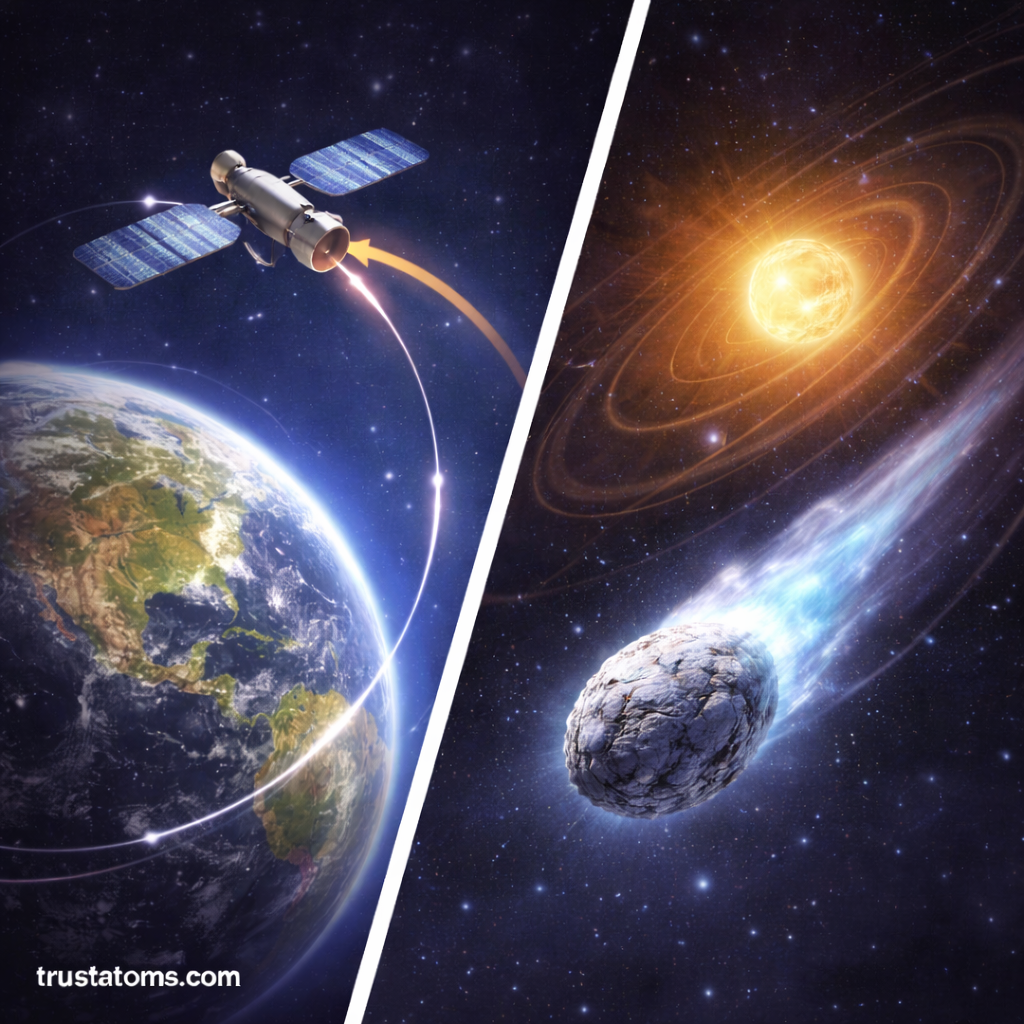
Most real orbits are not perfectly circular — they are elliptical.
In elliptical orbits:
- Distance from the central body changes.
- Speed varies along the path.
- The object moves fastest when closest to the center.
- The object moves slowest when farthest away.
This behavior follows fundamental laws of orbital motion discovered through astronomical observation.
Conservation of Angular Momentum
One of the most important principles in central force systems is conservation of angular momentum.
In a central force system:
- No external torque acts on the object.
- Angular momentum remains constant.
- The object sweeps out equal areas in equal times.
This explains why orbital speed increases when the object moves closer to the central body.
For example:
- A comet moves very quickly when near the Sun.
- It slows down when far away.
The same principle explains why figure skaters spin faster when pulling their arms inward.
Energy in Orbital Motion
Orbital motion involves two forms of energy:
- Kinetic energy (due to motion)
- Gravitational potential energy (due to position)
In stable orbits:
- Total mechanical energy remains constant.
- Energy shifts between kinetic and potential forms.
- The balance determines orbit shape.
If total energy is:
- Negative → bound orbit (circular or elliptical)
- Zero or positive → escape trajectory
This distinction is crucial in space travel.
Escape Velocity
Escape velocity is the minimum speed required to break free from a central gravitational field without additional propulsion.
Key ideas:
- It depends on the mass of the central body.
- It does not depend on the mass of the escaping object.
- It increases for more massive planets.
If an object reaches escape velocity:
- It will not return.
- It transitions from bound orbit to unbound motion.
This concept is essential for rocket launches and interplanetary travel.
Central Force and Inverse-Square Law
Gravitational force follows an inverse-square relationship:
- As distance increases, force decreases rapidly.
- Doubling the distance reduces force significantly.
- This affects orbital speed and stability.
This inverse-square behavior is why distant planets orbit more slowly than those close to the Sun.
It also explains how gravitational fields extend far into space but weaken with distance.
Applications of Orbital Motion
Understanding orbital motion is essential in:
- Satellite communication systems
- GPS technology
- Space missions
- Planetary science
- Astrophysics
- Aerospace engineering
Engineers calculate orbital paths to:
- Maintain stable satellite altitude
- Launch spacecraft efficiently
- Predict planetary motion
- Avoid orbital collisions
Without central force analysis, modern space exploration would not be possible.
Common Misconceptions
Many people believe:
- Objects in orbit are not affected by gravity.
- Astronauts float because there is no gravity in space.
- Orbits require continuous engine thrust.
In reality:
- Gravity is what keeps objects in orbit.
- Astronauts experience free fall, not absence of gravity.
- Stable orbits require no propulsion once achieved (ignoring drag).
Understanding these distinctions clarifies how central force systems truly operate.
Step-by-Step Approach to Analyzing Orbital Motion
To analyze an orbital system:
- Identify the central force.
- Determine the distance from the center.
- Consider energy conservation.
- Apply angular momentum conservation.
- Evaluate whether the orbit is circular, elliptical, or unbound.
This structured approach simplifies complex orbital problems.
Why Orbital Motion Matters
Orbital motion reveals the deep connection between force, energy, and motion in the universe.
It explains:
- The structure of solar systems
- The motion of moons
- The design of artificial satellites
- The behavior of galaxies
Central force systems are fundamental to understanding both classical mechanics and modern astrophysics.
Key Takeaways
- A central force always points toward or away from a fixed center.
- Gravity is the primary central force governing orbits.
- Circular orbits have constant speed and radius.
- Elliptical orbits vary in speed and distance.
- Angular momentum is conserved in central force systems.
- Escape velocity determines whether motion is bound or unbound.
- Orbital motion is governed by energy and inverse-square behavior.
Final Thoughts
Orbital motion in central force systems demonstrates how simple physical principles create complex and beautiful structures in the universe. From satellites circling Earth to planets orbiting distant stars, central forces shape cosmic motion on every scale.
By understanding central forces, energy conservation, and angular momentum, we gain insight into how the universe organizes itself — and how humanity explores it.