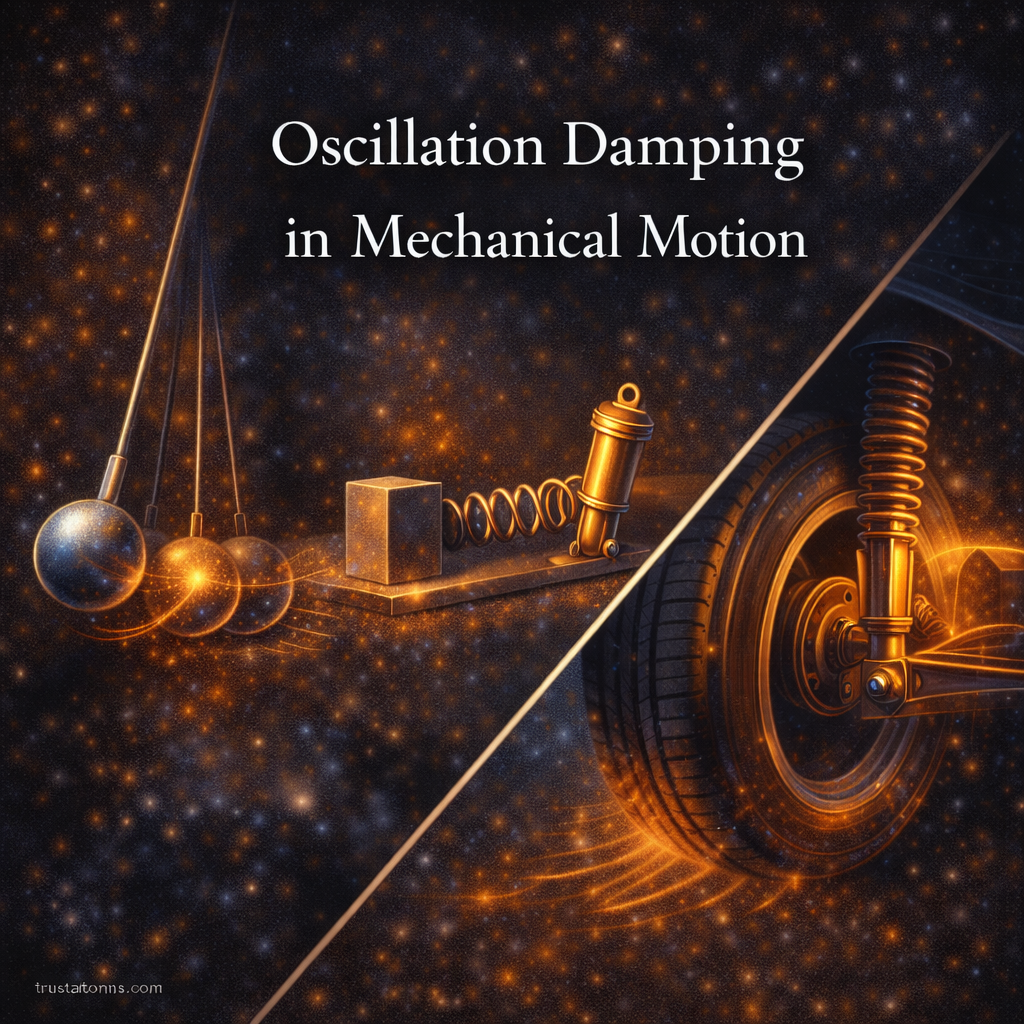
Oscillation damping in mechanical motion explains why swinging pendulums eventually stop, why car suspensions settle after a bump, and why vibrations in buildings fade over time.
In an ideal world, oscillations would continue forever. But in reality, energy is gradually lost due to friction, air resistance, and internal material forces. This loss of energy reduces the amplitude of motion — a process known as damping.
In this article, we’ll explore what oscillation damping is, the different types of damping, and how it affects real-world mechanical systems.
What Is Oscillation?
Oscillation is repetitive back-and-forth motion around an equilibrium position.
Common examples include:
- A swinging pendulum
- A vibrating guitar string
- A mass attached to a spring
- A car bouncing after hitting a bump
In ideal systems with no energy loss, oscillations continue indefinitely. However, most real systems experience damping.
What Is Damping?
Damping is the gradual reduction in the amplitude of oscillation due to energy loss.
Energy is typically lost through:
- Friction
- Air resistance
- Internal material deformation
- Fluid resistance
As energy leaves the system, motion becomes smaller until the system eventually comes to rest.
Why Damping Occurs
Mechanical oscillations involve kinetic and potential energy exchanging back and forth.
With damping present:
- Some energy converts to heat.
- Some energy transfers to surrounding air or materials.
- The total mechanical energy decreases over time.
Because energy is not conserved within the oscillating system alone, the motion weakens.
Types of Damping in Mechanical Systems
There are three primary categories of damping.
1. Underdamped Motion
In an underdamped system:
- Oscillations continue.
- Amplitude gradually decreases.
- Motion fades over time.
This is common in:
- Guitar strings
- Suspension systems
- Mechanical vibrations
The system still oscillates, but each cycle becomes smaller.
2. Critically Damped Motion
A critically damped system:
- Returns to equilibrium as quickly as possible.
- Does not oscillate.
This is ideal for systems like:
- Door closers
- Shock absorbers
- Measurement instruments
The system settles quickly without overshooting.
3. Overdamped Motion
In an overdamped system:
- The system returns to equilibrium slowly.
- No oscillation occurs.
- Motion is sluggish.
Too much damping reduces responsiveness.
The Role of Damping Force
In many mechanical systems, damping force is proportional to velocity.
This means:
- Faster motion → stronger opposing force
- Slower motion → weaker opposing force
This type of damping is called viscous damping.
Examples include:
- Motion in fluids
- Hydraulic shock absorbers
- Air drag at moderate speeds
Real-World Examples of Oscillation Damping

Car Suspension Systems
Shock absorbers in vehicles are designed to:
- Prevent continuous bouncing.
- Quickly stabilize motion after disturbances.
Without damping, driving would be unsafe and uncomfortable.
Musical Instruments
When a guitar string is plucked:
- It vibrates.
- Air resistance and internal friction reduce amplitude.
- Sound fades gradually.
Controlled damping shapes tone and sound quality.
Structural Engineering
Buildings and bridges experience oscillations due to:
- Wind
- Earthquakes
- Traffic
Engineers use damping systems to:
- Reduce vibration amplitude
- Prevent structural damage
- Improve safety
Some skyscrapers use large tuned mass dampers to control sway.
Energy Perspective on Damping
From an energy viewpoint:
- Total mechanical energy decreases over time.
- Energy transforms into heat or sound.
- Amplitude is directly related to system energy.
The faster energy dissipates, the stronger the damping effect.
Mathematical Insight (Conceptual)
In damped oscillation:
- The restoring force pulls the system toward equilibrium.
- The damping force opposes motion.
- The combined effect determines system behavior.
Key parameters include:
- Mass
- Stiffness
- Damping coefficient
Changing these values alters how quickly oscillations fade.
Resonance and Damping
Resonance occurs when an external force matches a system’s natural frequency.
Damping plays a crucial role in resonance:
- Low damping → large amplitude at resonance.
- High damping → reduced resonance peaks.
Engineers design damping carefully to avoid dangerous resonance effects.
Damping in Different Environments
Air vs Vacuum
In air:
- Air resistance causes damping.
- Oscillations fade faster.
In vacuum:
- Air resistance is eliminated.
- Oscillations last longer.
This difference is observed in precision laboratory experiments.
Fluid Damping
In fluids like oil:
- Motion slows rapidly.
- Energy dissipates quickly.
Hydraulic systems use fluid damping for controlled motion.
Why Damping Is Essential
While oscillations can be useful, uncontrolled oscillations can be dangerous.
Damping helps:
- Improve stability
- Protect mechanical systems
- Reduce noise
- Increase safety
From household appliances to spacecraft, damping is engineered into nearly every mechanical system.
Common Misconceptions
“Oscillations Always Stop Because of Gravity”
Gravity alone does not stop oscillations.
Energy loss due to damping forces causes motion to fade.
“More Damping Is Always Better”
Too much damping:
- Slows system response.
- Reduces efficiency.
- Decreases performance in some designs.
Optimal damping depends on the application.
Final Thoughts
Oscillation damping in mechanical motion explains how energy loss gradually reduces vibration and repetitive motion.
It determines whether systems:
- Continue oscillating
- Settle quickly
- Return slowly to equilibrium
From car suspensions and musical instruments to skyscrapers and spacecraft, damping plays a crucial role in mechanical design.
Understanding damping allows engineers and physicists to predict motion, control stability, and ensure safety in dynamic systems.