Aquatic organisms live in environments where water and dissolved salts constantly move across their body surfaces. Because of this, maintaining a stable internal balance of water and ions is a major biological challenge. Osmoregulation is the process that allows organisms to control this balance and maintain proper cellular function.
In aquatic environments such as oceans, lakes, and rivers, the concentration of salts outside the organism can vary significantly. Without effective regulatory systems, cells could swell with excess water or shrink due to dehydration. Osmoregulation helps prevent these problems by carefully managing water movement and ion concentrations inside the body.
This process is essential for survival in both freshwater and marine ecosystems.
What Is Osmoregulation?
Osmoregulation refers to the biological processes that control the balance of water and dissolved solutes—such as salts—within an organism’s body.
These regulatory systems help maintain stable internal conditions even when the external environment changes.
Osmoregulation allows organisms to:
- Maintain proper cell volume
- Regulate ion concentrations
- Prevent dehydration or excess water intake
- Support normal metabolic processes
The process works closely with diffusion and osmosis, which naturally move water and ions across membranes.
Why Osmoregulation Is Important in Aquatic Environments
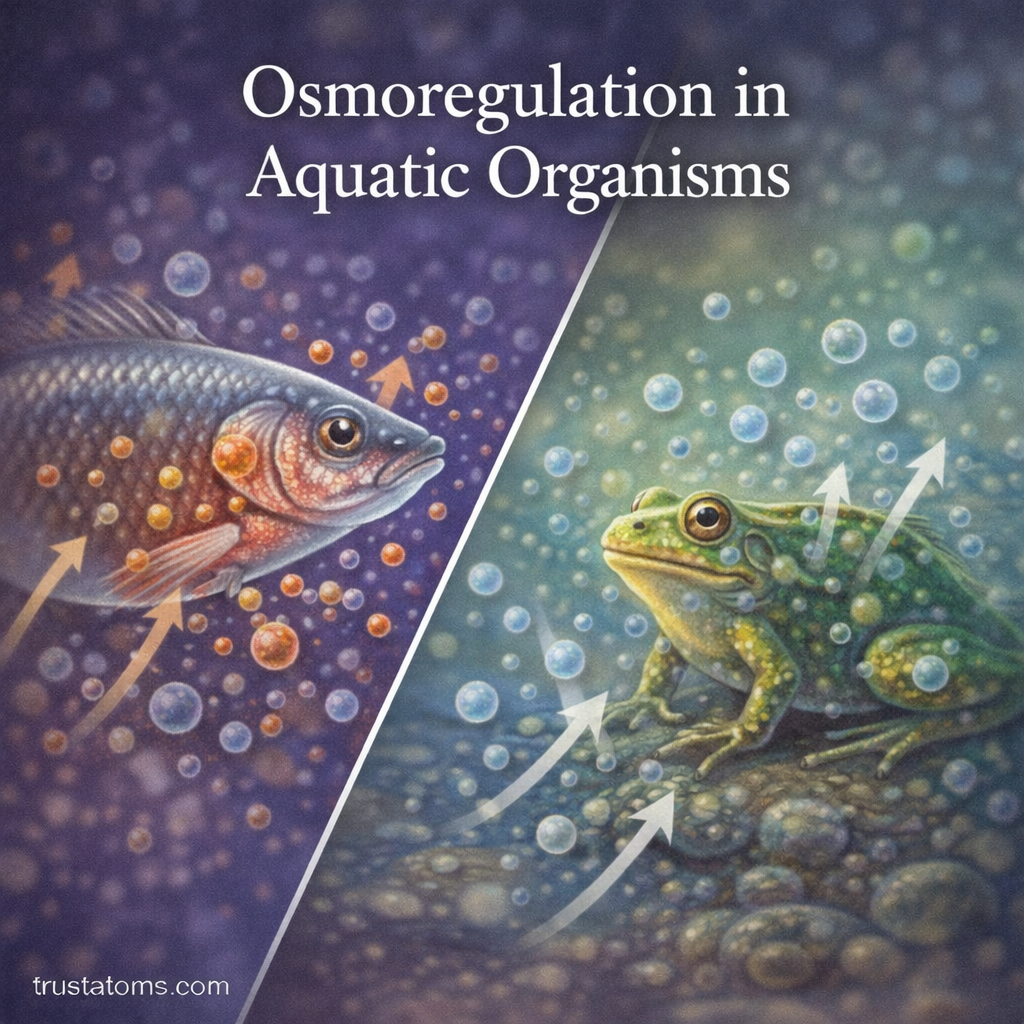
Water moves across biological membranes through osmosis. When aquatic organisms live in environments where the salt concentration differs from their internal fluids, water will naturally move in or out of their bodies.
Without regulation, this movement could disrupt cellular function.
Osmoregulation helps organisms:
- Prevent cells from swelling or shrinking
- Maintain electrolyte balance
- Preserve enzyme function
- Support nerve and muscle activity
Maintaining this balance is especially important for animals that live entirely in water.
Freshwater Environments and Osmotic Challenges
Freshwater environments, such as rivers and lakes, contain relatively low concentrations of dissolved salts.
Because the internal fluids of most aquatic animals contain more salts than freshwater, these organisms are considered hyperosmotic relative to their surroundings.
This creates two major challenges:
- Water continuously enters the organism through osmosis.
- Essential salts tend to diffuse out into the surrounding water.
Freshwater organisms must therefore manage excess water intake while conserving important ions.
Adaptations in Freshwater Organisms
To maintain balance, freshwater animals often use several strategies:
- Producing large amounts of dilute urine
- Actively absorbing salts through specialized cells
- Reducing permeability of body surfaces to water
Fish, for example, absorb ions through cells in their gills to replace salts lost to the environment.
Marine Environments and Osmotic Challenges
Marine environments, such as oceans, contain high concentrations of dissolved salts. In this case, the surrounding water has a higher salt concentration than the internal fluids of many aquatic animals.
These organisms are considered hypoosmotic relative to seawater.
In marine environments:
- Water tends to leave the organism through osmosis.
- Salt tends to enter the body through diffusion.
Without regulation, marine organisms could become dehydrated while accumulating excessive salt.
Adaptations in Marine Organisms
Marine animals use specialized mechanisms to regulate water and salt levels.
Common strategies include:
- Drinking seawater to replace lost fluids
- Excreting excess salt through gills or specialized glands
- Producing concentrated urine to conserve water
Many marine fish remove excess salts using chloride cells in their gills.
Osmoregulation in Marine Invertebrates
Not all marine organisms actively regulate their internal environment.
Many marine invertebrates are osmoconformers, meaning their internal fluid concentrations closely match the surrounding seawater.
Instead of regulating salt levels, these organisms allow their internal environment to remain similar to the external environment.
Examples of osmoconformers include:
- Many marine worms
- Certain mollusks
- Some echinoderms
Although osmoconformers do not tightly control salt levels, they still regulate essential cellular processes to maintain biological stability.
Osmoregulation in Fish
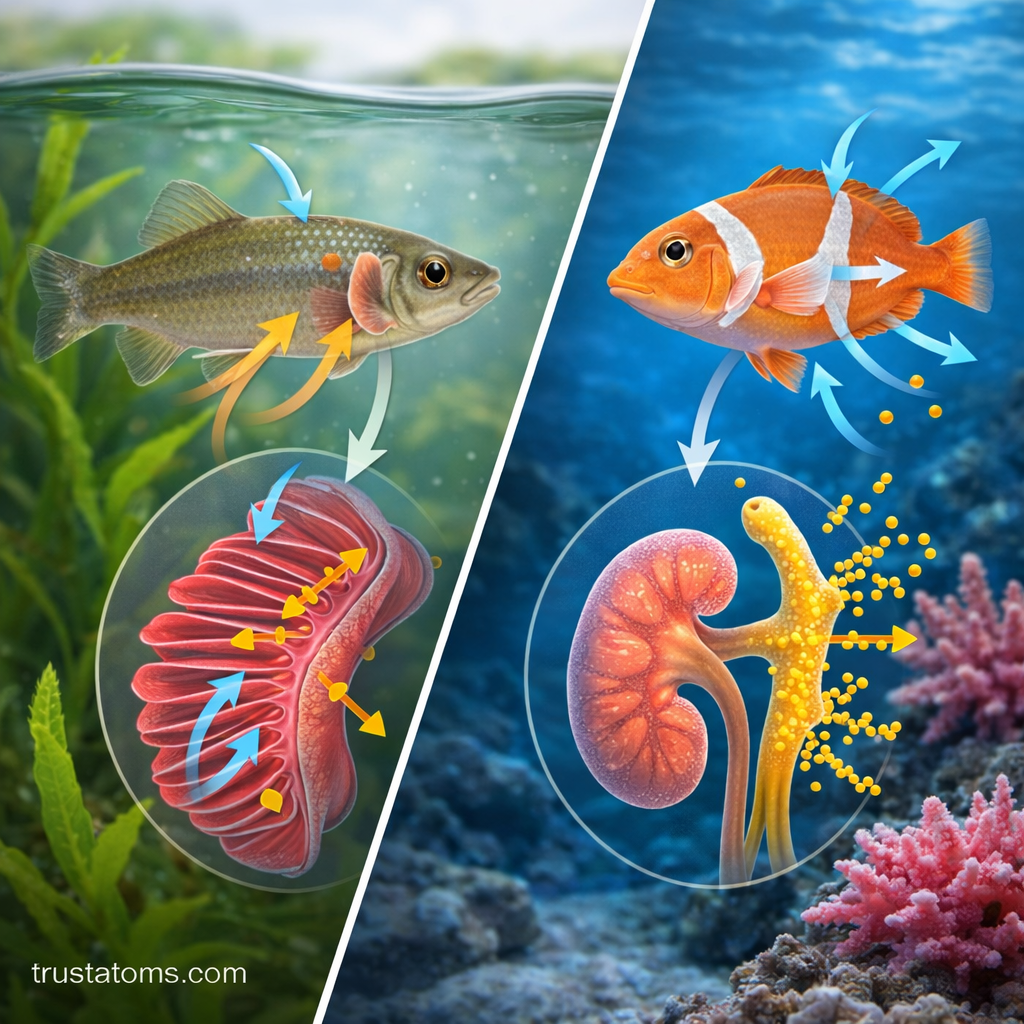
Fish demonstrate some of the most well-studied examples of osmoregulation.
Freshwater Fish
Freshwater fish constantly gain water through osmosis. To prevent swelling, they:
- Produce large volumes of dilute urine
- Absorb salts through specialized gill cells
- Limit salt loss through protective body surfaces
Marine Fish
Marine fish experience water loss through osmosis. To compensate, they:
- Drink seawater regularly
- Excrete excess salts through gill cells
- Produce smaller amounts of concentrated urine
These adaptations allow fish to survive in environments with very different salt concentrations.
Osmoregulation in Aquatic Amphibians
Some amphibians spend part of their lives in aquatic environments. Their skin is highly permeable, allowing water and ions to pass through easily.
Because of this permeability, amphibians must regulate osmotic balance carefully.
Adaptations may include:
- Specialized kidney function
- Behavioral adjustments to control water exposure
- Physiological changes during different life stages
These strategies help amphibians maintain stable internal conditions despite changing environments.
Organs and Structures Involved in Osmoregulation
Aquatic organisms rely on several organs and specialized structures to regulate water and salt balance.
Common structures include:
- Gills – regulate ion exchange in many aquatic animals
- Kidneys – control urine concentration and fluid balance
- Salt glands – remove excess salt in some marine animals
- Cell membranes – regulate water movement through osmosis
Together, these systems form a coordinated network that maintains internal stability.
Osmoregulation and Homeostasis
Osmoregulation is an important component of homeostasis, which refers to the ability of organisms to maintain stable internal conditions.
Stable internal environments allow biological systems to function efficiently.
Osmoregulation helps maintain:
- Proper cell hydration
- Balanced ion concentrations
- Stable pH levels
- Efficient metabolic activity
These conditions support essential physiological processes throughout the organism.
Why Osmoregulation Matters in Biology
Osmoregulation is essential for survival in aquatic ecosystems. Because water and dissolved salts move naturally across membranes, organisms must constantly regulate these movements to prevent harmful imbalances.
Studying osmoregulation helps scientists understand:
- How organisms adapt to different environments
- How cells maintain internal stability
- How physiological systems respond to environmental stress
These insights contribute to a broader understanding of biology, ecology, and evolutionary adaptation.
Final Thoughts
Osmoregulation allows aquatic organisms to survive in environments where water and salt concentrations constantly influence their internal balance. By regulating the movement of water and ions, organisms maintain stable cellular conditions that support life.
Freshwater and marine organisms face different osmotic challenges, but both have evolved specialized systems to maintain equilibrium. Through structures such as gills, kidneys, and specialized cells, aquatic animals carefully control their internal environment.
This ability to regulate water and salt balance highlights the remarkable adaptability of living organisms in diverse aquatic habitats.