Quantum mechanics can feel abstract — wavefunctions, operators, Hilbert spaces. But there’s another powerful way to understand how particles move and interact: path integrals.
Instead of asking “What is the particle’s wavefunction doing?”, the path integral approach asks a different question:
What if a particle explores every possible path between two points?
In this guide, we’ll break down path integrals in plain language, explain why they matter in modern physics, and show how they connect quantum mechanics, relativity, and quantum field theory.
What Is a Path Integral?
In classical physics, a particle travels along a single, well-defined path.
In quantum mechanics, things work differently.
According to the path integral formulation developed by Richard Feynman:
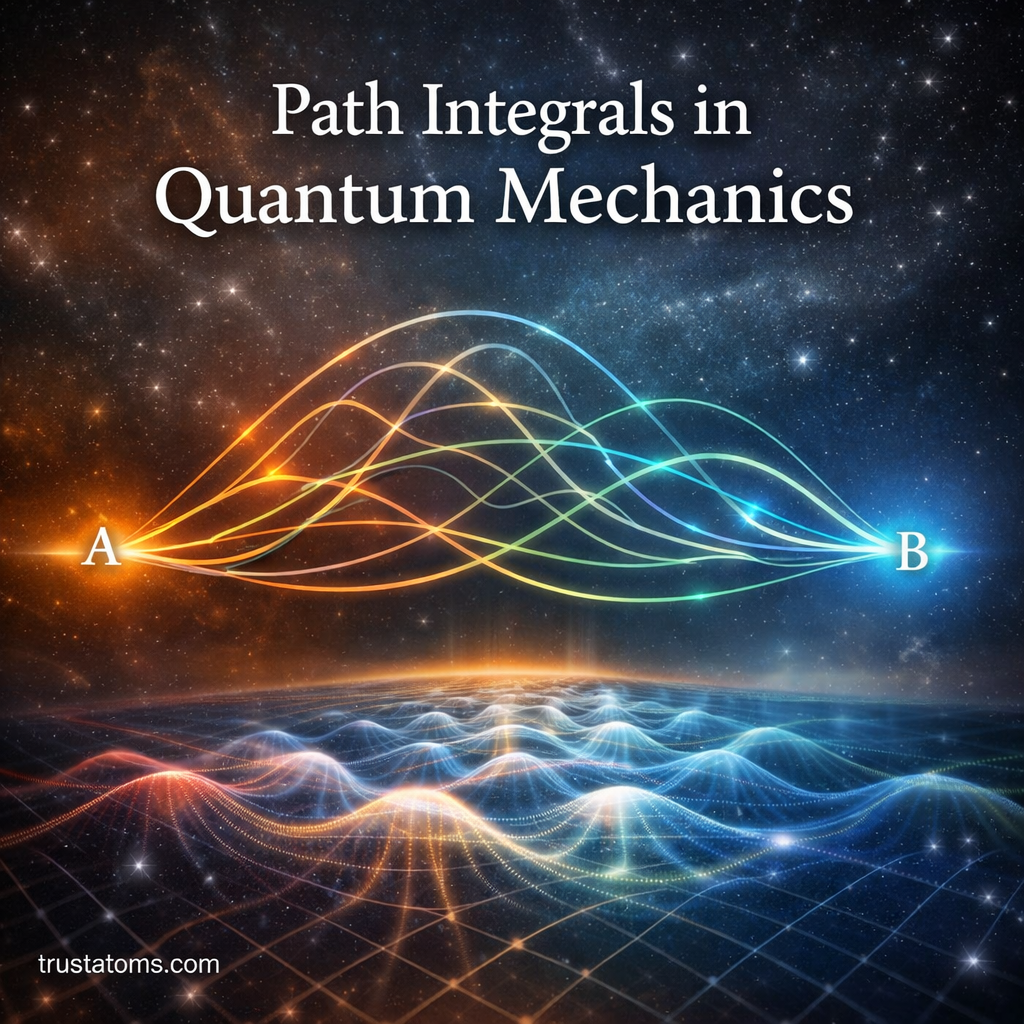
A particle traveling from point A to point B does not take one path — it takes all possible paths.
Each path contributes to the particle’s overall behavior.
Mathematically, we “sum over” every possible trajectory the particle could take. That sum — over infinitely many paths — determines the probability amplitude of the particle going from one point to another.
This idea is called the sum-over-histories formulation of quantum mechanics.
Who Developed the Path Integral Approach?
The path integral formulation was introduced by physicist Richard Feynman in the 1940s.
Feynman showed that quantum mechanics could be reformulated in a way that:
- Matches standard wave mechanics
- Is deeply connected to classical mechanics
- Provides a natural bridge to quantum field theory
His approach later became foundational in particle physics and quantum electrodynamics.
The Core Idea: Every Path Contributes
Imagine throwing a ball in classical mechanics. It follows a single trajectory determined by Newton’s laws.
In quantum mechanics:
- The particle explores all conceivable paths.
- Some paths are straight.
- Some are wildly curved.
- Some loop around.
- Some zigzag infinitely.
Each path contributes a complex number (a probability amplitude).
These amplitudes:
- Add together (interfere)
- Sometimes reinforce each other
- Sometimes cancel out
The final observable probability depends on this interference.
This interference between possible paths is what produces quantum behavior.
The Mathematical Structure (Conceptual Overview)
The central object in the path integral formulation is the action.
In classical mechanics, the action is defined as:
Action = Integral of (Lagrangian) over time
Where:
- The Lagrangian = kinetic energy − potential energy
In classical physics, the true path of a system is the one that minimizes (or makes stationary) the action.
This is called the principle of least action.
In the quantum version:
- We assign each path a phase factor: exp(i × Action / ħ)
- Then we sum over all possible paths.
Paths with very different actions tend to cancel each other out due to destructive interference.
Paths near the classical path reinforce each other.
This explains something remarkable:
Classical mechanics emerges naturally from quantum mechanics.
Why Path Integrals Are So Powerful
The path integral formulation is not just philosophical — it is extremely practical.
Here’s why physicists love it:
1. It Connects Quantum and Classical Physics
As Planck’s constant (ħ) becomes very small:
- Only the classical path survives.
- Quantum fluctuations become negligible.
This provides a clear bridge between quantum and classical worlds.
2. It Works Beautifully in Quantum Field Theory
Path integrals are the foundation of:
- Quantum electrodynamics (QED)
- The Standard Model
- Modern particle physics
In quantum field theory, instead of summing over particle paths, we sum over field configurations.
This generalization is essential in high-energy physics.
3. It Handles Systems With Many Degrees of Freedom
For complicated systems:
- Many particles
- Interacting fields
- Statistical systems
Path integrals often simplify calculations compared to wavefunction methods.
A Simple Intuitive Analogy
Think of quantum motion like ripples in a pond.
When multiple waves overlap:
- Some regions become larger (constructive interference).
- Some flatten out (destructive interference).
In path integrals:
- Each path produces a “wave.”
- All paths interfere.
- The final probability is the combined wave pattern.
The particle’s behavior emerges from this interference.
How Path Integrals Differ from Schrödinger’s Equation

Standard quantum mechanics uses:
- The Schrödinger equation
- Wavefunctions evolving in time
Path integrals instead focus on:
- Probability amplitudes between events
- Histories rather than instantaneous states
Both approaches are mathematically equivalent — but they offer different perspectives.
Schrödinger’s approach is often more intuitive for simple systems.
Path integrals are often more powerful for advanced physics.
Where Path Integrals Are Used Today
Path integrals are central in:
- Particle physics
- Quantum field theory
- Statistical mechanics
- Condensed matter physics
- Quantum gravity research
- Cosmology
They are also essential in string theory and modern approaches to black hole physics.
Without path integrals, much of modern theoretical physics would not exist in its current form.
Common Misconceptions
“Does the particle literally travel every path?”
Not in a classical sense.
The paths are mathematical contributions to a probability amplitude — not classical trajectories.
“Is this just philosophical?”
No. Path integrals produce experimentally verified predictions. They are one of the most accurate tools in theoretical physics.
“Is this interpretation different from standard quantum mechanics?”
It’s not a different theory — it’s a different formulation of the same underlying physics.
Why Path Integrals Matter Conceptually
Path integrals change how we think about motion:
- Reality is not a single trajectory.
- Possibilities interfere.
- Classical behavior emerges from quantum interference.
They reveal that determinism at large scales is the result of quantum probabilities canceling and reinforcing in precise ways.
In this sense, path integrals provide one of the deepest conceptual bridges in all of physics.
Final Thoughts
Path integrals in quantum mechanics offer:
- A powerful computational tool
- A bridge between classical and quantum physics
- The foundation of quantum field theory
- A radically different way to think about motion
Instead of asking which path nature chooses, path integrals tell us:
Nature explores every possibility — and the universe we observe emerges from their interference.
For anyone studying advanced physics, understanding path integrals isn’t just helpful — it’s essential.