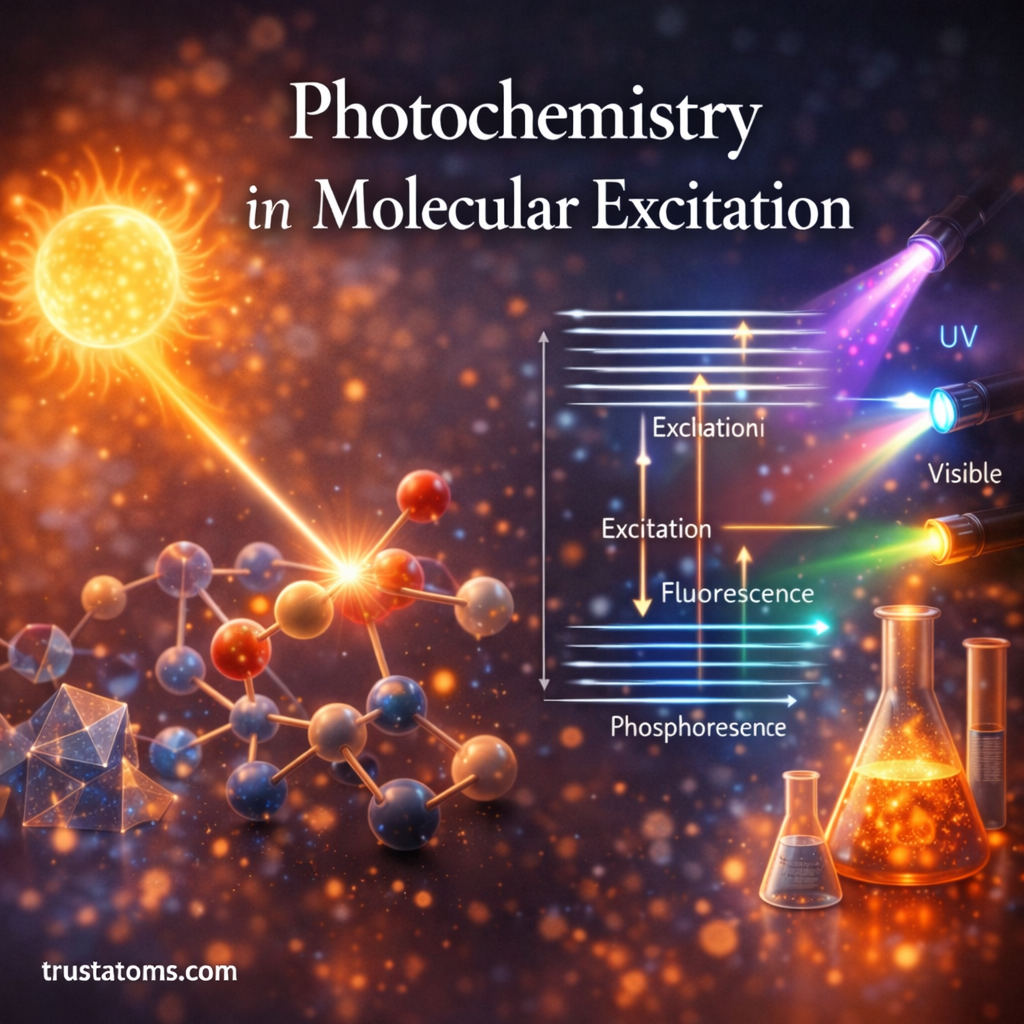
Photochemistry is the study of chemical reactions and molecular changes triggered by light. When molecules absorb light energy, their electrons can become excited and move to higher energy levels. This process, known as molecular excitation, often leads to chemical reactions, energy transfer, or structural changes within the molecule.
Photochemistry plays a major role in natural processes such as photosynthesis and atmospheric chemistry, as well as modern technologies including solar cells, photodynamic therapy, and light-activated materials. Understanding how light interacts with molecules allows chemists to control and predict these reactions.
What Is Molecular Excitation?
Molecular excitation occurs when a molecule absorbs energy and one of its electrons transitions from a lower energy state to a higher energy state.
In photochemistry, this energy usually comes from ultraviolet (UV), visible, or near-infrared light.
The process involves three main steps:
- A photon of light strikes a molecule.
- The molecule absorbs the photon’s energy.
- An electron jumps to a higher electronic energy level.
This excited state is often unstable, meaning the molecule will quickly release energy or undergo a chemical reaction.
The Role of Photons in Chemical Reactions
Light consists of particles called photons, each carrying a specific amount of energy. The energy of a photon depends on its wavelength.
Different wavelengths interact with molecules in different ways:
- Ultraviolet light carries high energy and can trigger strong chemical reactions.
- Visible light excites many organic molecules and pigments.
- Infrared light typically causes vibrational excitation rather than electronic transitions.
For a molecule to absorb light, the photon’s energy must match the difference between two electronic energy levels. If the energy does not match, the photon will pass through or reflect off the molecule instead of being absorbed.
Electronic Energy Levels in Molecules
Electrons in molecules occupy specific energy levels. When light energy is absorbed, electrons transition between these levels.
Common electronic states include:
- Ground state (S₀) – the molecule’s lowest energy configuration
- Excited singlet states (S₁, S₂, etc.) – higher energy states with paired electron spins
- Triplet states (T₁, T₂) – excited states with unpaired spins
These states play a crucial role in determining how molecules behave after absorbing light.
For example:
- Singlet states often lead to fluorescence
- Triplet states may produce phosphorescence or chemical reactions
The Jablonski Diagram
A Jablonski diagram is a common tool used to illustrate the energy transitions involved in photochemistry.
It visually represents:
- Electronic energy levels
- Light absorption processes
- Energy relaxation pathways
- Emission of light
Key transitions shown in these diagrams include:
Absorption
A molecule absorbs a photon and moves from the ground state to an excited electronic state.
Vibrational Relaxation
After excitation, molecules often lose some energy through vibrational motion before reaching a stable excited state.
Internal Conversion
Energy may transfer between excited electronic states without emitting light.
Intersystem Crossing
An excited molecule can change from a singlet state to a triplet state through spin conversion.
Fluorescence and Phosphorescence
Two important photochemical processes occur when excited molecules release energy as light.
Fluorescence
Fluorescence occurs when an excited molecule returns to the ground state and emits a photon.
Characteristics of fluorescence include:
- Very fast emission (nanoseconds)
- Emitted light has lower energy than the absorbed light
- Common in fluorescent dyes and biological imaging
Phosphorescence
Phosphorescence occurs when a molecule emits light from a triplet state.
Characteristics include:
- Slower emission (milliseconds to minutes)
- Occurs after intersystem crossing
- Responsible for glow-in-the-dark materials
Both processes provide valuable information in analytical chemistry and spectroscopy.
Photochemical Reactions
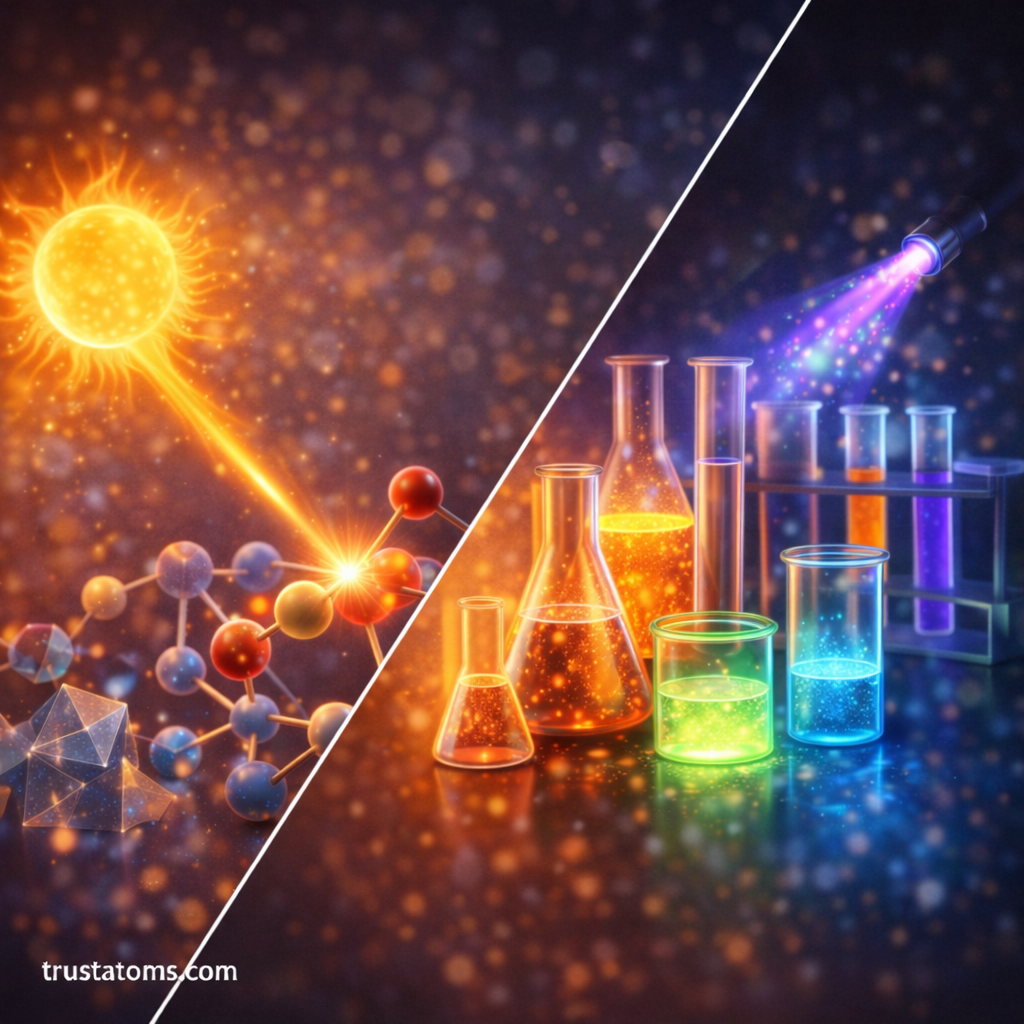
Excited molecules often behave differently from molecules in their ground state. The added energy can break chemical bonds, rearrange molecular structures, or form new compounds.
Common photochemical reactions include:
- Photodissociation – breaking chemical bonds with light
- Photoisomerization – rearranging atoms within a molecule
- Energy transfer reactions – transferring energy between molecules
- Electron transfer reactions – moving electrons between chemical species
Because excited molecules are highly reactive, photochemistry often enables reactions that would not occur under normal conditions.
Applications of Photochemistry
Photochemistry has numerous applications across science, medicine, and technology.
Photosynthesis
Plants use sunlight to convert carbon dioxide and water into glucose and oxygen. This process is driven by photochemical excitation of pigments such as chlorophyll.
Solar Energy
Solar cells convert light into electrical energy through photoexcited electrons in semiconductor materials.
Atmospheric Chemistry
Photochemical reactions play a major role in atmospheric processes, including:
- Formation of ozone in the upper atmosphere
- Breakdown of pollutants
- Photochemical smog formation
Photodynamic Therapy
In medicine, light-activated drugs can destroy cancer cells or harmful microorganisms.
Fluorescent Imaging
Fluorescent molecules allow scientists to observe biological processes inside cells and tissues.
Factors That Influence Photochemical Reactions
Several factors determine how molecules behave after absorbing light.
Important variables include:
- Light wavelength and intensity
- Molecular structure
- Presence of other molecules or solvents
- Temperature and environmental conditions
These factors affect how efficiently molecules absorb light and what pathways the excited molecules follow afterward.
Quantum Yield in Photochemistry
Quantum yield measures the efficiency of a photochemical reaction.
It is defined as the ratio between:
- The number of molecules that react
- The number of photons absorbed
Quantum yield helps chemists determine how effectively light drives a particular reaction.
Examples include:
- High quantum yield in fluorescence imaging dyes
- Lower quantum yield in inefficient photochemical processes
Understanding this efficiency is important when designing photochemical systems.
Photochemistry in Modern Research
Photochemistry continues to be an important research field in chemistry and materials science.
Current areas of development include:
- Light-driven catalytic reactions
- Artificial photosynthesis
- Photochemical energy storage
- Light-activated molecular switches
- Advanced photochemical materials
These innovations may help improve renewable energy technologies and create new chemical processes.
Conclusion
Photochemistry in molecular excitation explains how light energy interacts with molecules to produce chemical and physical changes. When photons are absorbed, electrons transition to higher energy states, creating excited molecules capable of emitting light or undergoing chemical reactions.
Processes such as fluorescence, phosphorescence, and photochemical transformations demonstrate how light can control molecular behavior. From photosynthesis to solar energy and medical imaging, photochemistry plays a vital role in both natural systems and modern technology.
As research advances, photochemical techniques will continue to expand the possibilities for energy production, medicine, and materials science.