The photoelectric effect is one of the most important experiments in modern physics. It demonstrated that light does not behave purely as a wave — it also behaves like a particle.
This discovery reshaped our understanding of energy, laid the foundation for quantum theory, and helped launch the modern age of electronics and solar power.
In this article, we’ll explore what the photoelectric effect is, why it challenged classical physics, and how it fits into quantum theory.
What Is the Photoelectric Effect?
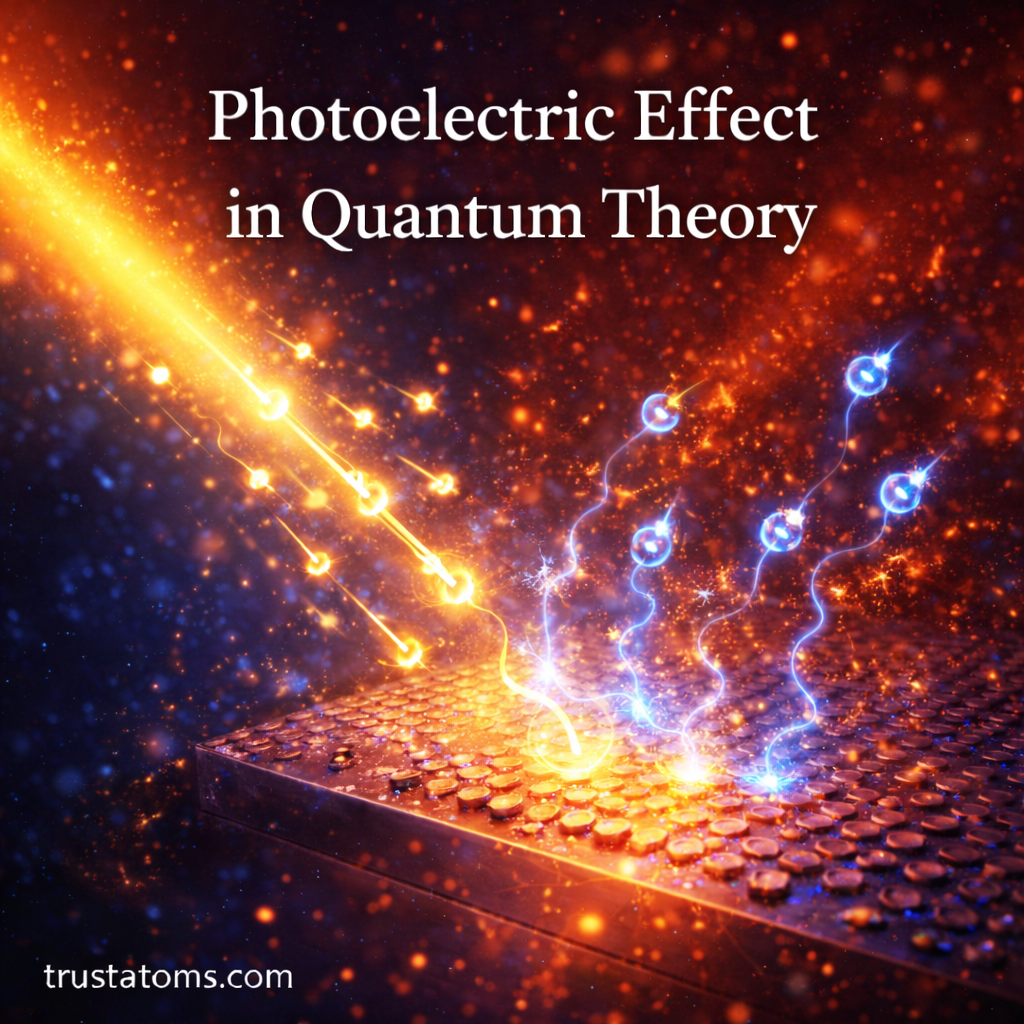
The photoelectric effect occurs when light shines on a metal surface and causes electrons to be emitted.
In simple terms:
- Light hits a metal.
- Electrons are ejected.
- An electric current can be produced.
However, the details of how this happens reveal something profound about the nature of light.
Classical Physics Predictions
Before quantum theory, scientists believed light behaved strictly as a wave.
According to classical wave theory:
- Increasing light intensity should increase electron energy.
- Low-frequency light should eventually eject electrons if intense enough.
- Energy transfer should occur gradually.
But experiments showed something very different.
Experimental Observations
When scientists tested the photoelectric effect, they observed:
- Electrons are emitted instantly when light hits the surface.
- Increasing light intensity increases the number of electrons emitted — not their energy.
- Below a certain frequency, no electrons are emitted — no matter how intense the light is.
This behavior could not be explained by classical wave theory.
Einstein’s Quantum Explanation
In 1905, Albert Einstein proposed a radical solution.
He suggested that light is made of discrete packets of energy called photons.
Key ideas:
- Each photon carries a fixed amount of energy.
- Photon energy depends on frequency.
- One photon transfers energy to one electron.
If a photon’s energy is high enough, it ejects an electron.
If it is not high enough, no electron is emitted — regardless of intensity.
This explained why frequency, not brightness, determines whether electrons are released.
Einstein’s work on the photoelectric effect later earned him the Nobel Prize.
Threshold Frequency
Every metal has a minimum frequency of light required to eject electrons. This is called the threshold frequency.
- Below this frequency, no electrons are emitted.
- Above this frequency, electrons are emitted.
- Higher frequency means higher electron kinetic energy.
The threshold frequency depends on the metal’s work function — the minimum energy needed to remove an electron.
Energy Transfer in the Photoelectric Effect
When a photon strikes an electron:
- The photon transfers its energy to the electron.
- Part of the energy overcomes the work function.
- The remaining energy becomes kinetic energy of the electron.
This shows that light energy is quantized — it comes in discrete units.
There is no gradual accumulation of energy, which contradicts classical expectations.
Why the Photoelectric Effect Supports Quantum Theory
The photoelectric effect provided direct evidence that:
- Light behaves as particles.
- Energy transfer occurs in discrete amounts.
- Frequency determines photon energy.
This helped establish the foundation of quantum mechanics, which describes how matter and energy behave at atomic scales.
Without this discovery, modern quantum physics would not exist.
Real-World Applications
The photoelectric effect is not just a theoretical concept. It has practical uses in everyday technology.
1. Solar Panels
Solar cells use the photoelectric principle to convert sunlight into electricity.
- Photons strike semiconductor materials.
- Electrons are excited and move through circuits.
- Electrical energy is produced.
2. Photodetectors
Light sensors in cameras and scientific instruments rely on photoelectric principles.
3. Vacuum Phototubes
Used in early light detection systems and scientific measurements.
The photoelectric effect forms the basis of modern photovoltaic energy systems.
Wave–Particle Duality
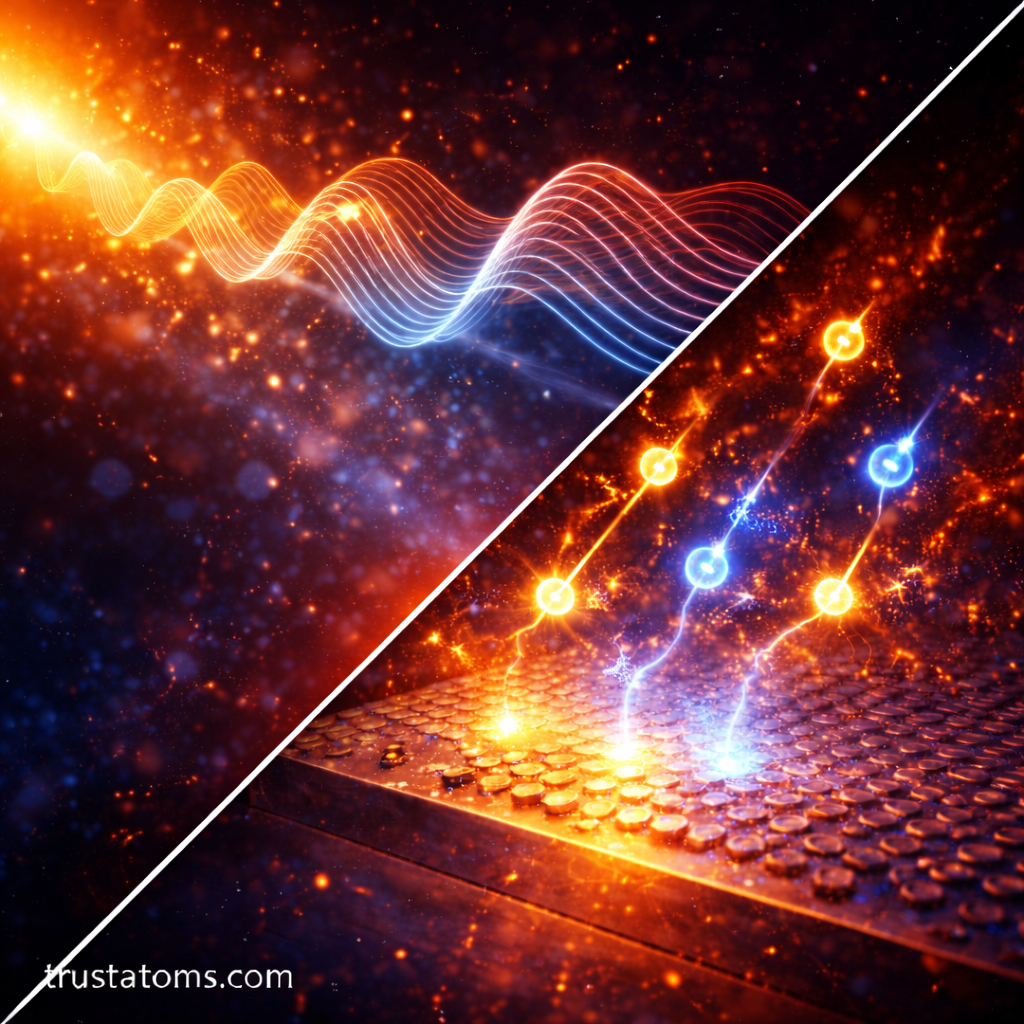
The photoelectric effect contributed to one of quantum theory’s most important ideas: wave–particle duality.
Light can behave as:
- A wave (interference and diffraction)
- A particle (photoelectric effect)
This dual nature also applies to electrons and other subatomic particles.
Quantum mechanics emerged to explain this strange but experimentally verified behavior.
Key Concepts Summary
To simplify, the photoelectric effect shows that:
- Light energy depends on frequency.
- Electrons are ejected only if photon energy exceeds a threshold.
- Increasing intensity increases the number of electrons emitted.
- Increasing frequency increases electron energy.
These principles contradicted classical physics and supported quantum theory.
Why the Photoelectric Effect Still Matters
The photoelectric effect remains essential in:
- Renewable energy research
- Semiconductor physics
- Quantum computing development
- Materials science
It represents one of the clearest examples of how quantum behavior differs from everyday classical intuition.
Even today, it serves as a foundational teaching tool in physics education.
Final Thoughts
The photoelectric effect marked a turning point in scientific history.
By showing that light behaves as particles, it challenged classical physics and helped give birth to quantum theory. It demonstrated that energy is quantized and that frequency determines photon energy.
From solar panels to modern electronics, the photoelectric effect continues to power innovation and deepen our understanding of the quantum world.
It remains one of the most elegant and influential discoveries in physics.