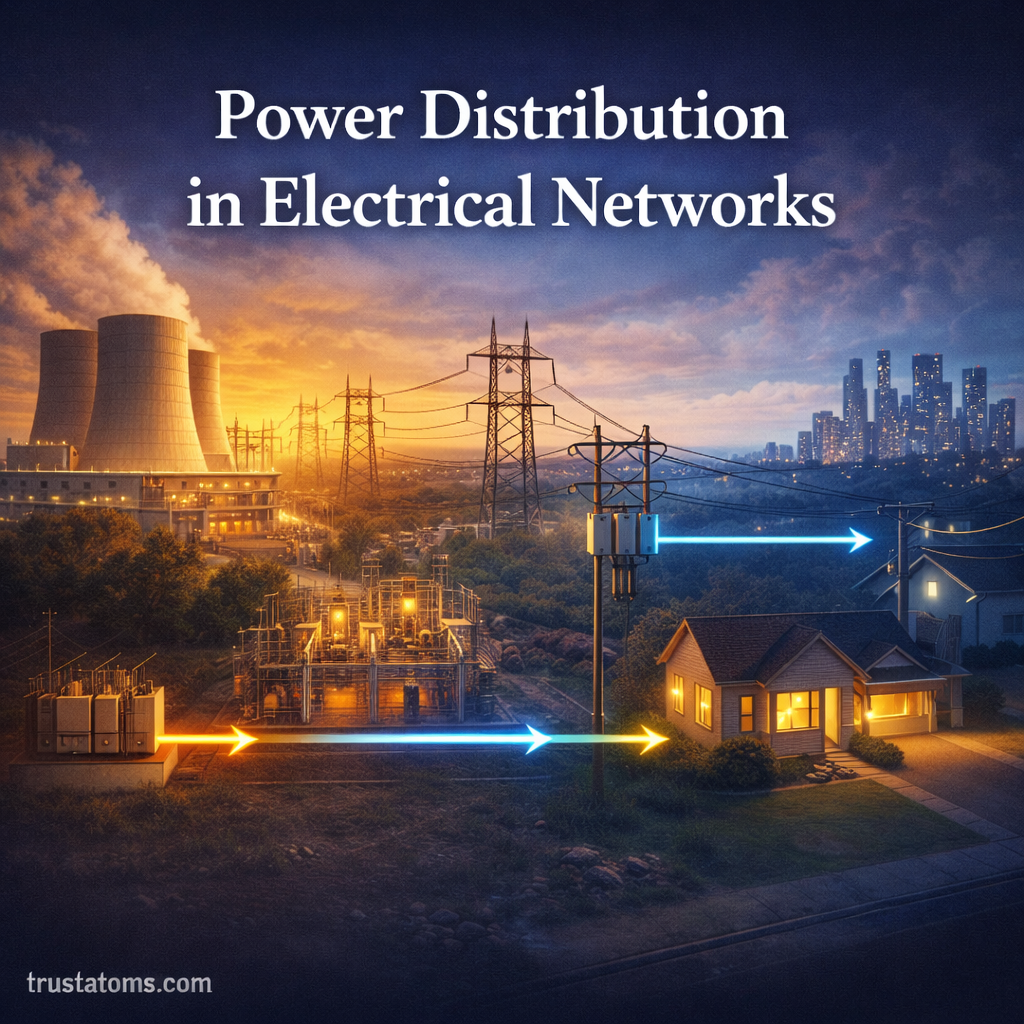
Electricity doesn’t just appear when you flip a switch. It travels through a carefully designed system called an electrical network. One of the most important parts of that system is power distribution.
Power distribution ensures that electricity generated at power plants is safely delivered to homes, businesses, schools, and industries at usable voltage levels. In this guide, we’ll explore how electrical networks distribute power, the physics principles involved, and why this system is essential for modern life.
What Is Power Distribution?
Power distribution is the final stage in the delivery of electricity from generation sources to consumers.
An electrical network typically has three main stages:
- Power generation
- Power transmission
- Power distribution
While transmission moves electricity over long distances at very high voltages, distribution reduces voltage to safe levels and delivers it locally.
The Structure of an Electrical Network
Electrical networks are organized in layers to maximize efficiency and safety.
1. Generation
Electricity is produced at power plants using:
- Fossil fuels
- Nuclear energy
- Hydroelectric power
- Wind and solar energy
Generators convert mechanical energy into electrical energy through electromagnetic induction.
2. Transmission
Electricity travels long distances through high-voltage transmission lines.
- Voltages can range from 110 kV to 765 kV
- High voltage reduces current
- Lower current reduces energy loss
Energy loss in wires occurs due to resistance and follows the formula:
Power loss ∝ current² × resistance
Reducing current significantly reduces heat loss.
3. Distribution
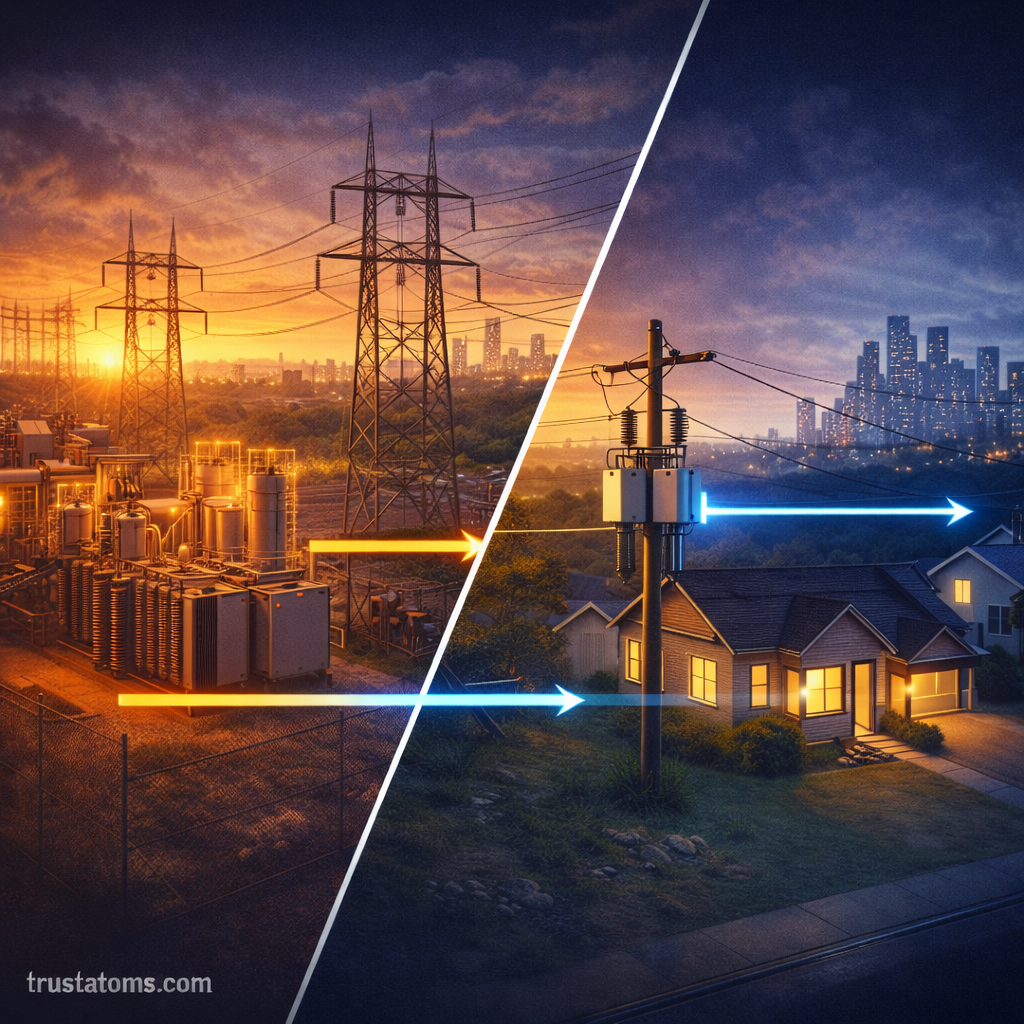
Distribution begins at substations, where voltage is stepped down for local delivery.
From there, electricity flows through:
- Distribution transformers
- Local power lines
- Service lines into buildings
This is the stage most directly connected to homes and businesses.
Why Voltage Is Stepped Down
Electricity is transmitted at high voltage to minimize power loss. However, high voltage is unsafe for residential and commercial use.
Transformers Make This Possible
Transformers use electromagnetic induction to change voltage levels.
There are two types used in networks:
- Step-up transformers (increase voltage for transmission)
- Step-down transformers (reduce voltage for distribution)
In residential areas in the United States, electricity is typically reduced to:
- 120 volts for standard outlets
- 240 volts for large appliances
Without voltage transformation, large-scale distribution would be inefficient and dangerous.
Types of Distribution Systems
Electrical distribution networks can be arranged in different configurations.
Radial System
- Simplest design
- Power flows in one direction
- Lower cost
- Used in rural areas
If a fault occurs, customers downstream lose power.
Ring (Loop) System
- Power can flow from multiple directions
- More reliable
- Used in urban areas
If one line fails, power can reroute.
Network System
- Multiple interconnected paths
- Very reliable
- Used in dense city centers
This configuration minimizes outages.
Single-Phase vs Three-Phase Distribution
Single-Phase Power
- Used primarily in homes
- Suitable for light loads
- Simpler wiring
Three-Phase Power
- Used in commercial and industrial settings
- Provides constant power flow
- More efficient for motors and heavy equipment
Three-phase systems reduce power fluctuations and improve efficiency.
Components of a Distribution Network
Several key components ensure safe and stable power delivery.
Substations
Substations:
- Reduce transmission voltage
- Regulate voltage levels
- Monitor and control power flow
Distribution Transformers
These are mounted on:
- Utility poles
- Ground-level enclosures
They reduce voltage to usable levels for neighborhoods.
Circuit Breakers and Protective Devices
These protect the network from:
- Overloads
- Short circuits
- Equipment failures
When a fault occurs, breakers interrupt current to prevent damage.
How Power Loss Occurs
Energy loss in distribution systems mainly happens due to resistance in conductors.
Causes of Power Loss
- Electrical resistance in wires
- Heat dissipation
- Reactive power in AC systems
Minimizing losses improves efficiency and reduces operational costs.
Utilities manage losses by:
- Using thicker conductors
- Maintaining optimal voltage levels
- Balancing load demand
Load Management in Electrical Networks
Power demand varies throughout the day.
Peak Demand
Occurs when many users consume electricity simultaneously, such as:
- Early evening residential use
- Extreme weather events
Off-Peak Demand
Lower usage periods, often late at night.
Utilities use load forecasting and smart grid technology to balance supply and demand efficiently.
Smart Grids and Modern Distribution
Traditional grids are evolving into smart grids.
Smart grid features include:
- Digital monitoring systems
- Automated fault detection
- Two-way communication
- Integration of renewable energy
Smart distribution networks improve reliability and energy efficiency.
Reliability and Redundancy
Modern electrical networks are designed for reliability.
Engineers build redundancy into systems by:
- Adding multiple supply routes
- Installing backup transformers
- Using automated switching systems
This reduces blackout risk and improves response time during faults.
The Importance of Power Distribution
Power distribution may be less visible than generation or transmission, but it is critical.
Without effective distribution:
- Electricity could not safely enter homes
- Appliances would not function properly
- Industries could not operate efficiently
- Modern cities would shut down
The physics of electromagnetic induction, resistance, voltage transformation, and AC power all work together to make distribution possible.
Final Thoughts
Power distribution in electrical networks is the bridge between large-scale energy production and everyday electricity use.
By stepping down voltage, managing loads, minimizing losses, and ensuring reliability, distribution systems deliver safe and consistent power to millions of users.
Understanding how electricity travels from power plants to your wall outlet reveals the complexity behind something we often take for granted. It’s one of the most important engineering and physics systems sustaining modern society.