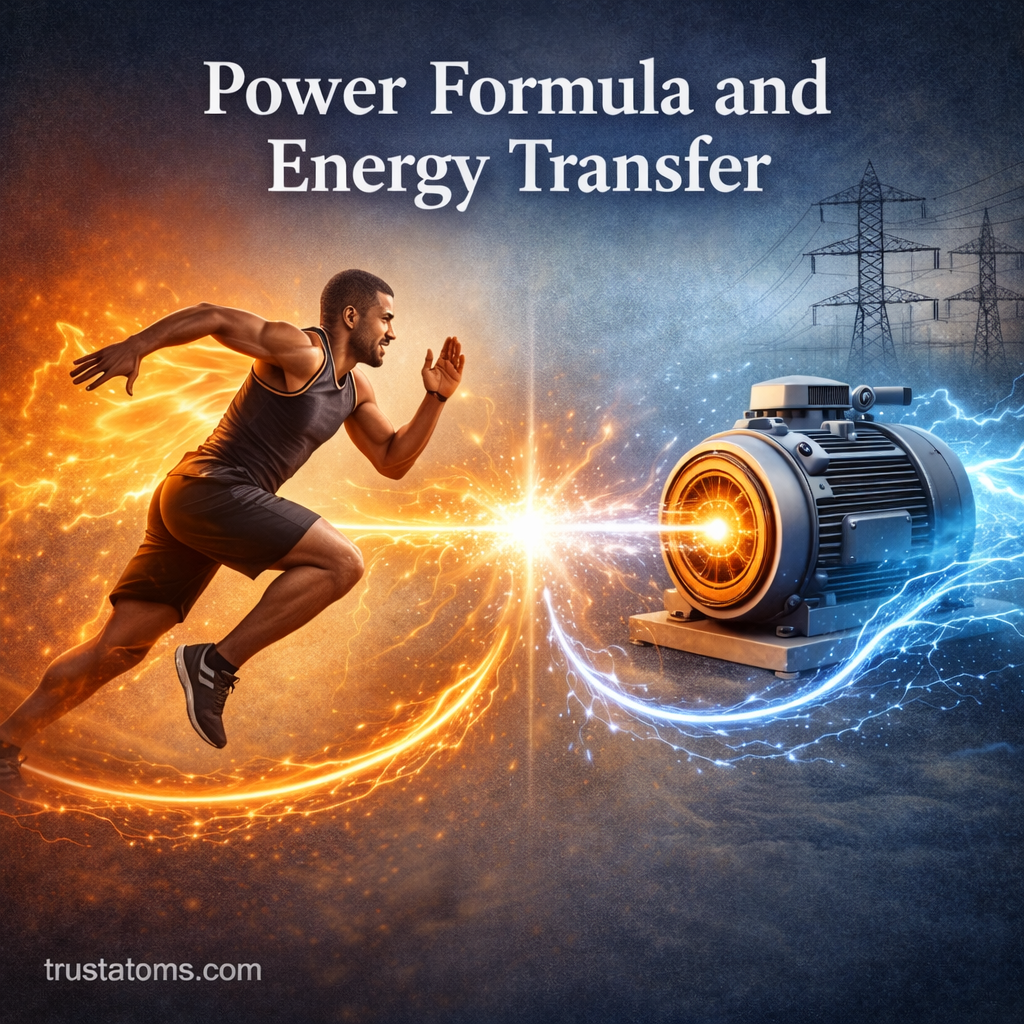
Power and energy are deeply connected in physics.
Whenever energy moves from one place to another — whether in a light bulb, a car engine, or your own muscles — power tells us how fast that transfer happens.
Understanding the power formula helps explain how machines work, why devices heat up, and how efficiently systems use energy.
What Is Power in Physics?
In physics, power is the rate at which energy is transferred or work is done.
In simple terms:
- Energy is the ability to do work.
- Work happens when force moves an object.
- Power tells us how quickly that work or energy transfer occurs.
If the same amount of energy is transferred in less time, the power is higher.
The Basic Power Formula
The most fundamental formula for power is:
P = E / t
Where:
- P = Power
- E = Energy transferred (or work done)
- t = Time
This formula shows that power depends on two things:
- How much energy is involved
- How long the transfer takes
What This Means Physically
- Large energy in short time → High power
- Small energy in long time → Low power
For example, a 100-watt device transfers 100 joules of energy every second.
Units of Power
The SI unit of power is the watt (W).
One watt equals:
1 joule per second
Other common units include:
- Kilowatt (kW) = 1,000 watts
- Megawatt (MW) = 1,000,000 watts
- Horsepower (hp) — often used for engines
Power ratings on appliances tell you how quickly they use energy.
How Power Relates to Energy Transfer
Energy transfer occurs whenever energy moves between systems.
This can happen through:
- Mechanical motion
- Electrical current
- Heat
- Light
- Sound
Power measures the rate of that transfer.
Example 1: Light Bulb
A 60-watt light bulb transfers 60 joules of electrical energy every second.
A 100-watt bulb transfers energy faster — which is why it shines brighter and consumes more electricity per second.
Example 2: Car Engine
Two engines may use the same total energy.
The engine that delivers that energy faster produces more power — resulting in quicker acceleration.
Electrical Power Formula
In electrical systems, power is calculated differently.
The electrical power formula is:
P = V × I
Where:
- V = Voltage
- I = Current
This equation explains how electrical energy is transferred in circuits.
For example:
If a device uses 12 volts and 5 amps:
Power = 12 × 5 = 60 watts
That means 60 joules of energy are transferred every second.
Mechanical Power Formula
Mechanical power can also be expressed as:
P = F × v
Where:
- F = Force
- v = Velocity
This formula applies when an object moves due to a force.
For example:
A motor pushing an object with a large force at high speed generates more power than one moving slowly.
Energy Transfer in Different Systems
Power helps compare different energy systems.
Mechanical Systems
- Engines
- Turbines
- Muscles
- Elevators
Power determines how fast work is done.
Electrical Systems
- Batteries
- Generators
- Household appliances
- Power grids
Power determines how quickly electrical energy is delivered.
Thermal Systems
- Heaters
- Boilers
- Stoves
Power determines how quickly temperature increases.
Power vs Energy: Why the Difference Matters
A common misconception is that power and energy are the same.
They are not.
Energy is the total amount transferred.
Power is the rate of transfer.
Example
Running a 100-watt device for 10 seconds:
Energy used = 100 × 10 = 1,000 joules
Running a 50-watt device for 20 seconds:
Energy used = 50 × 20 = 1,000 joules
Both use the same energy.
But the first device transfers energy twice as fast.
Instantaneous vs Average Power
There are two ways to measure power:
Average Power
Total energy divided by total time.
Used when energy transfer is steady.
Instantaneous Power
Power at a specific moment.
Used when energy transfer changes over time (like a car accelerating).
Why Power Is Important in Physics
Power plays a central role in:
- Engineering design
- Energy efficiency
- Electricity billing
- Performance analysis
- Renewable energy systems
Without understanding power, we cannot evaluate how effectively energy systems operate.
Key Takeaways
- Power measures how fast energy is transferred.
- The basic formula is P = E / t.
- The unit of power is the watt (joules per second).
- Electrical power uses P = V × I.
- Mechanical power can use P = F × v.
- Power and energy are related but not the same.
Understanding the power formula helps connect energy, motion, electricity, and performance into one clear framework.
Final Thoughts
Energy tells us how much work can be done.
Power tells us how quickly that work happens.
From engines and electric circuits to heating systems and athletic performance, the concept of power explains why speed matters in energy transfer.
Mastering the power formula gives you a deeper understanding of how the physical world operates — one second at a time.