Many biological traits do not follow simple inheritance patterns controlled by a single gene. Instead, they are influenced by multiple genes and environmental factors. Quantitative genetics is the field of biology that studies how these complex traits are inherited and how genetic variation contributes to differences within populations.
Quantitative genetics helps scientists understand traits that vary continuously rather than appearing in distinct categories. These traits include characteristics such as height, weight, skin pigmentation, crop yield, and many behavioral or physiological traits.
By analyzing how genes and environmental conditions interact, quantitative genetics provides insight into evolution, agriculture, medicine, and population biology.
What Is Quantitative Genetics?
Quantitative genetics focuses on traits that are controlled by many genes and are influenced by environmental factors.
Unlike Mendelian traits—which are often determined by a single gene—quantitative traits show a range of variation within a population.
Examples of quantitative traits include:
- Human height
- Body mass
- Milk production in cattle
- Seed size in plants
- Blood pressure
- Metabolic rates
Because many genes contribute to these traits, the inheritance patterns are more complex and require statistical methods to analyze.
Quantitative Traits and Continuous Variation
Quantitative traits typically display continuous variation, meaning they form a spectrum of possible values rather than discrete categories.
For example, human height does not fall into fixed groups. Instead, individuals range gradually from shorter to taller heights.
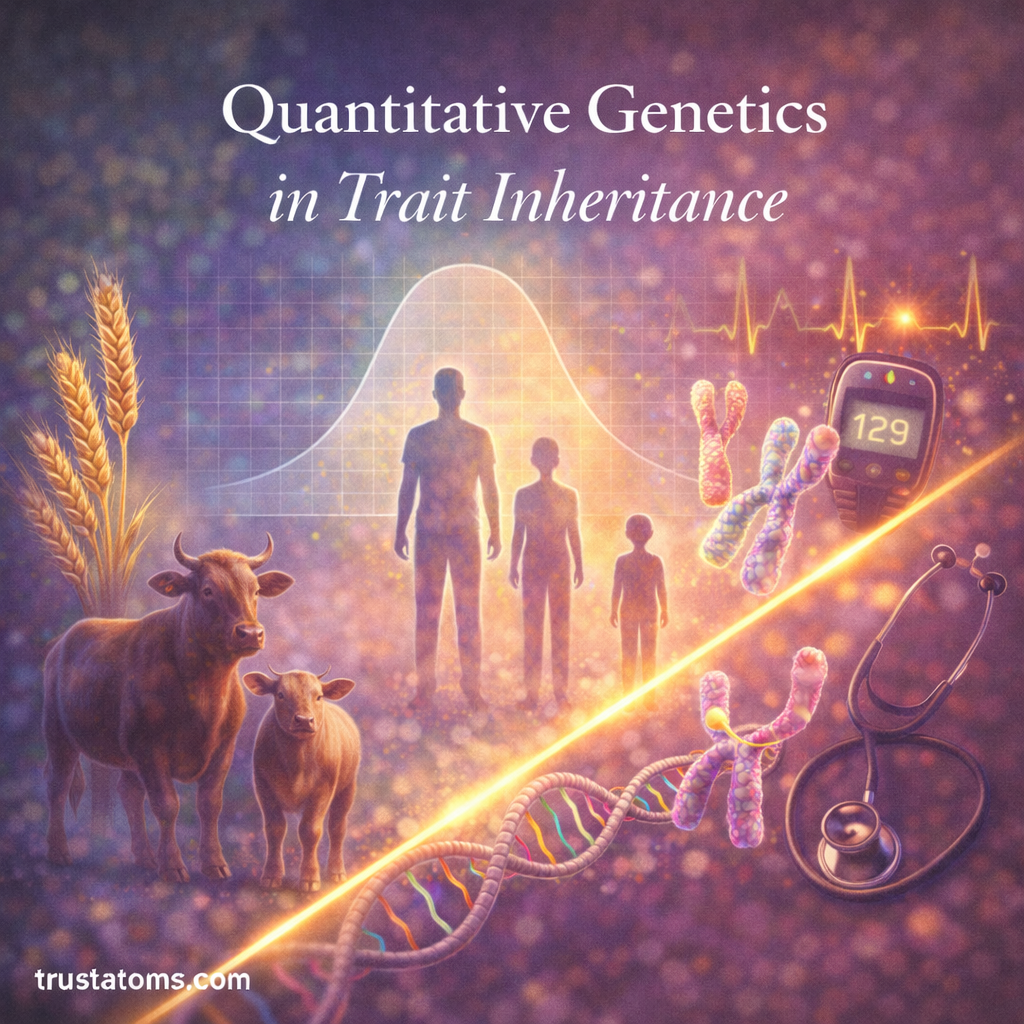
When researchers plot quantitative traits across a population, the distribution often forms a bell-shaped curve, also known as a normal distribution.
This pattern occurs because many genes contribute small effects that combine to produce the final trait value.
Environmental influences further increase the variation observed within populations.
Polygenic Inheritance
Most quantitative traits are controlled through polygenic inheritance, where multiple genes contribute to a single characteristic.
Each gene involved in a polygenic trait may have a small effect, but together they shape the overall phenotype.
Polygenic inheritance has several important features:
- Multiple genes contribute to the same trait
- Each gene contributes a small additive effect
- Many combinations of alleles can produce similar trait values
For example, human height may involve hundreds of genes that influence growth, hormone levels, bone development, and metabolism.
This complexity explains why quantitative traits rarely follow simple dominant or recessive inheritance patterns.
Environmental Influence on Quantitative Traits

Environmental factors often interact with genes to influence quantitative traits.
Even individuals with similar genetic backgrounds may display different trait values depending on environmental conditions.
Environmental influences can include:
- Nutrition
- Climate
- Physical activity
- Disease exposure
- Stress
- Developmental conditions
For instance, genetic potential for height may be affected by nutrition during childhood.
Quantitative genetics studies how genetic and environmental components combine to produce observed variation.
Phenotypic and Genetic Variation
To understand quantitative traits, scientists analyze two major types of variation.
Phenotypic Variation
Phenotypic variation refers to the observable differences in traits among individuals.
This variation results from both genetic factors and environmental influences.
Genetic Variation
Genetic variation refers to differences in DNA sequences that contribute to trait differences.
Some genes may increase trait values, while others reduce them.
Quantitative genetics attempts to separate these sources of variation to understand how much of a trait is inherited.
Heritability of Quantitative Traits
Heritability measures the proportion of variation in a trait that can be attributed to genetic differences among individuals.
Heritability is expressed as a value between 0 and 1.
- High heritability means genetic factors strongly influence the trait.
- Low heritability means environmental factors play a larger role.
For example:
- Human height has relatively high heritability.
- Traits such as language ability may have stronger environmental influences.
It is important to note that heritability describes variation within a population rather than predicting traits for individual organisms.
Genetic Architecture of Complex Traits
The genetic architecture of quantitative traits includes several types of gene interactions.
These interactions influence how genes contribute to phenotype.
Additive Effects
Additive effects occur when multiple genes each contribute small amounts to a trait.
These effects combine to influence the final phenotype.
Dominance Effects
Dominance occurs when one allele masks the effect of another allele at the same gene location.
This can influence how traits appear in offspring.
Epistasis
Epistasis occurs when genes interact with each other in ways that influence trait expression.
One gene may enhance, suppress, or modify the effect of another gene.
These interactions add complexity to quantitative trait inheritance.
Quantitative Genetics and Evolution
Quantitative genetics plays a major role in evolutionary biology because many traits under natural selection are quantitative.
Traits such as body size, speed, fertility, and environmental tolerance influence survival and reproductive success.
When these traits have genetic components, natural selection can shift their distribution within populations.
Over many generations, this process can lead to evolutionary change.
Quantitative genetics allows scientists to model how selection influences traits and how populations adapt to new environments.
Applications in Agriculture and Breeding
Quantitative genetics is widely used in agriculture, animal breeding, and plant improvement.
By analyzing trait inheritance, breeders can select individuals with desirable characteristics.
Examples include:
- Increasing crop yield
- Improving disease resistance
- Enhancing livestock growth rates
- Developing drought-tolerant plants
Modern breeding programs often use genomic data combined with quantitative genetic models to predict which individuals are most likely to produce beneficial traits.
Quantitative Genetics in Human Health
Quantitative genetics also contributes to the study of complex diseases and health conditions.
Many medical traits are influenced by multiple genes and environmental factors.
Examples include:
- Diabetes
- Heart disease
- Obesity
- Mental health disorders
- Immune responses
Genome-wide association studies (GWAS) help scientists identify genetic variants associated with these complex traits.
Understanding quantitative genetics allows researchers to better predict disease risk and develop targeted treatments.
Final Thoughts
Quantitative genetics provides a framework for understanding how complex traits are inherited and expressed within populations. By examining the combined influence of multiple genes and environmental factors, scientists can explain the wide range of variation seen in biological traits.
From evolution and ecology to agriculture and medicine, quantitative genetics offers valuable insights into how traits develop, change, and influence survival.
As genomic technologies continue advancing, the study of quantitative genetics will remain essential for understanding the complexity of inheritance and the diversity of life.