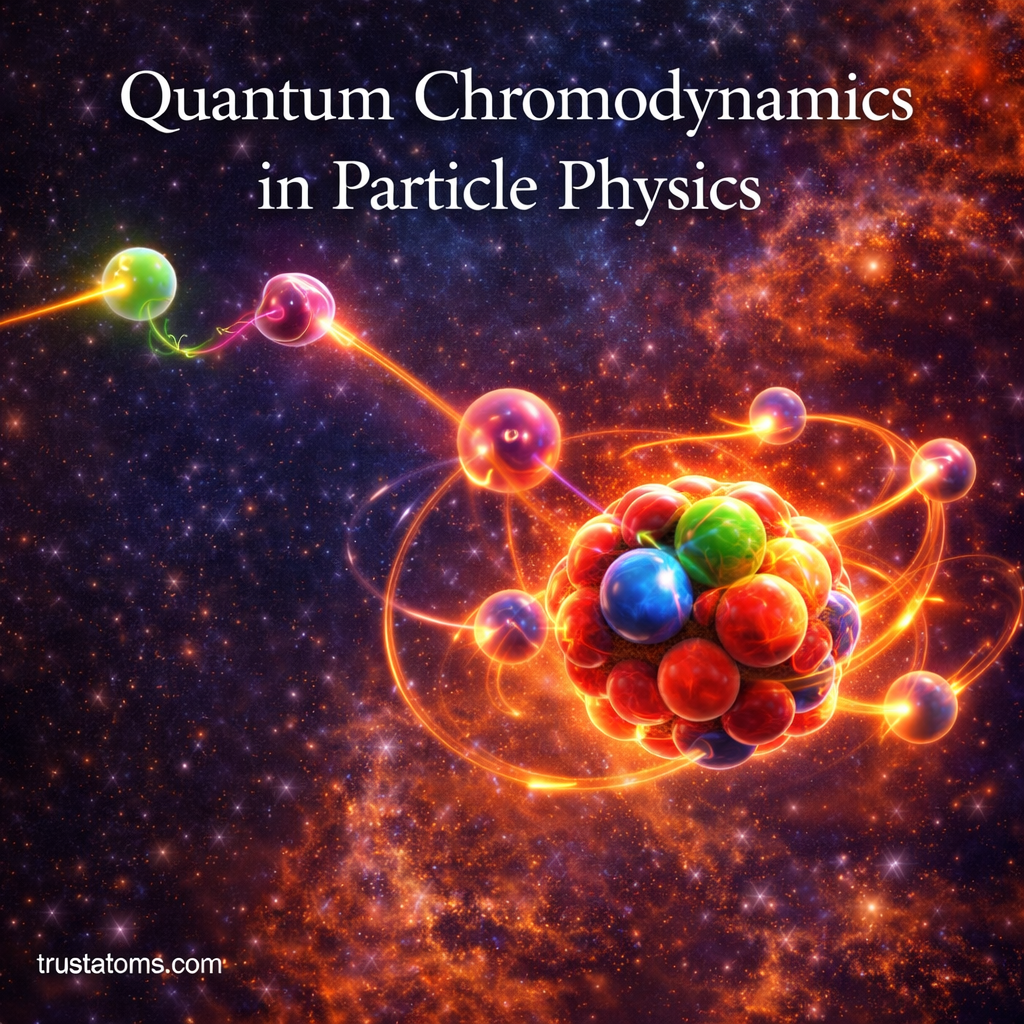
Quantum Chromodynamics (QCD) is the theory that explains how quarks and gluons interact through the strong nuclear force.
It is a central pillar of the Standard Model of particle physics and describes how protons, neutrons, and other hadrons are formed — and why quarks are never observed in isolation.
In this guide, we’ll break down what quantum chromodynamics is, how it works, and why it is essential to understanding matter at the most fundamental level.
What Is Quantum Chromodynamics?
Quantum Chromodynamics is the quantum field theory that describes the strong interaction — the force that binds quarks together.
It explains:
- How quarks form protons and neutrons
- How gluons transmit the strong force
- Why quarks are permanently confined inside hadrons
QCD is to the strong force what quantum electrodynamics (QED) is to electromagnetism.
The Fundamental Particles in QCD
Quantum chromodynamics revolves around two types of particles:
1. Quarks
Quarks are elementary particles that:
- Combine to form protons and neutrons
- Come in six types (flavors): up, down, charm, strange, top, bottom
- Carry a property called color charge
Protons and neutrons are made of three quarks each.
2. Gluons
Gluons are the force carriers of the strong interaction.
They:
- Bind quarks together
- Carry color charge themselves
- Mediate the exchange of the strong force
Unlike photons in electromagnetism, gluons can interact with each other because they carry the charge they transmit.
This makes QCD mathematically richer — and more complex.
What Is “Color” in Quantum Chromodynamics?
Color in QCD does not refer to visual color.
It is a type of charge, similar in concept to electric charge, but with three varieties:
- Red
- Green
- Blue
Quarks carry one of these color charges.
To form stable particles, quarks combine in ways that produce a “color-neutral” result:
- Three quarks (red + green + blue)
- A quark and antiquark pair (color + anticolor)
This principle is called color confinement.
Confinement: Why Quarks Are Never Free
One of the most remarkable features of QCD is confinement.
Quarks cannot exist independently in nature.
If you try to separate two quarks:
- The force between them increases.
- Instead of isolating a quark, you create new quark–antiquark pairs.
This explains why only composite particles (hadrons) are observed.
Confinement is one of the defining features of quantum chromodynamics.
Asymptotic Freedom
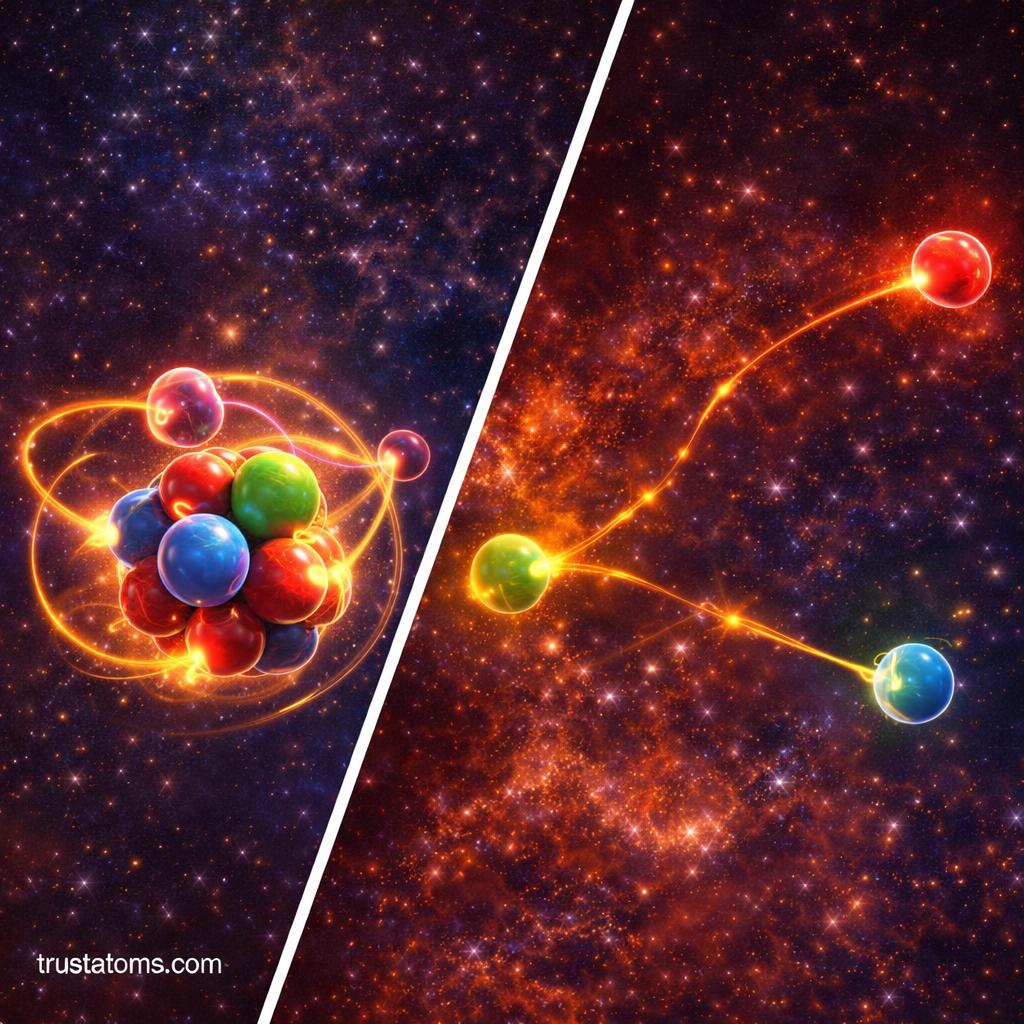
QCD has another surprising property: asymptotic freedom.
At extremely short distances (or very high energies):
- The strong force becomes weaker.
- Quarks behave almost like free particles.
At larger distances:
- The force becomes stronger.
- Quarks become tightly bound.
This behavior is opposite to electromagnetism.
Asymptotic freedom was a major theoretical breakthrough and helped confirm QCD as the correct theory of the strong force.
The Mathematical Framework of QCD
Quantum chromodynamics is a type of non-Abelian gauge theory.
Key characteristics include:
- Based on SU(3) symmetry
- Describes interactions through gauge fields (gluons)
- Allows gluon self-interactions
Because gluons interact with each other, QCD equations are highly nonlinear.
This makes exact calculations difficult except at high energies.
Hadrons: The Products of QCD
QCD explains the formation of hadrons — composite particles made of quarks.
Two major categories:
1. Baryons
- Made of three quarks
- Examples: protons, neutrons
2. Mesons
- Made of a quark and an antiquark
- Often unstable
- Observed in particle accelerators
All visible matter is built from baryons bound by QCD interactions.
QCD and the Mass of Matter
One surprising fact:
Most of the mass of a proton does not come from the quarks themselves.
Instead, it comes from:
- The energy of gluon fields
- The kinetic energy of quarks
- Strong force interactions
According to Einstein’s equation (E = mc²), energy contributes to mass.
Thus, QCD dynamics generate most of the mass of ordinary matter.
Experimental Evidence for QCD
Quantum chromodynamics is supported by:
- High-energy particle collisions
- Deep inelastic scattering experiments
- Jet formation in accelerators
- Observations from large facilities like the CERN
At high energies, particle collisions reveal patterns consistent with quark and gluon behavior predicted by QCD.
QCD in Extreme Conditions
Under extreme temperatures and densities:
- Matter enters a state called quark–gluon plasma.
- Quarks and gluons are no longer confined inside hadrons.
This state existed shortly after the Big Bang and can be recreated briefly in particle accelerators.
Studying it helps physicists understand the early universe.
Challenges in Quantum Chromodynamics
QCD is elegant but difficult.
Challenges include:
- Calculating low-energy interactions
- Understanding confinement analytically
- Solving complex non-linear equations
To study these problems, physicists use:
- Lattice QCD simulations
- Supercomputers
- Numerical approximations
Despite its complexity, QCD remains one of the most successful theories in physics.
Why Quantum Chromodynamics Matters
Quantum chromodynamics is fundamental because it:
- Explains the structure of protons and neutrons
- Accounts for most visible mass in the universe
- Describes the strongest known force
- Connects particle physics with cosmology
Without QCD:
- Atoms could not form stable nuclei
- Matter would not exist in its current form
- The early universe would be incomprehensible
Common Misconceptions
“Is QCD just another name for the strong force?”
Not exactly.
The strong force is the interaction.
QCD is the theoretical framework that explains it.
“Are quarks tiny solid particles?”
No.
They are fundamental quantum fields described by wavefunctions and interactions.
“Why is it called chromodynamics?”
“Chromo” refers to color charge.
“Dynamics” refers to how those charges interact.
It is the dynamics of color.
Final Thoughts
Quantum chromodynamics is one of the deepest achievements of modern physics.
It reveals:
- Why quarks are confined
- Why the strong force behaves differently from electromagnetism
- Why most of the mass of matter comes from energy
- How the early universe behaved moments after the Big Bang
Although mathematically complex, its core ideas — color charge, confinement, and asymptotic freedom — provide a powerful framework for understanding the subatomic world.
In particle physics, QCD is not optional knowledge — it is foundational.