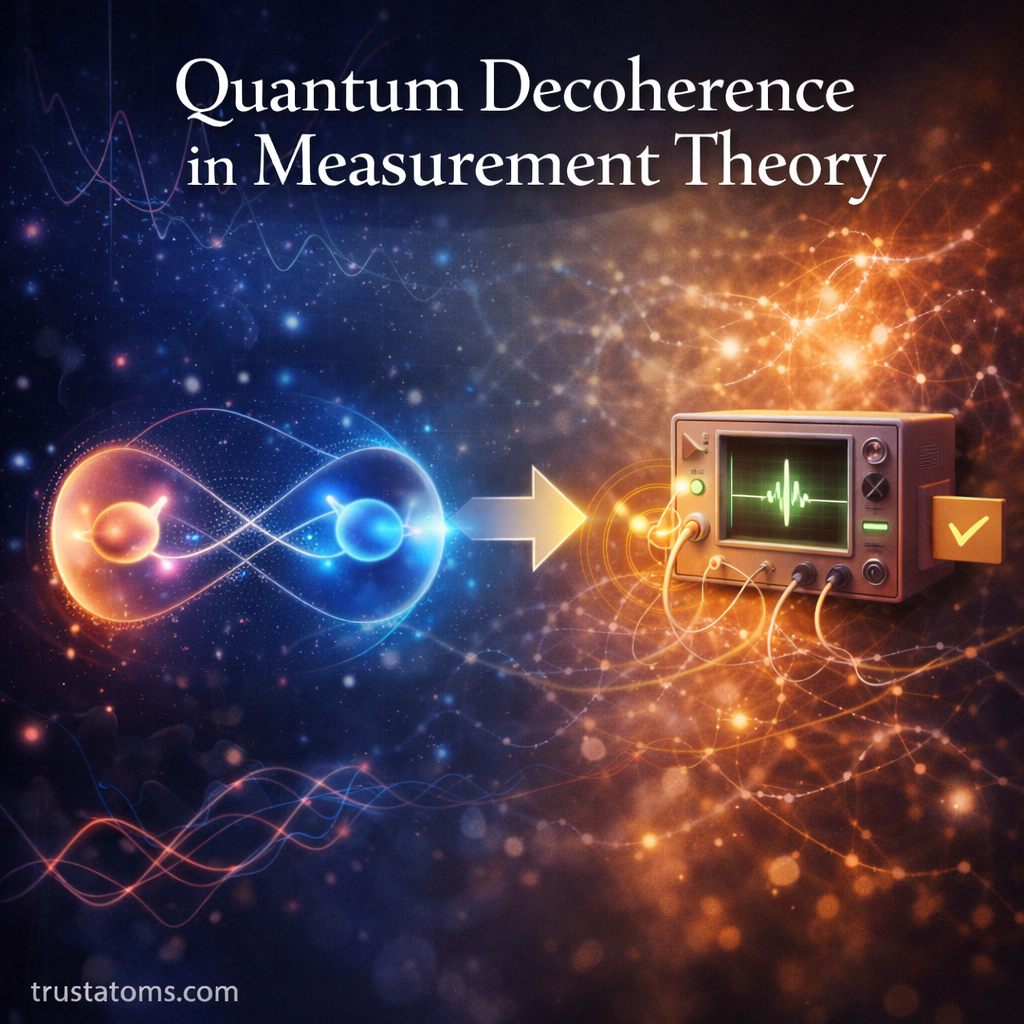
Quantum mechanics describes a world where particles can exist in multiple states at once. Yet when we measure a system, we always observe a definite outcome.
Why?
Quantum decoherence offers one of the most important explanations in modern physics. It helps clarify how quantum superpositions appear to “collapse” into classical reality during measurement — without requiring mysterious forces or conscious observers.
In measurement theory, decoherence explains how interactions with the environment suppress quantum interference, giving rise to the stable, classical world we experience.
The Measurement Problem in Quantum Mechanics
At the heart of quantum theory lies a puzzle known as the measurement problem.
Quantum systems evolve smoothly and deterministically according to the Schrödinger equation. But when we measure them, the system appears to jump into a specific state.
For example:
- An electron can exist in multiple spin states simultaneously.
- A photon can pass through two slits at once.
- A particle can occupy multiple positions in a probability distribution.
However, once measured, only one outcome is observed.
This apparent transition from superposition to definite result raises a fundamental question:
How does quantum possibility become classical reality?
What Is Quantum Decoherence?
Quantum decoherence describes how quantum systems lose their ability to exhibit interference effects when they interact with their environment.
In simple terms:
- A quantum system rarely exists in total isolation.
- It constantly interacts with surrounding particles, radiation, and fields.
- These interactions entangle the system with its environment.
- The coherence (phase relationships) between quantum states becomes scrambled.
When coherence is lost, superpositions effectively behave like classical mixtures.
Importantly, decoherence does not destroy superposition. Instead, it makes interference effects unobservable in practice.
Coherence vs. Decoherence
To understand decoherence, we need to distinguish between coherent and incoherent states.
Coherent Quantum States
- Maintain fixed phase relationships.
- Allow interference patterns.
- Exhibit measurable quantum effects.
Decohered States
- Lose phase alignment due to environmental interaction.
- Suppress interference patterns.
- Appear classical in measurement.
The transition can happen extremely quickly — often in fractions of a second for macroscopic objects.
The Role of the Environment

The environment plays a central role in decoherence.
Whenever a system interacts with its surroundings:
- Information about the system leaks into the environment.
- The system becomes entangled with external degrees of freedom.
- Interference between possible outcomes becomes effectively inaccessible.
For microscopic systems like atoms, decoherence may take longer under controlled laboratory conditions.
For macroscopic objects, decoherence happens almost instantly, which is why we do not observe everyday objects in quantum superpositions.
Decoherence in Measurement Theory
Measurement devices themselves are physical systems. When they interact with a quantum particle:
- The particle becomes entangled with the measuring apparatus.
- The apparatus becomes entangled with the surrounding environment.
- Coherent superpositions spread into countless environmental states.
This process selects certain stable states called pointer states.
Pointer states:
- Resist environmental disturbance.
- Remain robust under interaction.
- Correspond to classical measurement outcomes.
Thus, decoherence explains why specific outcomes become stable and observable.
Does Decoherence Solve the Measurement Problem?
Decoherence explains how classical behavior emerges from quantum interactions. However, it does not fully answer every philosophical question about measurement.
What decoherence does explain:
- Why interference disappears in macroscopic systems.
- Why classical probabilities replace quantum superpositions.
- Why measurement outcomes appear definite.
What it does not explain:
- Why a single specific outcome is realized.
- Whether wavefunction collapse is fundamental or emergent.
Different interpretations of quantum mechanics incorporate decoherence in different ways.
Experimental Evidence for Decoherence
Quantum decoherence is not just theoretical. It has been observed experimentally in:
- Interference experiments with large molecules.
- Superconducting quantum circuits.
- Trapped ion systems.
- Quantum computing platforms.
In each case, increasing environmental interaction reduces observable interference effects.
Controlling decoherence is essential for building stable quantum computers, where maintaining coherence is crucial for computation.
Decoherence and the Emergence of Classical Reality
One of the most profound implications of decoherence is its explanation for the classical world.
It shows that:
- Classical behavior emerges naturally from quantum laws.
- Macroscopic definiteness arises through environmental interaction.
- The boundary between quantum and classical is not fixed — it depends on isolation and scale.
Rather than requiring a special rule for measurement, decoherence demonstrates that classical reality emerges from quantum entanglement spreading into the environment.
Applications and Modern Research
Research on quantum decoherence continues to influence multiple fields:
- Quantum computing: Minimizing decoherence improves qubit stability.
- Quantum cryptography: Protecting coherence ensures secure communication.
- Foundations of physics: Clarifying the interpretation of quantum mechanics.
- Cosmology: Studying how early-universe quantum fluctuations became classical structures.
Understanding decoherence is essential for advancing both practical technology and fundamental theory.
Key Takeaways
Quantum decoherence:
- Explains the loss of interference in open quantum systems.
- Connects quantum theory with classical observations.
- Emerges naturally from environmental interaction.
- Plays a central role in modern measurement theory.
It does not eliminate all mysteries of quantum mechanics — but it provides a powerful physical mechanism explaining how definite outcomes emerge from superposition.
Final Thoughts
Quantum decoherence reshapes our understanding of measurement.
Instead of viewing wavefunction collapse as a mysterious event, decoherence shows that classical reality emerges through entanglement and environmental interaction.
The world we observe — stable, definite, and classical — is not separate from quantum mechanics. It is a large-scale consequence of it.
As research advances, decoherence remains one of the most important concepts bridging microscopic quantum behavior and macroscopic experience.