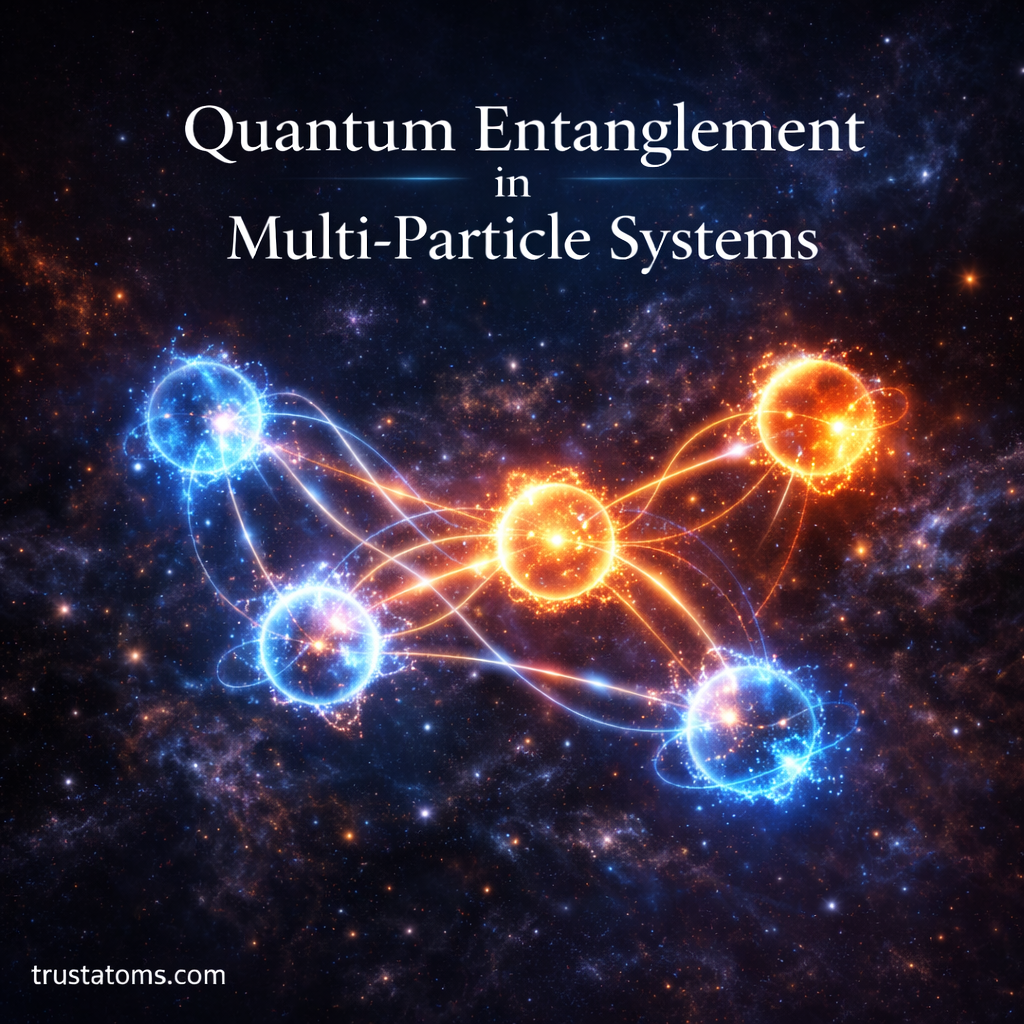
Quantum entanglement is one of the most intriguing and counterintuitive phenomena in modern physics. When particles become entangled, their properties are linked in such a way that measuring one instantly affects the state of another — no matter how far apart they are.
While entanglement between two particles is already fascinating, multi-particle entanglement opens the door to even deeper insights into quantum mechanics, quantum computing, and fundamental physics.
In this guide, we’ll explore how quantum entanglement works in multi-particle systems, why it matters, and how it’s shaping the future of technology.
What Is Quantum Entanglement?
Quantum entanglement occurs when two or more particles share a single, combined quantum state.
In an entangled system:
- The particles cannot be described independently.
- Measuring one particle influences the overall system.
- The outcome of one measurement determines correlated outcomes in others.
This correlation persists even if the particles are separated by large distances.
Entanglement challenges classical ideas about locality and independence.
From Two Particles to Many
Most introductory explanations focus on entanglement between two particles. However, real quantum systems often involve:
- Three particles
- Four particles
- Large networks of interacting qubits
Multi-particle entanglement introduces new properties that do not exist in simple two-particle systems.
As the number of particles increases:
- The complexity of the quantum state grows exponentially.
- The system’s correlations become richer.
- New collective behaviors emerge.
How Multi-Particle Entanglement Works
In a multi-particle entangled system:
- The particles interact in a controlled way.
- Their quantum states become linked.
- The system forms a shared wavefunction.
Instead of describing each particle separately, physicists describe the entire system as one unified state.
This unified state contains information about all particles simultaneously.
When a measurement is made:
- The entire system’s state updates.
- Correlations between particles become evident.
Types of Multi-Particle Entangled States
Several important classes of multi-particle entangled states exist.
GHZ States (Greenberger–Horne–Zeilinger States)
These involve three or more particles.
Key features:
- Strong, all-or-nothing correlations
- Highly sensitive to measurement
- Useful in foundational tests of quantum mechanics
GHZ states highlight the non-classical nature of quantum reality.
W States
W states distribute entanglement more robustly across particles.
Characteristics include:
- Greater resistance to particle loss
- Distributed correlations
- Applications in quantum communication
Unlike GHZ states, W states remain partially entangled even if one particle is removed.
Cluster States
Cluster states are essential in:
- Measurement-based quantum computing
- Quantum networks
They form structured entanglement across many particles in a lattice-like arrangement.
Why Multi-Particle Entanglement Is Different
Multi-particle entanglement introduces new phenomena such as:
- Genuine multipartite entanglement
- Quantum nonlocality across many systems
- Complex interference patterns
The complexity grows rapidly because:
- Each added particle doubles the number of possible states.
- The total system cannot be broken into independent parts.
This exponential growth is what gives quantum computing its potential power.
Applications in Quantum Technology
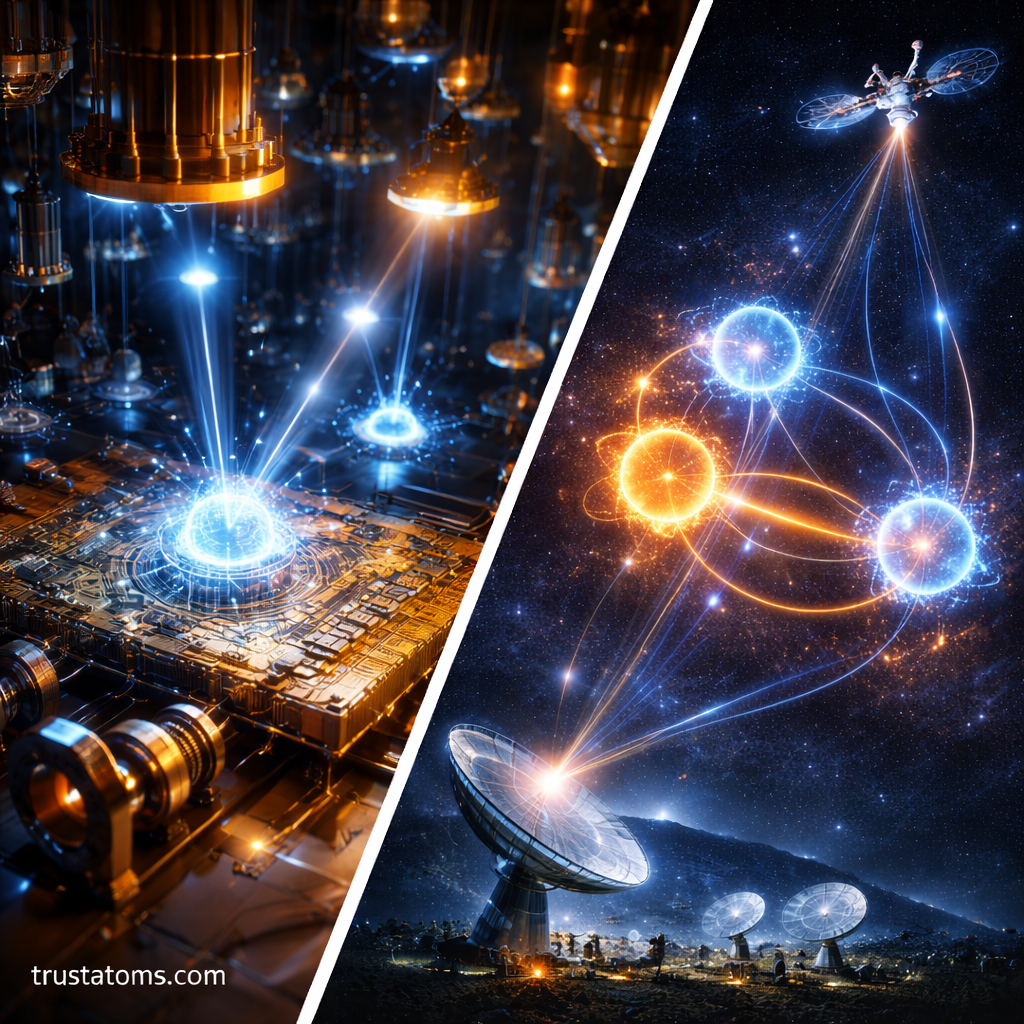
1. Quantum Computing
Quantum computers rely on:
- Entangled qubits
- Parallel quantum processing
- Collective state manipulation
Multi-particle entanglement allows quantum systems to perform calculations that would be impossible for classical computers in reasonable time.
2. Quantum Communication
Entanglement enables:
- Secure quantum key distribution
- Distributed quantum networks
- Teleportation of quantum states
Multi-particle systems allow more advanced network protocols.
3. Quantum Sensing and Metrology
Entangled particles improve measurement precision.
Applications include:
- Atomic clocks
- Gravitational wave detection
- Magnetic field sensing
Entanglement can reduce noise below classical limits.
Entanglement and Nonlocality
One of the most striking features of entanglement is nonlocal correlation.
This does not mean information travels faster than light.
Instead:
- Measurement outcomes are correlated in ways classical physics cannot explain.
- The correlations arise from the shared quantum state.
Experiments repeatedly confirm that these correlations violate classical assumptions.
Decoherence: The Main Challenge
Multi-particle entanglement is fragile.
Interactions with the environment can cause:
- Loss of coherence
- Breakdown of entangled states
- Transition to classical behavior
This process is called decoherence.
As systems grow larger, maintaining entanglement becomes increasingly difficult.
Engineering solutions aim to:
- Isolate quantum systems
- Reduce thermal noise
- Use error correction techniques
Entanglement Scaling and Complexity
In multi-particle systems:
- The number of possible configurations grows exponentially.
- Describing the full system requires enormous computational resources.
This is why:
- Simulating large quantum systems on classical computers is extremely difficult.
- Quantum simulators are being developed to model such systems directly.
Understanding entanglement structure is essential for managing complexity.
Experimental Realizations
Scientists create multi-particle entanglement using:
- Trapped ions
- Superconducting circuits
- Photonic systems
- Ultracold atoms
Laboratory experiments now routinely entangle:
- Dozens of particles
- Hundreds in specialized systems
Research continues toward scalable quantum networks.
Common Misconceptions
“Entanglement Means Instant Communication”
No.
Entanglement produces correlations, but it does not allow faster-than-light information transfer.
“Only Two Particles Can Be Entangled”
False.
Large multi-particle entangled states are now experimentally verified.
“Entanglement Is Only Theoretical”
Incorrect.
It has been demonstrated extensively and forms the foundation of quantum technologies.
Why Quantum Entanglement Matters
Quantum entanglement in multi-particle systems:
- Challenges classical intuition
- Expands our understanding of reality
- Enables next-generation technologies
It connects:
- Fundamental physics
- Information theory
- Engineering innovation
Multi-particle entanglement is not just a philosophical curiosity — it is the engine driving the quantum revolution.
Final Takeaway
Quantum entanglement in multi-particle systems occurs when:
- Multiple particles share a unified quantum state.
- Their properties cannot be described independently.
- Measurements reveal deep correlations.
As particle numbers increase:
- Complexity grows exponentially.
- New quantum behaviors emerge.
- Technological potential expands dramatically.
From quantum computing to secure communication, multi-particle entanglement represents one of the most powerful and transformative ideas in modern physics.