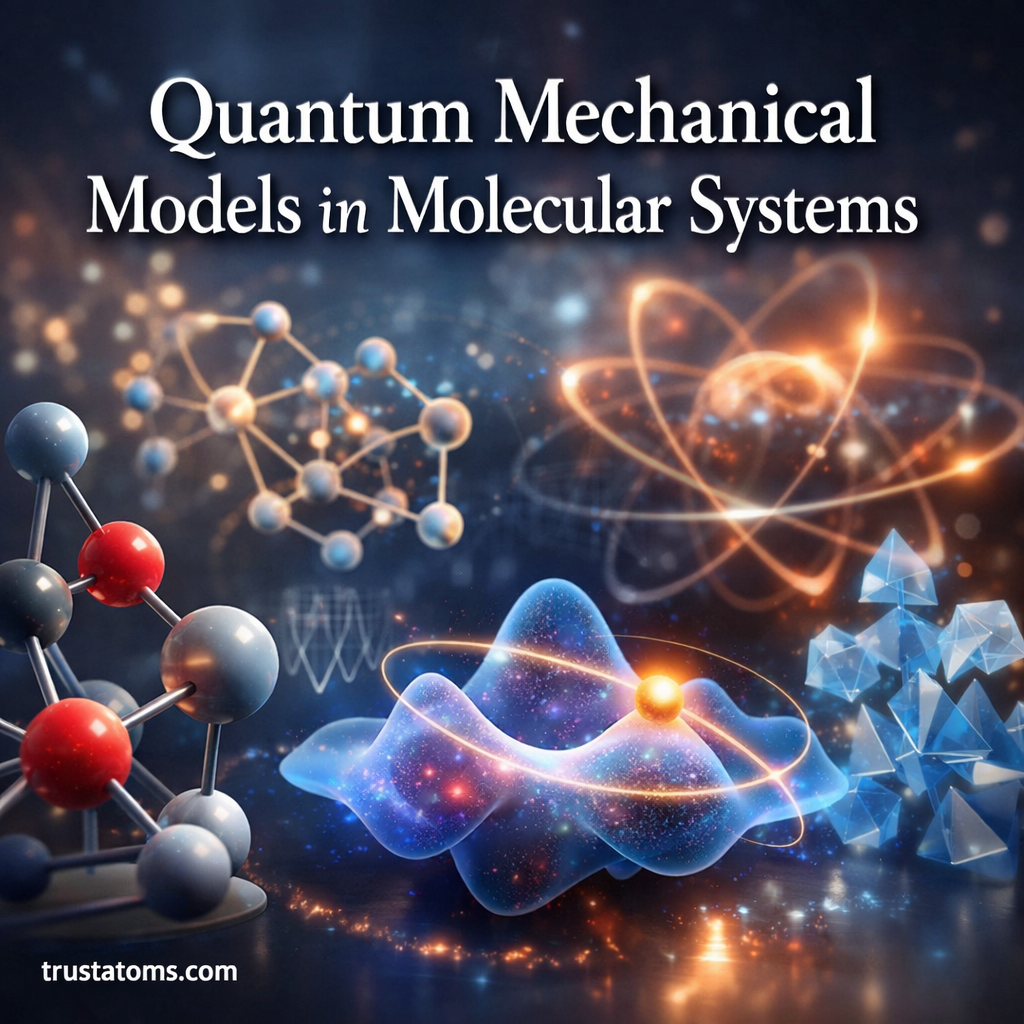
Quantum mechanics plays a central role in modern chemistry. While classical models can explain many everyday chemical behaviors, they fail when describing the microscopic world of atoms and molecules. Quantum mechanical models provide the framework scientists use to understand how electrons behave, how chemical bonds form, and how molecules interact.
In molecular systems, these models help explain properties such as molecular shape, reactivity, energy levels, and spectroscopy. By applying quantum principles, chemists can predict molecular behavior with remarkable accuracy.
Why Quantum Mechanics Is Needed in Chemistry
Atoms and molecules operate at extremely small scales where classical physics breaks down. Electrons do not behave like tiny planets orbiting a nucleus. Instead, they behave according to quantum rules that involve probabilities and wave-like behavior.
Quantum mechanical models allow chemists to:
- Predict electron distributions within molecules
- Understand chemical bonding and molecular structure
- Calculate reaction pathways and energy changes
- Interpret spectroscopic data
- Simulate molecular interactions in complex systems
Without quantum mechanics, modern chemistry fields such as materials science, pharmaceuticals, and nanotechnology would not be possible.
The Foundation: The Schrödinger Equation
At the core of quantum chemistry is the Schrödinger equation. This mathematical equation describes how the quantum state of a system changes over time.
For molecular systems, the Schrödinger equation allows scientists to calculate:
- Electron energy levels
- Probability distributions of electrons
- Molecular orbital structures
- Bond strengths and molecular stability
However, solving the exact Schrödinger equation for large molecules is extremely complex. Because of this, chemists use approximations and computational methods to model molecular systems.
Wavefunctions and Probability
In quantum mechanics, electrons are described by wavefunctions rather than precise positions.
A wavefunction represents the probability of finding an electron in a specific region around a nucleus. Instead of a fixed orbit, electrons exist in regions called orbitals.
Important characteristics of wavefunctions include:
- Probability density determines where electrons are likely to be found
- Wavefunctions can interfere and combine
- They determine electron energy and spatial distribution
These probability-based descriptions are essential for understanding molecular structure and chemical bonding.
Molecular Orbital Theory
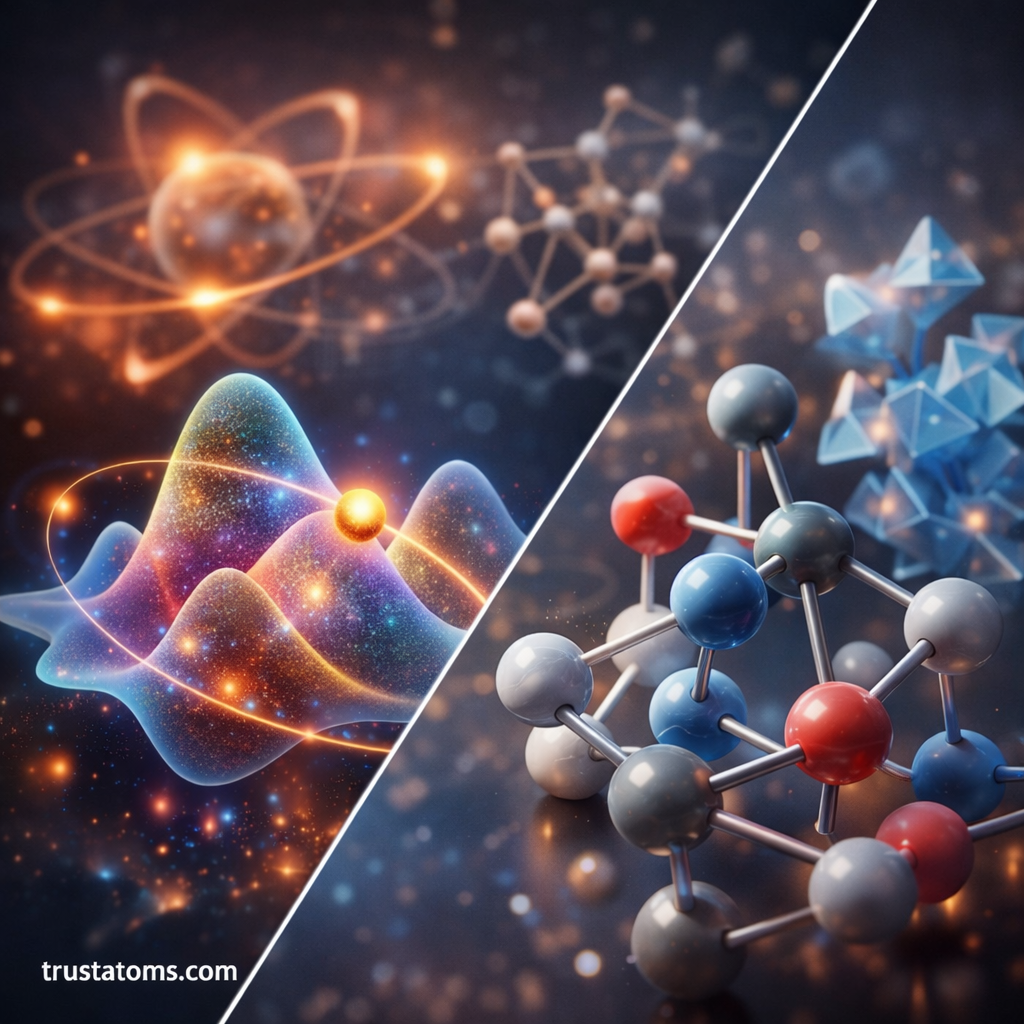
Molecular Orbital (MO) Theory is one of the most important quantum mechanical models used to describe molecules.
Instead of assigning electrons to individual atoms, MO theory treats electrons as belonging to the entire molecule. Atomic orbitals combine to form molecular orbitals that extend across multiple atoms.
Key principles include:
- Atomic orbitals combine to form bonding and antibonding orbitals
- Electrons fill orbitals starting with the lowest energy levels
- Bond order helps determine molecular stability
For example:
- Bonding orbitals stabilize a molecule
- Antibonding orbitals destabilize it
The balance between these orbitals determines whether a molecule forms and how strong the bond will be.
Valence Bond Theory
Valence Bond (VB) Theory offers another quantum approach to molecular bonding. While MO theory focuses on molecular orbitals spread across the molecule, VB theory emphasizes localized bonds between atoms.
According to VB theory:
- Bonds form when atomic orbitals overlap
- Electrons pair within the overlapping region
- Hybridization explains molecular geometry
Common hybridization types include:
- sp hybridization (linear molecules)
- sp² hybridization (trigonal planar molecules)
- sp³ hybridization (tetrahedral molecules)
This model helps explain molecular shapes and bond angles observed in many compounds.
Approximations Used in Molecular Quantum Mechanics
Because solving quantum equations exactly is often impossible for large molecules, chemists rely on approximations.
Some common approaches include:
Born–Oppenheimer Approximation
This approximation separates nuclear motion from electron motion. Since nuclei are much heavier than electrons, they move more slowly and can be treated independently during calculations.
Hartree–Fock Method
The Hartree–Fock method approximates electron interactions by averaging the effect of electron repulsion. While not perfect, it provides a useful starting point for many molecular calculations.
Density Functional Theory (DFT)
DFT is widely used in modern computational chemistry. Instead of tracking individual electron wavefunctions, it focuses on electron density distributions.
Advantages of DFT include:
- Lower computational cost
- Good accuracy for many molecular systems
- Ability to model large molecules and materials
Because of this balance between accuracy and efficiency, DFT is commonly used in research and industry.
Applications of Quantum Mechanical Models
Quantum mechanical models allow scientists to investigate molecular behavior in ways that experiments alone cannot achieve.
Important applications include:
Drug Discovery
Computational chemistry models how drug molecules interact with biological targets. This helps researchers design medications more efficiently.
Materials Science
Quantum models help scientists develop new materials with desirable electrical, magnetic, or optical properties.
Catalysis
Understanding molecular energy surfaces allows chemists to design catalysts that speed up reactions.
Spectroscopy
Quantum models explain how molecules absorb or emit light, allowing scientists to interpret infrared, UV-visible, and nuclear magnetic resonance spectra.
Limitations of Quantum Mechanical Models
Despite their power, quantum mechanical models have limitations.
Challenges include:
- High computational cost for large systems
- Dependence on approximations and assumptions
- Difficulty modeling extremely complex biological systems
Even so, continuous improvements in computing power and algorithms are expanding the scope of what quantum chemistry can achieve.
The Future of Quantum Chemistry
Quantum mechanical models continue to evolve alongside advances in computing. Emerging technologies such as machine learning and quantum computing may dramatically improve the ability to simulate molecular systems.
These advances could lead to breakthroughs in areas such as:
- Clean energy materials
- Advanced pharmaceuticals
- Sustainable chemical processes
- Nanotechnology
As computational tools grow more powerful, quantum mechanical models will remain essential for understanding and designing the molecular world.
Conclusion
Quantum mechanical models provide the theoretical foundation for understanding molecular systems. By describing electron behavior using probability-based wavefunctions and energy calculations, these models explain how atoms bond, how molecules form, and how chemical reactions occur.
Through approaches like molecular orbital theory, valence bond theory, and computational methods such as density functional theory, chemists can explore molecular behavior with extraordinary precision. Although challenges remain, quantum mechanical modeling continues to push the boundaries of modern chemistry.