Quantum tunneling is one of the most fascinating and counterintuitive phenomena in physics. In classical mechanics, a particle must have enough energy to overcome a barrier. If it does not, it simply reflects back.
In quantum mechanics, that rule no longer strictly applies.
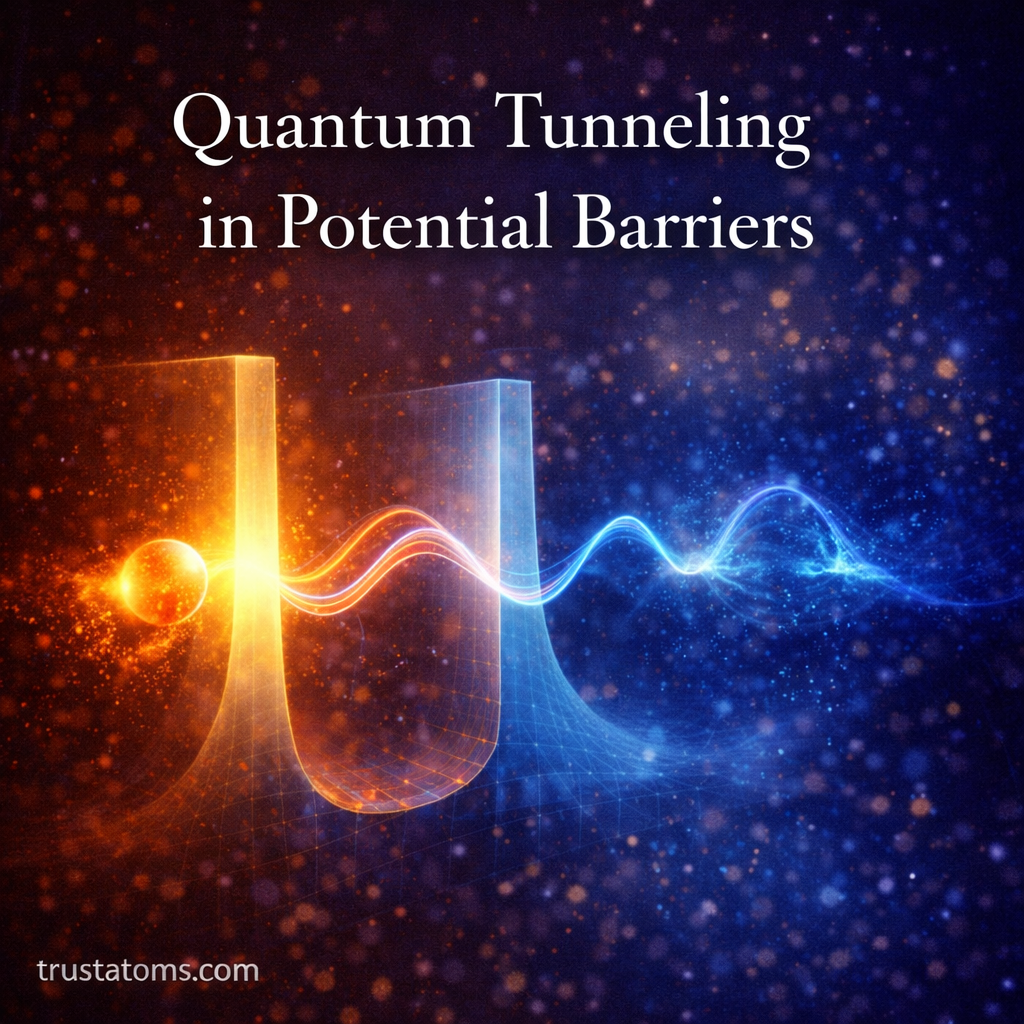
Particles described by wave functions can pass through potential barriers—even when they do not have enough classical energy to climb over them. This phenomenon is known as quantum tunneling.
Quantum tunneling is not just theoretical. It plays a crucial role in nuclear physics, semiconductor devices, and even the fusion reactions powering the Sun.
What Is Quantum Tunneling?
Quantum tunneling occurs when a particle has a finite probability of crossing a region of higher potential energy than its total energy.
In classical physics:
- If energy is less than the barrier height, transmission is impossible.
In quantum physics:
- The particle’s wave function extends into the barrier.
- There is a nonzero probability of appearing on the other side.
This behavior arises from the wave-like nature of matter.
Understanding Potential Barriers
A potential barrier is a region where potential energy increases.
Examples include:
- An electron approaching an energy gap in a material
- A proton inside a nucleus facing electrostatic repulsion
- A particle encountering a thin insulating layer
Classically, a particle needs sufficient kinetic energy to cross the barrier.
Quantum mechanics introduces a probability-based outcome instead of certainty.
The Wave Function and Probability
In quantum mechanics, particles are described by a wave function.
The wave function:
- Represents probability amplitude
- Extends beyond classical boundaries
- Decays exponentially inside a barrier
Even inside a region where the particle “should not exist” classically, the wave function remains nonzero.
If the barrier is thin enough, the wave function emerges on the other side.
This results in tunneling.
Why Tunneling Happens
Quantum tunneling occurs because:
- Particles behave as waves.
- Waves do not abruptly stop at boundaries.
- The wave amplitude decreases gradually inside the barrier.
- A portion of the wave may reach the other side.
The thinner and lower the barrier, the higher the probability of transmission.
Barrier width and height strongly influence tunneling rates.
Factors That Affect Tunneling Probability
Several variables determine how likely tunneling is:
- Barrier height
- Barrier width
- Particle mass
- Particle energy
Lighter particles tunnel more easily than heavier ones.
For example:
- Electrons tunnel relatively easily.
- Protons tunnel less frequently.
- Large objects effectively never tunnel because probabilities become vanishingly small.
Quantum effects dominate at microscopic scales.
Mathematical Description (Conceptual Overview)
While the full solution involves solving Schrödinger’s equation, the essential idea is:
- Inside the barrier, the wave function decreases exponentially.
- The probability of tunneling depends on how much the wave decays before reaching the far side.
This exponential dependence explains why tunneling probability drops rapidly as barrier thickness increases.
No classical equivalent exists for this behavior.
Real-World Applications of Quantum Tunneling

Quantum tunneling is not merely theoretical. It underlies many important technologies and natural processes.
Nuclear Fusion in Stars
In the Sun:
- Protons repel each other due to electric charge.
- Classically, they lack sufficient energy to overcome this repulsion.
- Quantum tunneling allows fusion to occur.
Without tunneling, stars would not shine.
Scanning Tunneling Microscope (STM)
The scanning tunneling microscope operates based on electron tunneling.
It works by:
- Bringing a sharp conductive tip very close to a surface
- Measuring tunneling current between tip and material
- Mapping atomic-scale structures
STM allows scientists to image individual atoms.
Semiconductor Devices
Tunneling plays a role in:
- Tunnel diodes
- Flash memory
- Quantum well devices
- Josephson junctions
As electronic components shrink to nanoscale dimensions, tunneling effects become increasingly significant.
Modern electronics depend on quantum tunneling.
Radioactive Decay
Alpha decay is explained by tunneling.
Inside certain nuclei:
- Alpha particles are trapped by nuclear forces.
- They tunnel through the nuclear potential barrier.
- This results in radioactive emission.
Tunneling explains how particles escape the nucleus despite insufficient classical energy.
Tunneling and Energy Conservation
Quantum tunneling does not violate energy conservation.
Important clarification:
- The particle does not gain extra energy.
- It does not “borrow” energy to cross the barrier.
- Instead, the wave function allows a probability of transmission.
Energy remains conserved before and after tunneling.
The process reflects quantum probability, not classical force.
Tunneling vs. Classical Penetration
In classical physics:
- If energy is lower than barrier height, penetration depth is zero.
In quantum physics:
- Penetration depth is finite.
- Transmission probability is nonzero.
The difference highlights a fundamental shift from deterministic mechanics to probabilistic quantum theory.
Quantum Tunneling and Modern Physics
Quantum tunneling challenges intuitive notions of reality.
It demonstrates that:
- Particles are not point-like objects with fixed trajectories.
- Probability governs microscopic behavior.
- Wave properties dominate at small scales.
Tunneling reinforces the core principles of quantum mechanics:
- Superposition
- Wave-particle duality
- Probabilistic outcomes
It is one of the clearest examples of quantum behavior deviating from classical expectations.
Limitations of Tunneling
While tunneling is powerful at microscopic scales, it becomes negligible for large objects.
For example:
- A baseball cannot tunnel through a wall in any realistic timeframe.
- Macroscopic objects have extremely tiny tunneling probabilities.
Quantum effects diminish as mass increases.
This explains why classical mechanics works well at everyday scales.
Final Thoughts
Quantum tunneling in potential barriers reveals the deeply nonclassical nature of the microscopic world.
Particles described by wave functions can cross energy barriers without sufficient classical energy. This phenomenon powers stars, enables advanced electronics, and allows scientists to observe atoms directly.
Tunneling illustrates one of the most profound lessons of quantum physics:
Nature does not follow classical intuition at small scales.
Instead, probability governs reality, and barriers are not always absolute.