Empty space is not truly empty.
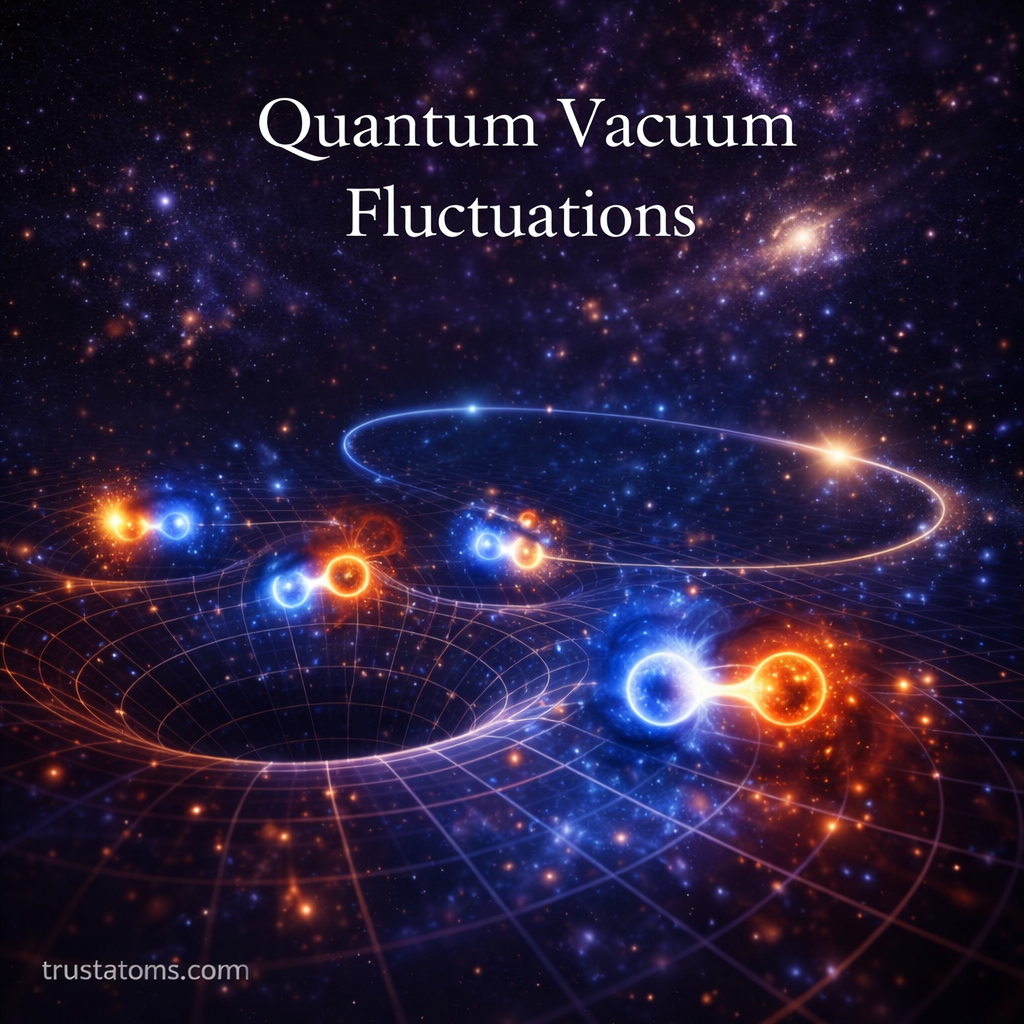
In classical physics, a vacuum is simply a region with no matter. But in quantum physics, even the most perfect vacuum is alive with activity. Fields constantly fluctuate. Energy briefly appears and disappears. Particles flicker into existence for incredibly short times.
This phenomenon is known as quantum vacuum fluctuations, and it is one of the most fascinating consequences of quantum field theory.
In this article, we’ll explore what quantum vacuum fluctuations are, why they occur, and how they influence the physical universe.
What Is a Quantum Vacuum?
In everyday language, a vacuum means “nothing.”
In quantum physics, a vacuum is:
- The lowest possible energy state of a quantum field
- A state with no real, detectable particles
- Still governed by quantum uncertainty
Even when no particles are present, quantum fields still exist. And those fields cannot remain perfectly still.
The Role of the Uncertainty Principle
The key reason vacuum fluctuations exist lies in the Heisenberg uncertainty principle.
This principle states that certain physical quantities cannot both be known with perfect precision. One important version involves energy and time:
- Energy cannot remain exactly fixed for extremely short time intervals.
- Tiny energy fluctuations are allowed briefly.
This means the vacuum can temporarily “borrow” small amounts of energy, as long as it returns that energy quickly.
The result:
Brief, spontaneous fluctuations in energy throughout empty space.
Virtual Particles: Temporary Appearances
Quantum vacuum fluctuations are often described using the concept of virtual particles.
These are:
- Short-lived particle–antiparticle pairs
- Not directly observable
- Mathematical features of quantum field interactions
They appear and disappear so quickly that they cannot be detected as real particles. However, their effects are measurable.
Examples include:
- Electron–positron pairs
- Quark–antiquark pairs
- Photon fluctuations
These transient events constantly occur everywhere in space.
Observable Effects of Vacuum Fluctuations
Although vacuum fluctuations are microscopic, their consequences are real and experimentally verified.
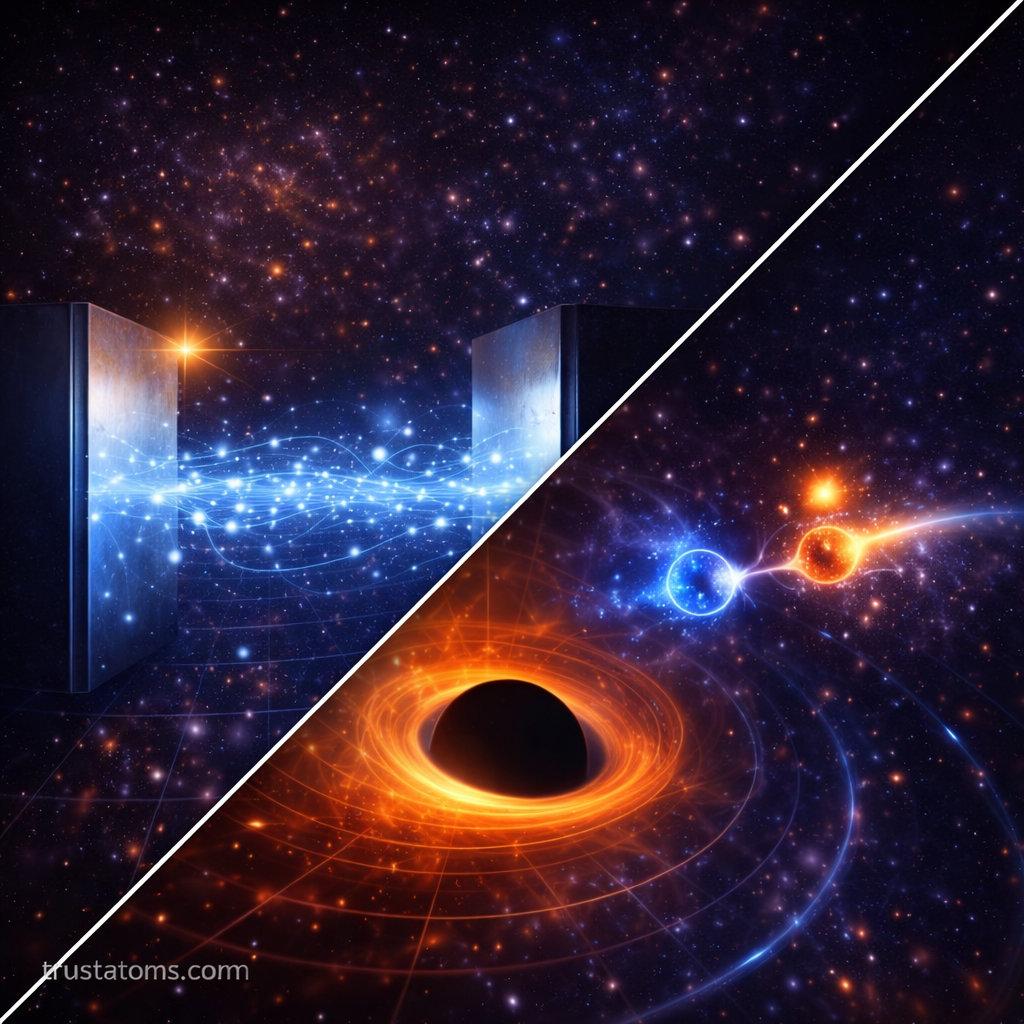
1. The Casimir Effect
When two metal plates are placed extremely close together in a vacuum:
- Certain quantum fluctuations are restricted between them.
- Outside fluctuations remain unrestricted.
- A tiny measurable force pushes the plates together.
This force arises purely from vacuum fluctuations and has been confirmed in laboratory experiments.
2. The Lamb Shift
In hydrogen atoms, energy levels are slightly shifted due to interactions with vacuum fluctuations.
This subtle difference, called the Lamb shift, cannot be explained by classical physics.
Its measurement provided strong confirmation of quantum electrodynamics.
3. Hawking Radiation
Near a black hole’s event horizon:
- Vacuum fluctuations can produce particle pairs.
- One particle falls in.
- The other escapes.
To an outside observer, it appears as radiation emitted by the black hole.
This theoretical prediction implies that black holes can slowly evaporate over time.
Vacuum Energy and Cosmology
Quantum vacuum fluctuations imply that empty space contains energy.
This vacuum energy may be connected to:
- Dark energy
- The accelerating expansion of the universe
However, there is a major unresolved issue.
When physicists calculate vacuum energy using quantum field theory, the predicted value is enormously larger than what cosmological observations suggest.
This discrepancy is one of the greatest unsolved problems in theoretical physics.
Are Vacuum Fluctuations “Real”?
This is a subtle question.
Vacuum fluctuations:
- Cannot be observed directly
- Cannot be isolated as particles
- Are inferred from measurable effects
In quantum field theory, fields are fundamental. Particles are excitations of those fields. Even in their lowest energy state, fields retain unavoidable fluctuations.
So while virtual particles are a convenient way to describe the phenomenon, the deeper reality is fluctuating quantum fields.
How Quantum Field Theory Explains It
In quantum field theory:
- Every type of particle corresponds to a field.
- Fields exist everywhere in space.
- Even the lowest-energy configuration of a field contains zero-point energy.
Zero-point energy means:
A field cannot have exactly zero energy due to quantum uncertainty.
As a result, fluctuations are built into the structure of reality.
Why Quantum Vacuum Fluctuations Matter
Quantum vacuum fluctuations are not just theoretical curiosities. They are central to modern physics.
They:
- Influence atomic structure
- Affect black hole thermodynamics
- Play a role in early-universe inflation
- Contribute to vacuum energy
They show that emptiness is not static or silent, but dynamic and restless.
Early Universe Implications
During cosmic inflation, the universe expanded rapidly.
Quantum vacuum fluctuations during this period were:
- Stretched to cosmic scales
- Amplified by expansion
- Imprinted into the large-scale structure of the universe
Tiny quantum fluctuations in the early universe eventually became:
- Galaxies
- Galaxy clusters
- Cosmic structure
In this way, quantum uncertainty helped shape the visible universe.
Common Misconceptions
There are a few common misunderstandings about vacuum fluctuations.
They do not mean:
- Energy is created from nothing without limits.
- The laws of physics are violated.
- The vacuum is chaotic in a classical sense.
Instead:
- Fluctuations are allowed within strict quantum constraints.
- Energy conservation remains valid overall.
- Effects are usually extremely small.
Quantum mechanics allows temporary deviations, not permanent violations.
Open Questions
Despite decades of study, many questions remain.
Physicists continue to investigate:
- The true nature of vacuum energy
- Its relationship to dark energy
- How vacuum fluctuations interact with gravity
- Whether a full quantum theory of gravity modifies them
Understanding the quantum vacuum may be essential for unifying quantum mechanics and general relativity.
Final Thoughts
Quantum vacuum fluctuations challenge our intuitive idea of emptiness.
In the quantum world:
- Space is never completely still.
- Energy can fluctuate briefly.
- Fields are always active at the smallest scales.
What appears to be nothing is, in fact, a dynamic foundation of physical reality.
From tiny atomic shifts to the structure of the cosmos, quantum vacuum fluctuations remind us that even “empty” space is full of possibility.