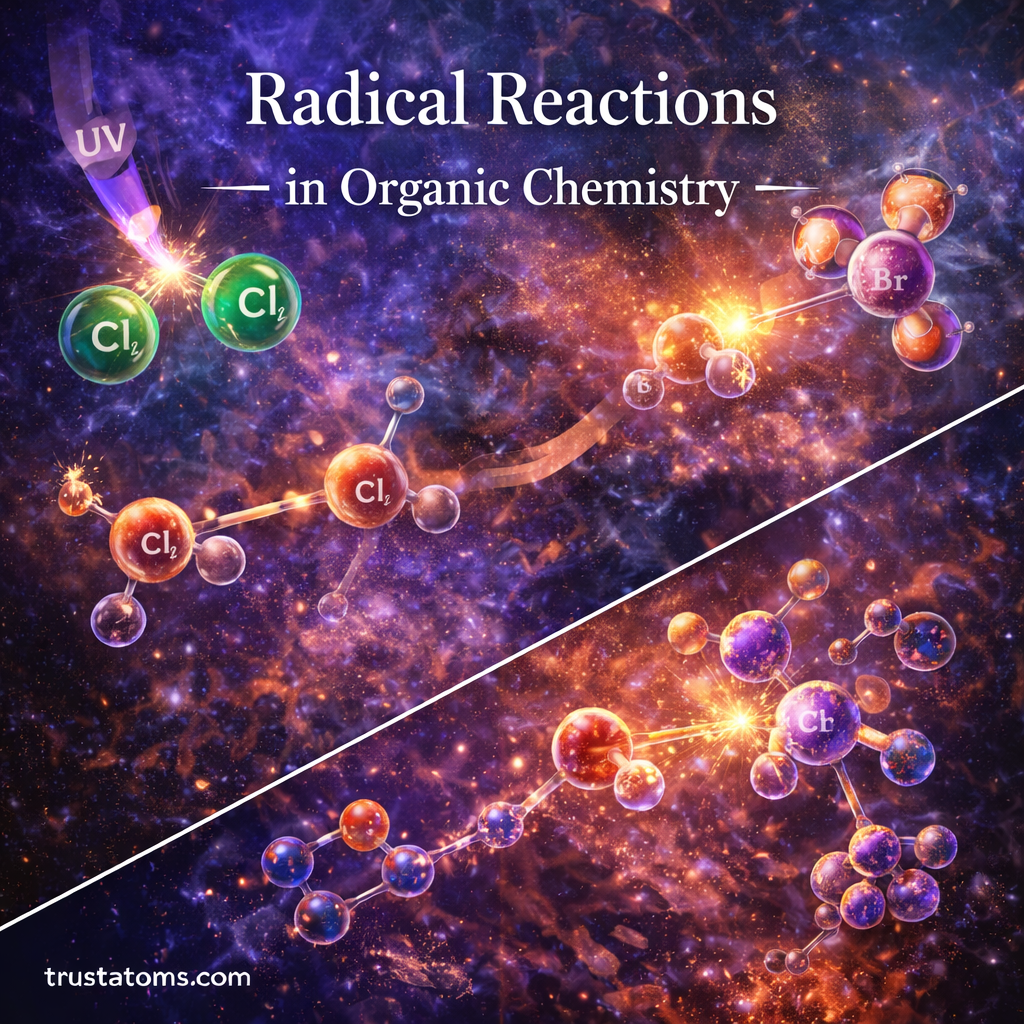
Radical reactions are an important class of chemical reactions in organic chemistry. Unlike many reactions that involve pairs of electrons moving together, radical reactions involve highly reactive species known as free radicals, which contain an unpaired electron.
Because of this unpaired electron, radicals are extremely reactive and can participate in chain reactions that rapidly transform molecules. Radical chemistry plays a role in many natural processes, industrial chemical reactions, and biological systems.
Understanding radical reactions helps chemists explain processes such as combustion, polymer formation, and atmospheric chemistry.
What Are Free Radicals?
A free radical is a chemical species that contains at least one unpaired electron.
Most stable molecules contain paired electrons in their chemical bonds. When a bond breaks in a way that each atom keeps one electron, two radicals are formed.
Key characteristics of free radicals include:
- They contain an unpaired electron
- They are highly reactive
- They often exist only for a short time
- They can trigger chain reactions
Free radicals can form through several processes, including heat, light, and chemical initiators.
Because radicals are unstable, they tend to react quickly with nearby molecules to achieve a more stable electron configuration.
Homolytic Bond Cleavage
Radical reactions typically begin with homolytic bond cleavage.
Homolytic cleavage occurs when a chemical bond breaks evenly, with each atom retaining one of the shared electrons.
This process produces two radicals.
For example, when a bond between two atoms breaks homolytically:
- Each atom takes one electron
- Two reactive radical species are produced
Homolytic cleavage often occurs under conditions such as:
- High temperatures
- Ultraviolet light exposure
- Presence of radical initiators
These conditions provide the energy required to break chemical bonds.
The Three Stages of Radical Reactions
Most radical reactions follow a chain mechanism consisting of three main stages.
- Initiation
- Propagation
- Termination
Each stage plays a specific role in the reaction process.
Initiation
The initiation step produces the first radicals that start the reaction chain.
During initiation:
- A stable molecule undergoes homolytic bond cleavage
- Two radical species are generated
This step often requires external energy such as:
- Heat
- Ultraviolet radiation
- Chemical initiators
Once radicals are formed, they can begin reacting with other molecules.
Propagation
Propagation is the stage where the radical reaction chain continues.
During propagation:
- A radical reacts with a stable molecule
- A new radical is produced
- The new radical continues the chain reaction
Because each step generates another radical, the reaction can continue repeatedly.
Propagation steps are responsible for most of the chemical transformation in radical reactions.
Termination
Termination occurs when radicals combine and the chain reaction stops.
This happens when:
- Two radicals react together
- A stable molecule forms
- No new radicals are produced
Examples of termination include:
- Radical–radical recombination
- Formation of stable molecules
- Radical neutralization
Termination steps reduce the number of radicals in the system and eventually stop the reaction.
Common Radical Reactions in Organic Chemistry
Radical reactions appear in many important chemical processes.
Several well-known reactions rely on radical mechanisms.
Halogenation of Alkanes
One of the most classic examples of radical reactions is alkane halogenation.
In this reaction:
- A halogen molecule reacts with an alkane
- A hydrogen atom is replaced by a halogen atom
- The reaction proceeds through radical intermediates
This reaction often occurs under ultraviolet light.
Halogenation reactions are commonly used in organic synthesis to introduce functional groups into molecules.
Polymerization Reactions
Many synthetic polymers form through radical polymerization.
In these reactions:
- Radical initiators start the process
- Monomer molecules link together
- Long polymer chains form
Common products created through radical polymerization include:
- Plastics
- Synthetic rubber
- Acrylic materials
Radical polymerization is widely used in industrial manufacturing.
Combustion Reactions
Combustion processes involve complex radical mechanisms.
During combustion:
- Fuel molecules react with oxygen
- Radical intermediates form
- Rapid chain reactions release energy
Radical chemistry explains how flames propagate and how combustion reactions sustain themselves.
Stability of Radicals
Not all radicals have the same stability. Some radicals are more stable than others depending on their molecular environment.
Factors that influence radical stability include:
Alkyl Substitution
Radicals attached to more substituted carbon atoms are generally more stable.
This occurs because surrounding groups help distribute electron density.
General stability trend:
- Tertiary radicals are more stable than secondary radicals
- Secondary radicals are more stable than primary radicals
Resonance Stabilization
Radicals can also be stabilized by resonance.
Resonance occurs when the unpaired electron can be distributed across multiple atoms in a molecular structure.
Examples include:
- Allylic radicals
- Benzylic radicals
Resonance stabilization lowers the energy of the radical and increases its lifetime.
Radical Inhibitors and Antioxidants
Because radical reactions can be extremely reactive, certain compounds are used to control them.
These substances are called radical inhibitors.
Radical inhibitors work by:
- Reacting with radicals
- Preventing propagation steps
- Stopping chain reactions
Examples include:
- Antioxidants in food preservation
- Stabilizers in plastics
- Biological molecules that neutralize harmful radicals
In biological systems, antioxidants help protect cells from oxidative damage caused by reactive radicals.
Applications of Radical Chemistry
Radical reactions are important in many scientific and industrial fields.
Key applications include:
Industrial Chemistry
Radical reactions are used in the production of:
- Plastics and polymers
- Synthetic fibers
- Chemical intermediates
Atmospheric Chemistry
Radical species influence atmospheric reactions such as:
- Ozone formation and depletion
- Pollutant breakdown
- Photochemical smog formation
Biological Chemistry
Free radicals also play roles in biological systems.
They are involved in processes such as:
- Cellular signaling
- Immune responses
- Oxidative stress
Understanding radical chemistry helps scientists study aging, disease, and cellular metabolism.
Final Thoughts
Radical reactions are a fundamental part of organic chemistry. By involving species with unpaired electrons, these reactions follow unique mechanisms that differ from traditional electron-pair reactions.
Through initiation, propagation, and termination steps, radical reactions can create powerful chain processes that transform molecules rapidly. From polymer production and combustion to biological systems and atmospheric chemistry, radical reactions influence many aspects of science and technology.
Studying radical mechanisms allows chemists to control these reactions, design new materials, and better understand the chemical processes occurring around us.