Radioactive half-life is one of the most important concepts in nuclear physics. It explains how unstable atomic nuclei transform over time and how quickly radioactive materials decay.
From carbon dating in archaeology to nuclear medicine and power generation, half-life plays a central role in science and technology.
In this guide, you’ll learn what radioactive half-life means, how nuclear decay works, and why this concept is essential in physics.
What Is Radioactive Decay?
Radioactive decay occurs when an unstable atomic nucleus loses energy by emitting radiation.
An unstable nucleus may release:
- Alpha particles
- Beta particles
- Gamma radiation
During decay, the nucleus changes into a different element or a more stable form of itself.
This process happens naturally and spontaneously.
What Is Half-Life?
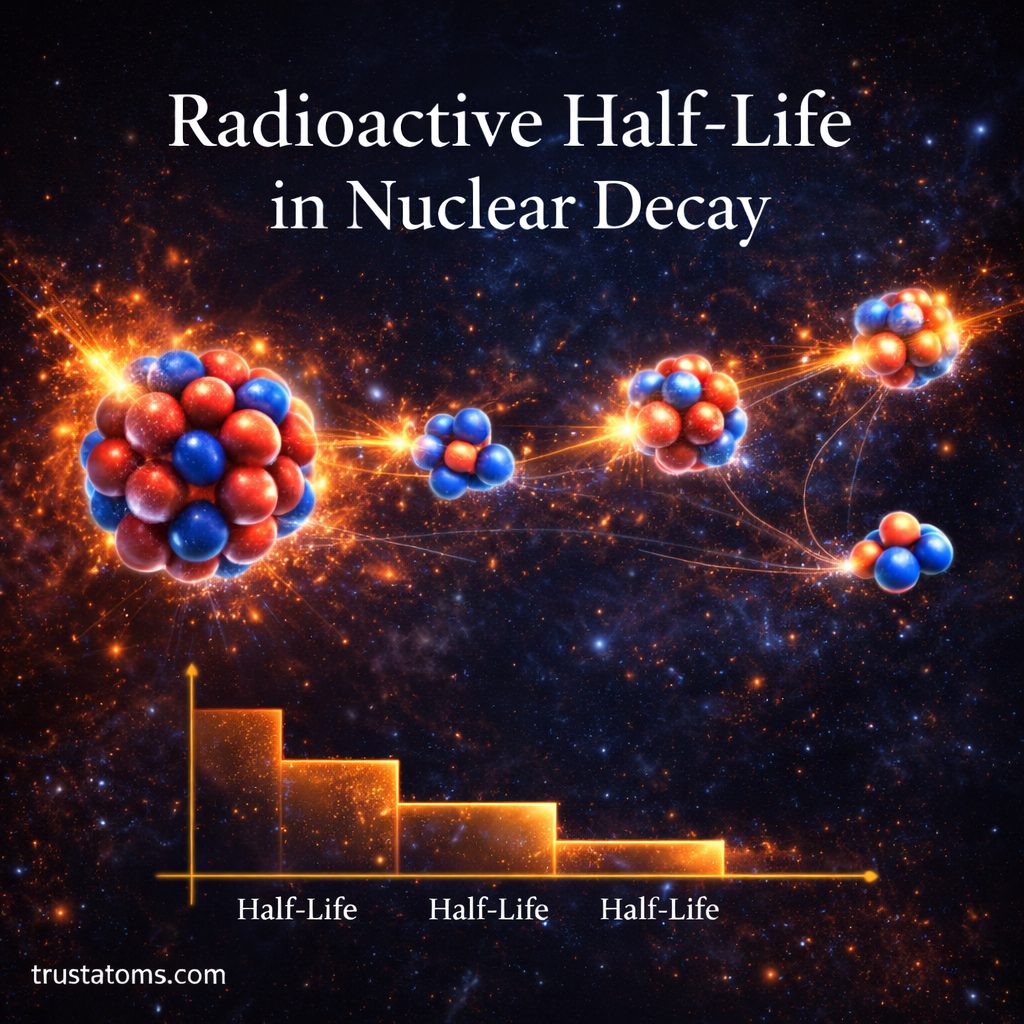
Half-life is the time required for half of the radioactive nuclei in a sample to decay.
If you start with 100 radioactive atoms:
- After one half-life → 50 remain
- After two half-lives → 25 remain
- After three half-lives → about 12 remain
The pattern continues exponentially.
Half-life does not mean half of the substance disappears instantly — it refers to a statistical average across many atoms.
Why Decay Is Random
Radioactive decay is governed by probability.
For any individual nucleus:
- There is no way to predict exactly when it will decay.
- Each nucleus has a constant probability of decaying per unit time.
However, when observing large numbers of atoms:
- The overall decay follows a precise mathematical pattern.
- The half-life remains constant for a given isotope.
This balance between randomness and predictability is a key feature of nuclear physics.
Exponential Nature of Decay
Radioactive decay follows an exponential pattern.
Important characteristics include:
- Rapid decrease at first
- Slower decline over time
- Never reaching zero completely
Even after many half-lives, a small fraction of radioactive material remains.
This exponential behavior allows scientists to calculate age and activity levels accurately.
Factors That Determine Half-Life
Half-life depends on the internal structure of the nucleus.
Key influences include:
- Nuclear binding energy
- Proton-to-neutron ratio
- Nuclear forces
- Quantum tunneling effects
Each radioactive isotope has its own unique half-life.
Some isotopes decay in fractions of a second.
Others take billions of years.
Common Examples of Half-Life
Different isotopes have dramatically different half-lives.
Examples include:
- Carbon-14 → about 5,730 years
- Uranium-238 → about 4.5 billion years
- Iodine-131 → about 8 days
These differences determine how each isotope is used in science and industry.
Applications of Radioactive Half-Life
1. Radiometric Dating
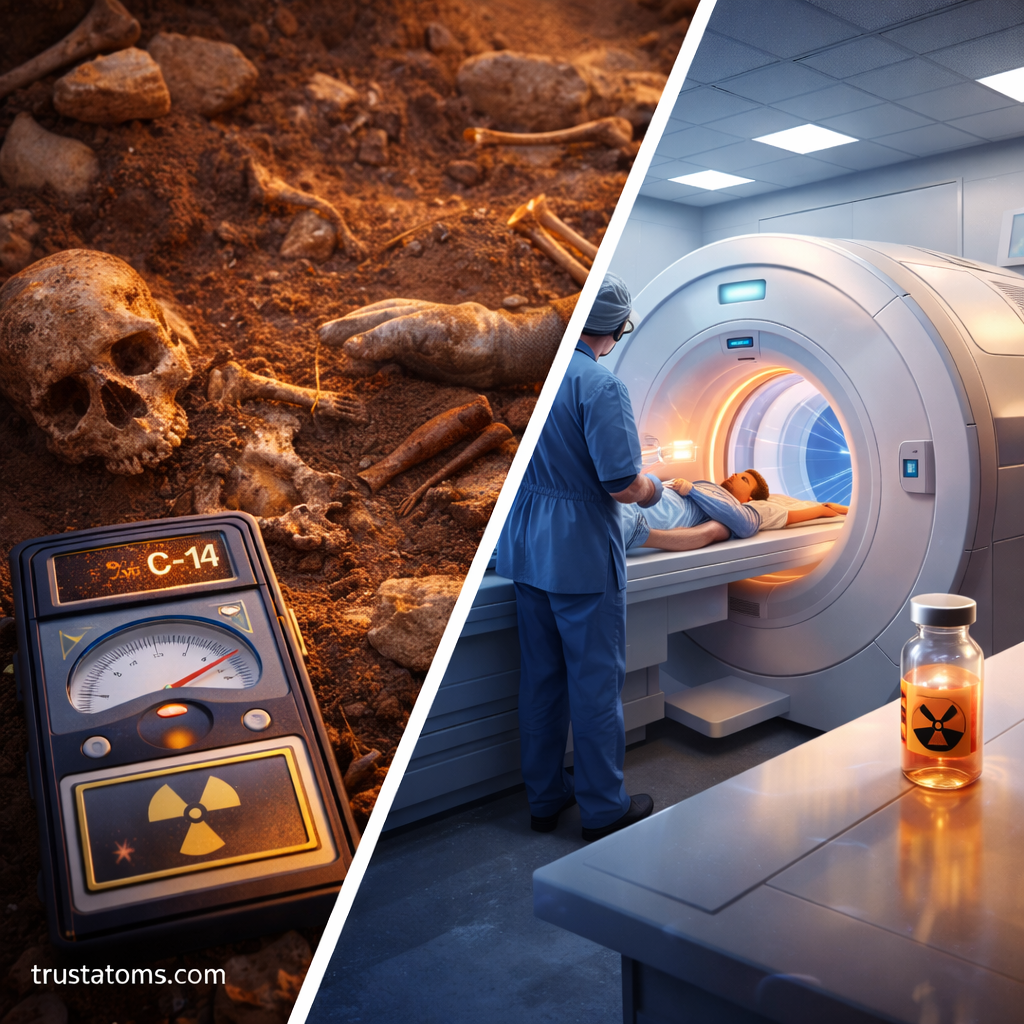
Half-life allows scientists to determine the age of objects.
For example:
- Carbon-14 dating estimates the age of organic materials.
- Uranium-based methods date rocks and minerals.
By measuring remaining radioactive material, scientists can calculate how long decay has occurred.
2. Nuclear Medicine
Medical treatments use radioactive isotopes with carefully chosen half-lives.
Ideal medical isotopes:
- Decay quickly enough to minimize long-term exposure.
- Last long enough to perform imaging or treatment.
Half-life determines dosage timing and safety.
3. Nuclear Power
In nuclear reactors:
- Radioactive decay contributes to heat production.
- Decay products influence fuel management.
Understanding half-life helps engineers design safe and efficient systems.
4. Environmental Monitoring
Radioactive contamination is tracked using half-life calculations.
This helps determine:
- How long materials remain hazardous.
- Cleanup timelines.
- Long-term environmental impact.
Half-Life vs. Activity
Radioactive activity refers to how many decays occur per second.
As time passes:
- Activity decreases.
- The number of undecayed nuclei decreases.
Short half-life materials typically have:
- Higher initial activity.
- Faster decay rates.
Long half-life materials decay more slowly but can remain radioactive for long periods.
Half-Life and Stability
A short half-life generally indicates:
- Highly unstable nuclei.
- Rapid transformation.
A long half-life suggests:
- Relative nuclear stability.
- Slow decay probability.
However, even long-lived isotopes are technically unstable — they just decay extremely slowly.
Misconceptions About Half-Life
“After One Half-Life, the Material Is Gone”
False.
Only half of the material has decayed after one half-life.
It takes many half-lives for radioactivity to become negligible.
“Half-Life Changes Over Time”
Incorrect.
Half-life is a constant property of each isotope.
External conditions like temperature or pressure do not significantly affect nuclear decay.
“Half-Life Is the Same for All Isotopes”
Not true.
Each radioactive isotope has a unique half-life.
Mathematical Perspective (Conceptual)
Radioactive decay follows a consistent statistical rule:
- The rate of decay is proportional to the number of remaining nuclei.
This produces an exponential decay curve.
Although the math can be expressed formally, the key idea is simple:
The more radioactive atoms present, the more decays occur per unit time.
Why Radioactive Half-Life Matters
Radioactive half-life connects:
- Nuclear structure
- Quantum mechanics
- Probability theory
- Energy transformation
It explains how matter changes at the atomic level and allows precise predictions over vast time scales.
From medical diagnostics to understanding Earth’s age, half-life provides a measurable clock within atomic nuclei.
Final Takeaway
Radioactive half-life in nuclear decay describes:
- The time required for half of a radioactive sample to decay.
- A predictable statistical pattern based on probability.
- An exponential decrease in radioactive material over time.
Each isotope has a unique half-life determined by its nuclear structure.
Understanding half-life allows scientists to measure time, manage nuclear materials, and explore the fundamental behavior of atomic nuclei.
It is one of the most powerful and practical concepts in nuclear physics.