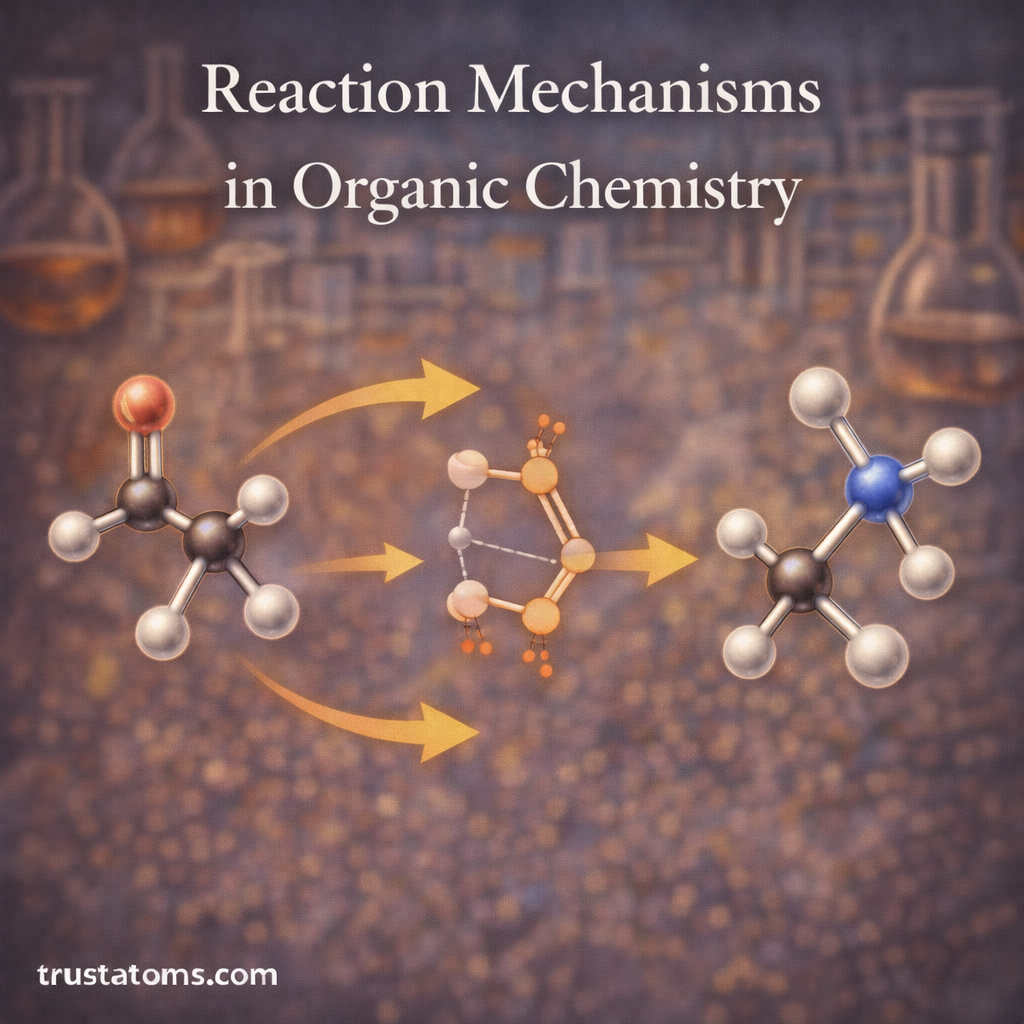
Reaction mechanisms are a core concept in organic chemistry that explain how chemical reactions occur step by step at the molecular level. Instead of only showing the starting materials and final products, reaction mechanisms reveal the detailed sequence of bond-breaking and bond-forming events that take place during a reaction.
Understanding reaction mechanisms helps chemists predict reaction outcomes, design new synthetic pathways, and control how molecules transform in laboratory and industrial processes.
By studying these mechanisms, scientists gain deeper insight into molecular behavior and chemical reactivity.
What Is a Reaction Mechanism?
A reaction mechanism describes the series of elementary steps that convert reactants into products.
Each step represents a small change in the molecular structure, such as:
- Breaking a chemical bond
- Forming a new bond
- Rearranging atoms within a molecule
- Transferring electrons between atoms
Rather than occurring all at once, most chemical reactions proceed through several intermediate stages.
Key components of a reaction mechanism include:
- Reactants
- Intermediates
- Transition states
- Final products
Understanding these components allows chemists to explain why certain reactions occur and how quickly they proceed.
Electron Movement in Organic Reactions
Organic reaction mechanisms are primarily driven by the movement of electrons.
Electrons move from areas of high electron density to areas of lower electron density. Chemists represent this movement using curved arrows in reaction diagrams.
Electron movement often occurs in two main ways:
- Bond formation when electrons move between atoms
- Bond breaking when electrons separate from a bond
This electron flow determines how molecules rearrange during a reaction.
Reaction Intermediates
Many reactions involve intermediates, which are temporary species formed during the reaction process.
Intermediates exist for only a short time before transforming into the next step of the reaction.
Common types of intermediates in organic chemistry include:
- Carbocations
- Carbanions
- Free radicals
- Reactive complexes
These intermediates play a major role in determining the pathway and speed of a reaction.
Transition States
A transition state represents the highest-energy point in a reaction step.
During this stage:
- Bonds are partially broken
- New bonds begin forming
- The molecular structure is unstable
Because the transition state requires high energy, it often determines the overall rate of the reaction.
Chemists frequently study transition states to understand reaction kinetics and improve reaction efficiency.
Types of Reaction Mechanisms
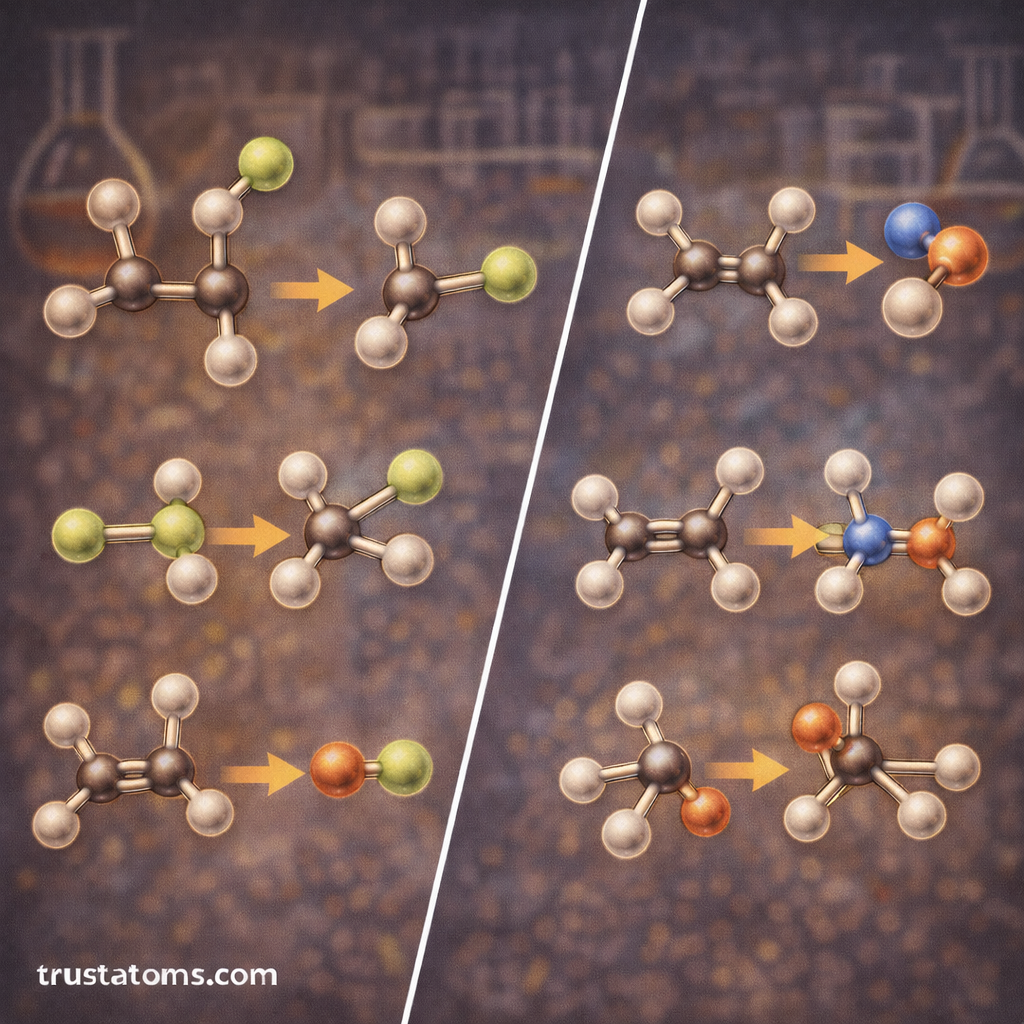
Organic chemistry includes several common reaction mechanisms that describe how molecules react.
Substitution Reactions
Substitution reactions occur when one atom or group replaces another in a molecule.
These reactions are commonly classified into two types:
- Unimolecular substitution
- Bimolecular substitution
Substitution reactions are widely used in organic synthesis and pharmaceutical chemistry.
Addition Reactions
Addition reactions occur when atoms or groups add across a multiple bond, such as a double or triple bond.
In these reactions:
- A bond in the original molecule breaks
- New atoms attach to the molecule
- The overall number of bonds increases
Addition reactions are common in reactions involving alkenes and alkynes.
Elimination Reactions
Elimination reactions involve removing atoms or groups from a molecule, usually resulting in the formation of a double bond.
Typical features include:
- Loss of small molecules such as hydrogen or halides
- Formation of unsaturated compounds
- Often occurring alongside substitution reactions
These reactions are important in producing alkenes from saturated molecules.
Rearrangement Reactions
Rearrangement reactions occur when atoms within a molecule shift positions to create a more stable structure.
These mechanisms may involve:
- Migration of groups within the molecule
- Changes in bonding structure
- Formation of more stable intermediates
Rearrangements often occur during complex organic reactions.
Factors That Influence Reaction Mechanisms
Several factors determine how a reaction mechanism proceeds.
Important influences include:
- Molecular structure of the reactants
- Solvent environment surrounding the molecules
- Temperature and pressure conditions
- Presence of catalysts or reagents
Changes in these factors can alter the pathway of a reaction and affect the reaction rate.
Reaction Mechanisms in Organic Synthesis
Understanding reaction mechanisms is essential for designing synthetic routes in organic chemistry.
Chemists use mechanistic knowledge to:
- Predict reaction products
- Improve reaction efficiency
- Control reaction selectivity
- Develop new chemical transformations
In complex molecule synthesis, reaction mechanisms guide the planning of multi-step reactions that produce pharmaceuticals, polymers, and advanced materials.
Importance of Reaction Mechanisms in Chemistry
Reaction mechanisms provide a deeper understanding of how molecules behave during chemical transformations.
They help chemists:
- Predict reaction outcomes
- Explain experimental observations
- Design safer and more efficient reactions
- Develop new technologies in chemistry
Mechanistic studies are essential in fields such as medicinal chemistry, materials science, and environmental chemistry.
Final Thoughts
Reaction mechanisms reveal the detailed molecular processes behind organic chemical reactions. By examining electron movement, intermediates, and transition states, chemists can understand how molecules transform during chemical reactions.
This knowledge allows scientists to predict reaction behavior, design complex syntheses, and improve industrial chemical processes. As organic chemistry continues to advance, reaction mechanisms remain a key tool for understanding and controlling chemical transformations.