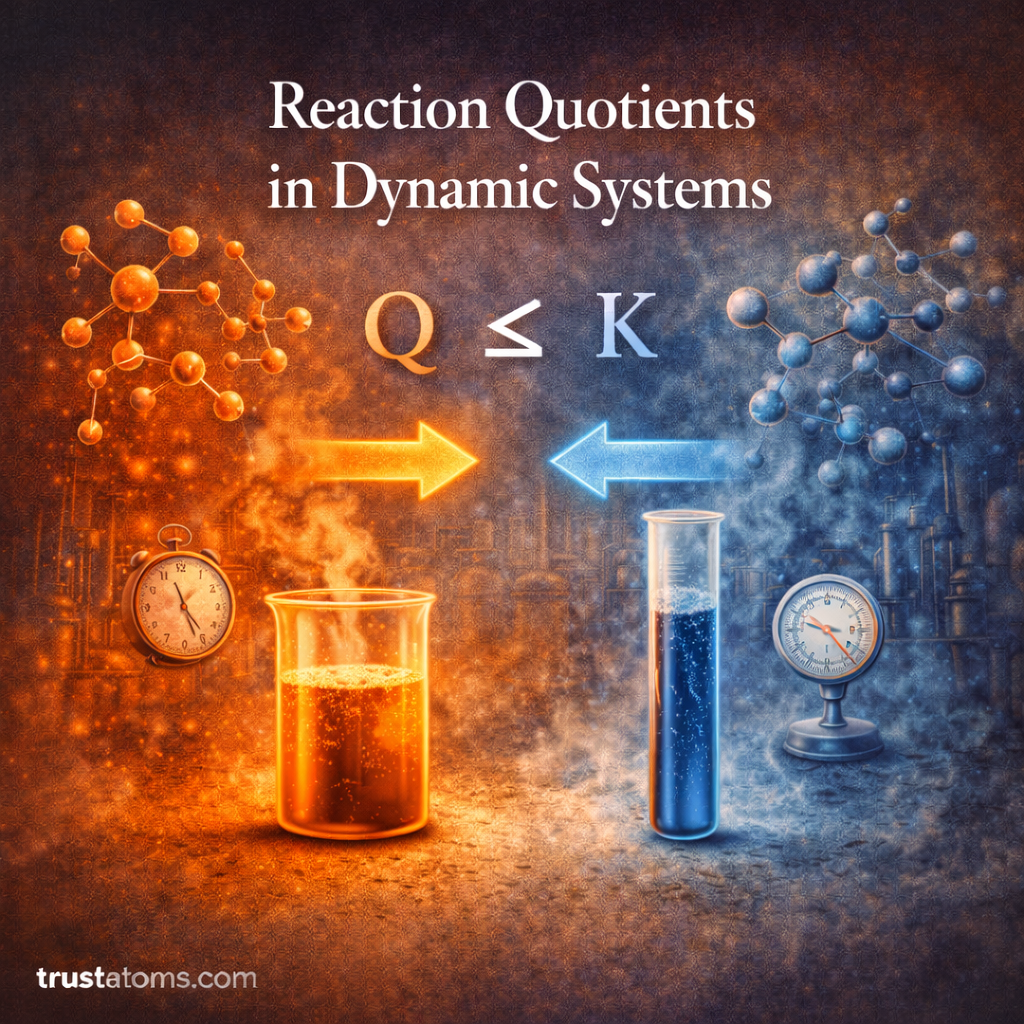
Chemical reactions rarely occur in completely static environments. Instead, they often operate in dynamic systems, where substances continuously react, transform, and interact. Understanding how these systems behave before equilibrium is reached is an important part of chemical thermodynamics.
One tool chemists use to analyze these changing systems is the reaction quotient, commonly represented by the symbol Q. The reaction quotient helps determine the current state of a reaction and predicts the direction the reaction will move in order to reach equilibrium.
By comparing the reaction quotient with the equilibrium constant, chemists can understand how far a reaction is from equilibrium and how the system will respond.
What Is a Reaction Quotient?
The reaction quotient (Q) is a value that measures the relative amounts of reactants and products at any moment during a chemical reaction.
Unlike the equilibrium constant, which applies only when equilibrium has been reached, the reaction quotient can be calculated at any time during the reaction process.
In simple terms:
- Q describes the current state of the reaction
- K describes the reaction at equilibrium
By comparing Q with K, chemists can predict whether a reaction will proceed forward or backward.
Dynamic Systems in Chemistry
A dynamic system is a system where changes are constantly occurring, even if the overall system appears stable.
In chemical reactions:
- Reactants are continuously forming products
- Products may also convert back into reactants
- Concentrations change over time until equilibrium is reached
Once equilibrium occurs, the system continues reacting in both directions at equal rates, creating a dynamic equilibrium.
The reaction quotient allows scientists to analyze systems before they reach this balanced state.
How Reaction Quotients Are Calculated
The reaction quotient is calculated using the same general relationship as the equilibrium constant.
However, the key difference is that Q uses the concentrations or pressures present at a specific moment, rather than equilibrium values.
To calculate the reaction quotient:
- Identify the balanced chemical reaction.
- Measure the concentrations or pressures of reactants and products.
- Use these values to determine the reaction quotient.
Because the reaction may still be changing, the value of Q can vary as the reaction proceeds.
Comparing Q and K
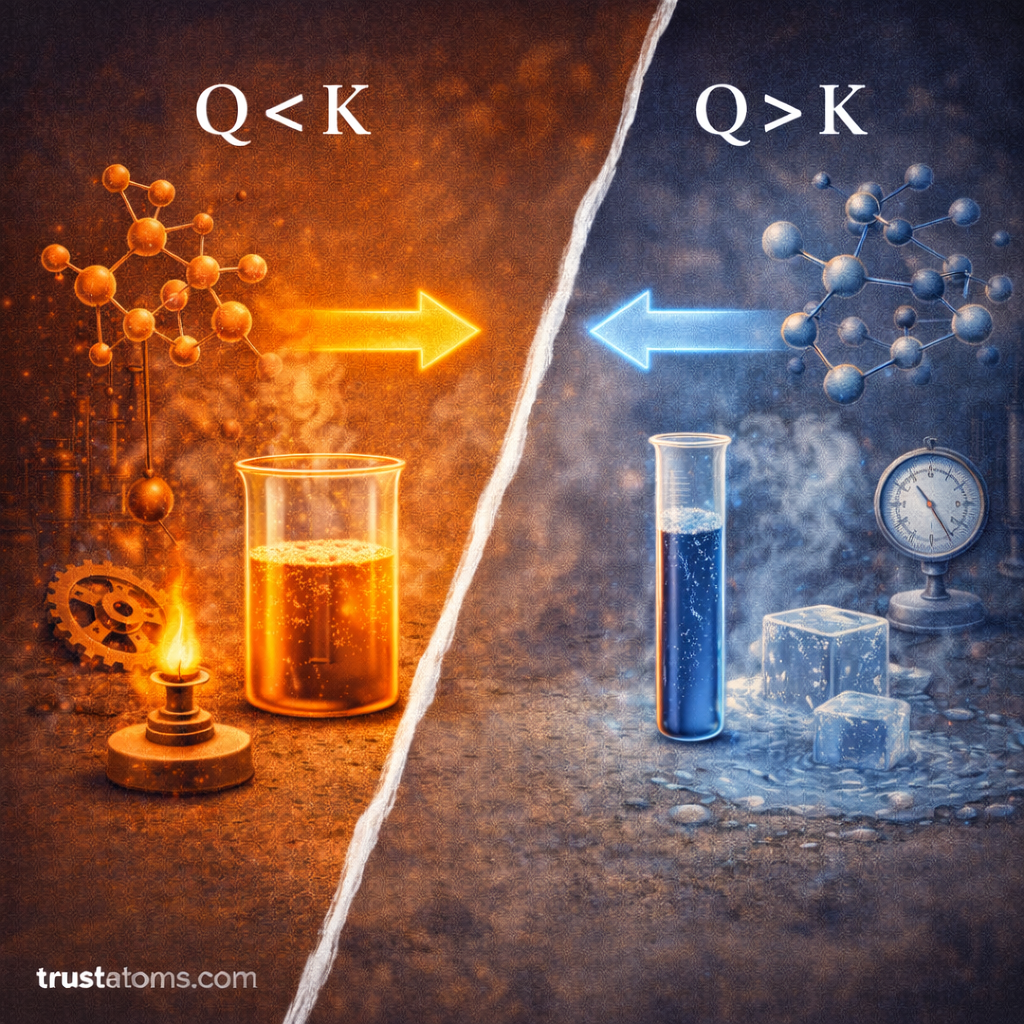
The most useful feature of the reaction quotient is how it predicts the direction of reaction progress.
Three outcomes are possible when comparing Q to the equilibrium constant K.
Q < K (Reaction Moves Forward)
If the reaction quotient is less than the equilibrium constant:
- The system contains too many reactants
- The reaction proceeds forward
- More products will form until equilibrium is reached
Q > K (Reaction Moves Backward)
If the reaction quotient is greater than the equilibrium constant:
- The system contains too many products
- The reaction shifts in reverse
- Reactants will form until equilibrium is established
Q = K (System at Equilibrium)
When the reaction quotient equals the equilibrium constant:
- The system has reached equilibrium
- Forward and reverse reactions occur at equal rates
- Concentrations remain constant
Why Reaction Quotients Are Important
Reaction quotients provide valuable insight into how chemical systems behave before equilibrium occurs.
They allow chemists to:
- Predict the direction of reaction progress
- Determine whether equilibrium has been reached
- Analyze reaction mixtures during experiments
- Understand chemical changes in real time
Because most chemical systems are not initially at equilibrium, the reaction quotient is an essential analytical tool.
Reaction Quotients in Laboratory Experiments
In laboratory settings, chemists frequently measure reaction quotients to track reaction progress.
Typical uses include:
- Monitoring reaction mixtures during synthesis
- Studying reaction mechanisms
- Determining how quickly equilibrium is approached
- Evaluating the effects of concentration changes
Reaction quotient calculations help scientists determine whether adjustments are needed to optimize reactions.
Reaction Quotients and Le Châtelier’s Principle
Reaction quotients work closely with Le Châtelier’s Principle, which describes how systems respond to disturbances.
When a system experiences changes such as:
- concentration changes
- pressure changes
- temperature changes
The reaction quotient immediately changes as well.
The system then adjusts by shifting in a direction that restores equilibrium.
For example:
- Adding reactants lowers Q and drives the reaction forward.
- Adding products increases Q and shifts the reaction backward.
This interaction between Q and K explains how chemical systems maintain balance.
Real-World Applications of Reaction Quotients
Reaction quotients are useful in many scientific and industrial fields.
Industrial Chemistry
Manufacturers use reaction quotient calculations to monitor chemical production processes and ensure reactions move toward desired products.
Environmental Chemistry
Scientists study reaction quotients to understand atmospheric reactions, ocean chemistry, and pollutant behavior.
Biochemistry
Many metabolic reactions operate in dynamic conditions rather than perfect equilibrium. Reaction quotients help researchers analyze these biological systems.
Common Misconceptions About Reaction Quotients
Several misunderstandings often arise when learning about reaction quotients.
Key clarifications include:
- The reaction quotient does not describe equilibrium conditions.
- Q can change constantly during a reaction.
- Q only equals the equilibrium constant when the system reaches equilibrium.
- Reaction quotients help predict direction, not reaction speed.
Understanding these distinctions is important when analyzing chemical systems.
Reaction Quotients and Chemical Stability
Reaction quotients help scientists understand how systems move toward stability.
Chemical systems naturally move toward equilibrium because it represents a stable energy balance between reactants and products.
By comparing Q and K, chemists can predict how systems will adjust until this balance is achieved.
This concept is fundamental in thermodynamics, chemical engineering, and biological chemistry.
Final Thoughts
Reaction quotients provide a powerful way to analyze chemical reactions that are still in progress. By measuring the current concentrations of reactants and products, chemists can determine whether a reaction will move forward, reverse, or remain stable.
When combined with equilibrium constants, reaction quotients allow scientists to predict reaction behavior in dynamic systems. This understanding is essential for studying chemical processes in laboratories, industrial production, environmental systems, and living organisms.
By tracking the relationship between Q and K, chemists gain valuable insight into how reactions evolve and eventually reach equilibrium.