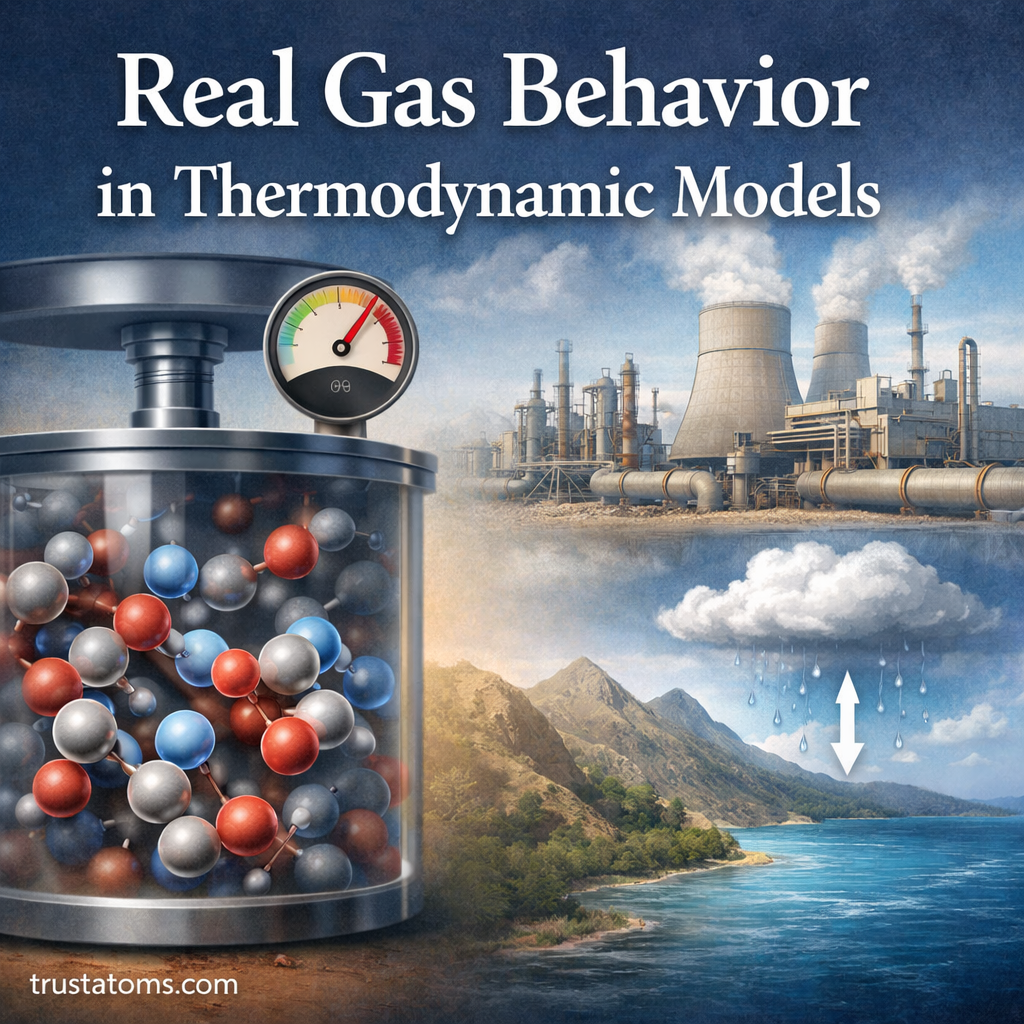
In introductory chemistry and physics, gases are often described using the ideal gas law, which assumes gas particles have no volume and experience no intermolecular forces. While this model works well under many conditions, real gases behave differently when pressure becomes high or temperature becomes low.
Understanding real gas behavior is essential in thermodynamics, chemical engineering, atmospheric science, and industrial chemistry. Real gas models help scientists predict how gases behave in practical systems such as engines, refrigeration cycles, pipelines, and chemical reactors.
This article explains how real gases differ from ideal gases and how thermodynamic models account for these differences.
The Ideal Gas Model: A Starting Point
The ideal gas law provides a simple relationship between pressure, volume, temperature, and amount of gas. It works well when:
- Gas particles are far apart
- Intermolecular forces are negligible
- Gas molecules occupy almost no space relative to the container
Under these conditions, gases behave predictably and the ideal model provides accurate results.
However, real-world gases rarely remain under perfectly ideal conditions.
Why Real Gases Deviate from Ideal Behavior
Real gases begin to deviate from the ideal model due to two primary factors:
1. Intermolecular Forces
Gas molecules attract and repel each other through weak forces.
These include:
- Van der Waals forces
- Dipole–dipole interactions
- Hydrogen bonding (in certain gases)
When these forces become significant, gas particles no longer move independently. This affects pressure and energy distribution within the system.
2. Finite Molecular Volume
The ideal model assumes particles occupy no space.
In reality:
- Molecules have measurable size
- Available container volume is slightly reduced
- Collisions occur sooner than predicted by ideal models
This becomes important when gases are compressed at high pressures.
Conditions Where Real Gas Effects Matter Most

Real gas behavior becomes most noticeable under specific thermodynamic conditions.
High Pressure
When pressure increases:
- Gas molecules are forced closer together
- Intermolecular attractions increase
- Molecular volume becomes significant
This leads to deviations from ideal predictions.
Low Temperature
Lower temperatures reduce molecular kinetic energy. As particles move more slowly:
- Attractive forces become more influential
- Gas particles may begin clustering
- Condensation becomes more likely
Near Phase Changes
When gases approach liquid formation, the ideal gas assumption fails entirely.
Real gas models are necessary to accurately describe behavior near these transitions.
The Van der Waals Equation
One of the earliest and most widely known real gas models is the Van der Waals equation.
This equation modifies the ideal gas law by introducing two corrections:
- A correction for intermolecular attraction
- A correction for molecular volume
Conceptually, these corrections account for:
- Reduced pressure due to attractive forces between molecules
- Reduced effective volume because particles occupy space
Although still a simplification, the Van der Waals model significantly improves predictions for many gases.
Other Real Gas Models
As thermodynamics advanced, scientists developed more accurate models for real gas behavior.
Common examples include:
Virial Equation of State
The virial equation expands gas behavior into a series that accounts for molecular interactions.
It is especially useful for:
- Moderate pressure systems
- Theoretical thermodynamics
- Statistical mechanics research
Redlich–Kwong Equation
This model improves predictions at higher temperatures and pressures.
It is commonly used in:
- Chemical engineering calculations
- Industrial gas processing
Peng–Robinson Equation
The Peng–Robinson equation is widely used in modern thermodynamic modeling.
Applications include:
- Petroleum engineering
- Natural gas processing
- Phase equilibrium analysis
These models allow scientists to more accurately simulate complex gas systems.
Compressibility Factor and Real Gas Behavior
A useful way to measure deviations from ideal behavior is the compressibility factor.
This factor compares how a real gas behaves relative to an ideal gas under the same conditions.
Interpretation is straightforward:
- Value near one → gas behaves nearly ideally
- Value greater than one → repulsive forces dominate
- Value less than one → attractive forces dominate
Compressibility charts are often used to estimate real gas behavior across various pressures and temperatures.
Real Gas Behavior in Industrial Applications
Accurate gas modeling is critical across many industries.
Chemical Manufacturing
Real gas equations help engineers design reactors and predict reaction conditions.
Energy Production
Gas turbines, power plants, and combustion systems rely on thermodynamic modeling to optimize efficiency.
Petroleum and Natural Gas
In oil and gas industries, real gas equations are used to model:
- Reservoir conditions
- Pipeline flow
- Gas storage behavior
Refrigeration and HVAC Systems
Thermodynamic models are used to simulate the behavior of refrigerants as they move through cooling cycles.
Without real gas models, system performance predictions would be inaccurate.
Why Real Gas Models Matter in Thermodynamics
Thermodynamics aims to describe energy, matter, and equilibrium in physical systems.
Real gas models allow scientists to:
- Predict phase behavior
- Model energy transfer
- Design efficient industrial systems
- Understand atmospheric processes
- Simulate chemical reactions
These models bridge the gap between simplified theory and real-world behavior.
Final Thoughts
The ideal gas law provides a useful foundation for understanding gas behavior, but it cannot capture the complexities of real gases under all conditions. When pressure increases, temperature decreases, or phase changes occur, intermolecular forces and molecular volume begin to influence system behavior.
Thermodynamic models such as the Van der Waals equation, virial expansions, and modern cubic equations of state allow scientists and engineers to accurately describe gas systems in practical environments.
Understanding real gas behavior is essential not only for chemistry but also for engineering, environmental science, and energy technology. These models ensure that predictions match reality when gases operate under demanding conditions.