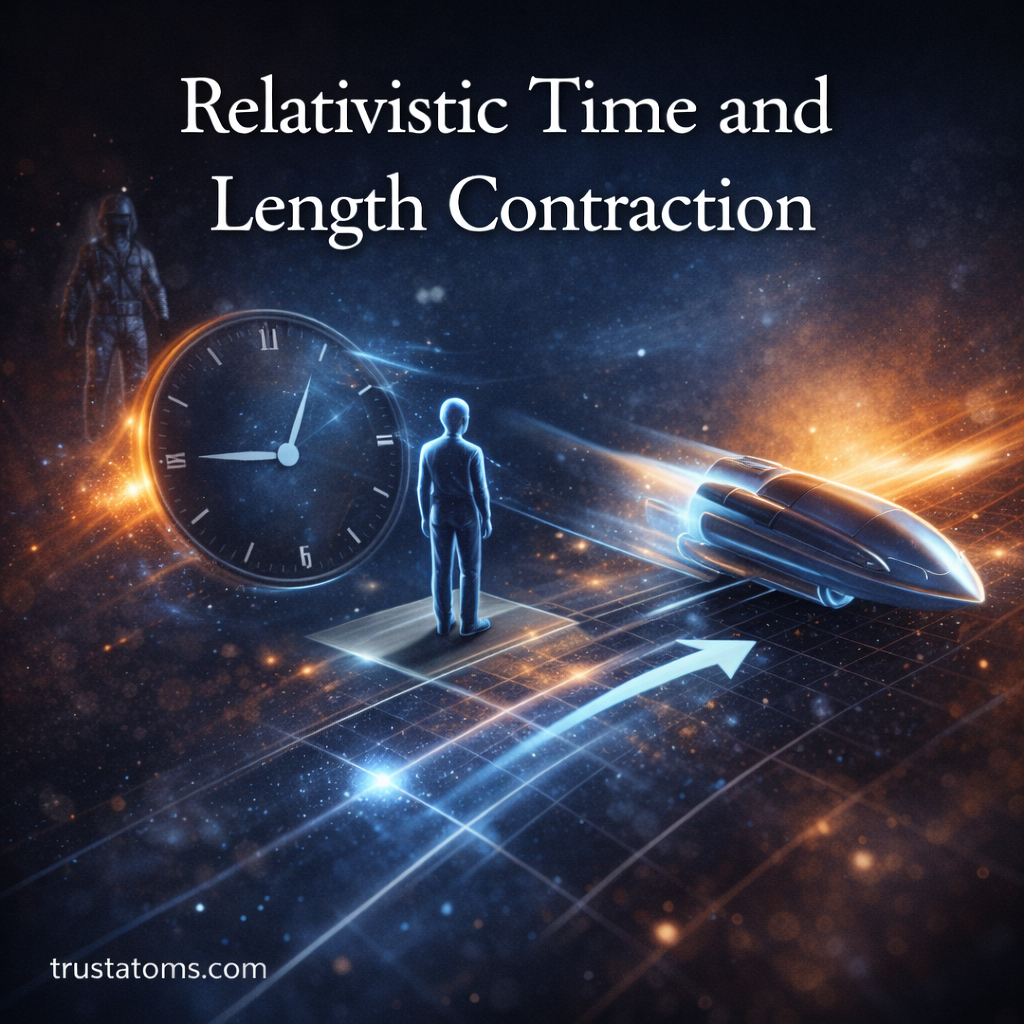
Space and time are not fixed backdrops to the universe. According to Einstein’s theory of relativity, they are flexible and depend on motion.
Two of the most surprising consequences of this theory are:
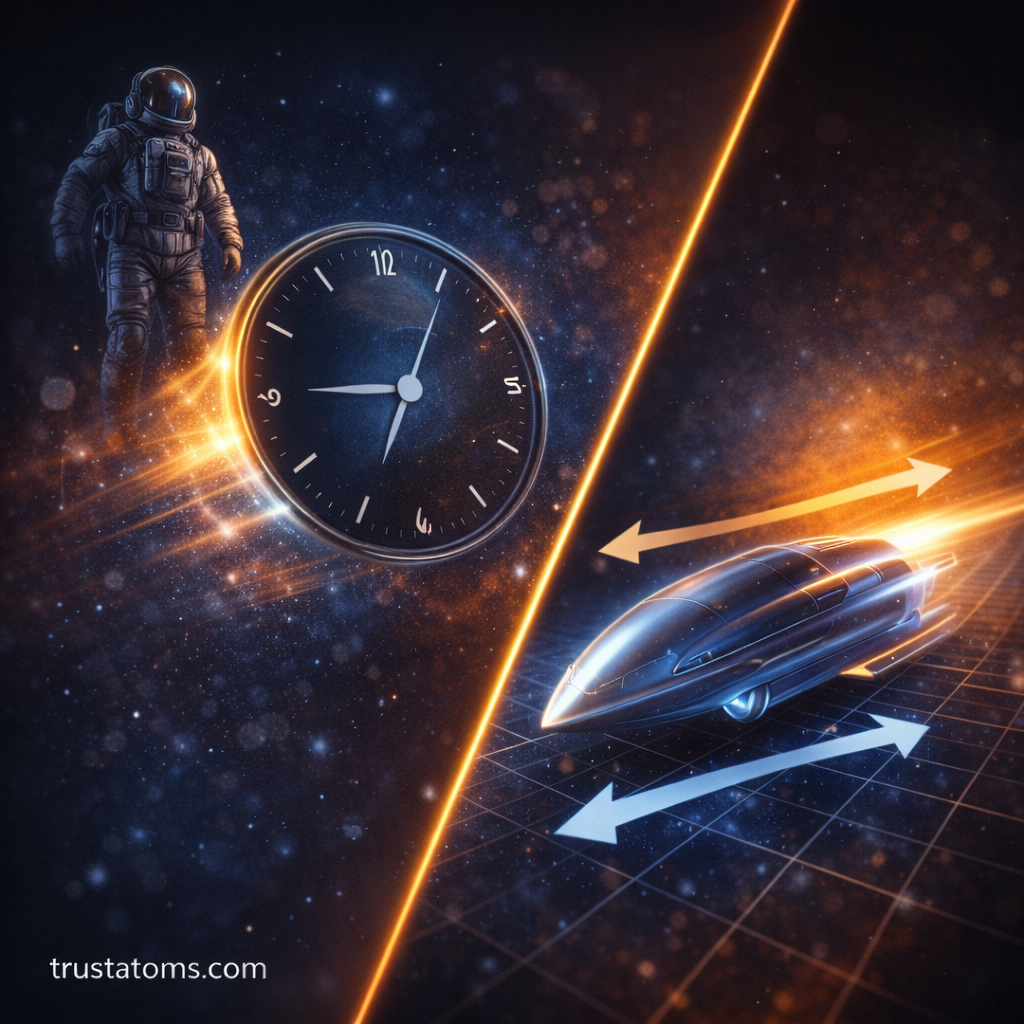
- Time dilation (moving clocks run slower)
- Length contraction (moving objects shrink along the direction of motion)
These effects only become noticeable at speeds close to the speed of light, but they have been experimentally confirmed many times. Understanding them reshapes how we think about motion, distance, and even reality itself.
The Foundation: Einstein’s Special Relativity
In 1905, Albert Einstein introduced the theory of special relativity, built on two key principles:
- The laws of physics are the same in all inertial (non-accelerating) frames of reference.
- The speed of light in a vacuum is constant for all observers, regardless of their motion.
The second principle is the revolutionary one.
No matter how fast you are moving, you will always measure light traveling at the same speed.
This forces space and time to adjust.
What Is Relativistic Time Dilation?
Time dilation means that a moving clock ticks more slowly compared to a stationary one.
If you travel at very high speed relative to someone else:
- Your time passes normally for you.
- But to a stationary observer, your clock appears to tick more slowly.
This is not an illusion.
It is a real, measurable physical effect.
Everyday Analogy (With Limits)
Imagine two identical clocks:
- One stays on Earth.
- One travels in a fast spacecraft.
When the spacecraft returns:
- Less time has passed for the traveler.
- The space traveler has aged less.
This scenario is known as the “twin paradox,” though it has a consistent physical explanation involving acceleration and frame changes.
Why Time Must Slow Down
If the speed of light is constant for everyone, then measurements of time and distance must change between observers.
Consider a light clock (a beam of light bouncing between two mirrors):
- For a stationary observer, the light travels straight up and down.
- For a moving observer, the light follows a diagonal path.
Because the diagonal path is longer and the speed of light cannot change, the only thing that can adjust is time.
Time stretches.
The Time Dilation Effect in Practice
Time dilation has been confirmed in multiple ways:
- High-speed particles created in the atmosphere live longer than expected.
- Atomic clocks flown on airplanes measure slightly less elapsed time.
- GPS satellites must correct for relativistic time effects to function accurately.
Without relativity corrections, GPS positioning would drift by kilometers per day.
Time dilation is not theoretical — it affects modern technology daily.
What Is Length Contraction?
Length contraction is the counterpart to time dilation.
An object moving at high speed appears shorter along the direction of motion to a stationary observer.
Key points:
- Contraction occurs only in the direction of motion.
- The object does not feel compressed in its own frame.
- The effect becomes significant only near light speed.
If a spaceship travels past you at relativistic speed, you would measure it as shorter than it measures itself.
Why Length Must Contract
If time slows down for moving objects, consistency requires space to adjust as well.
Otherwise, observers would disagree about fundamental physical laws.
Because the speed of light is fixed:
- Space and time must transform together.
- Distance along the motion direction compresses.
- This ensures the speed of light remains constant in all frames.
Time dilation and length contraction are two sides of the same geometric transformation.
Relativity of Simultaneity
One of the most profound consequences of special relativity is that simultaneity is relative.
Two events that occur at the same time in one frame may not occur at the same time in another moving frame.
This challenges our intuitive belief that time flows universally and uniformly.
Instead:
- Each observer has their own slice of “now.”
- There is no absolute universal clock.
The Lorentz Transformation (Conceptually)
The mathematical rules that describe these changes are called Lorentz transformations.
They show how:
- Time intervals stretch
- Lengths shrink
- Events shift in time ordering
All while preserving the invariant speed of light.
You can think of relativity as rotating space and time together into a unified structure called spacetime.
Spacetime: A Unified View
Before Einstein, space and time were treated separately.
Relativity merges them into a four-dimensional framework:
- Three dimensions of space
- One dimension of time
Motion changes how these dimensions mix.
The faster you move through space, the slower you move through time.
In a sense, all objects move through spacetime at a constant “total rate,” but motion redistributes how that movement is divided between space and time.
Experimental Evidence
Relativistic effects have been measured repeatedly.
Some major confirmations include:
- Muon decay experiments
- Atomic clock experiments
- Particle accelerator measurements
- GPS satellite corrections
All confirm predictions with remarkable precision.
Relativity is one of the most tested theories in physics.
Why We Don’t Notice These Effects
Relativistic effects become noticeable only when velocity approaches the speed of light.
At everyday speeds:
- Time dilation is extremely small.
- Length contraction is imperceptible.
For example, at highway speeds:
- The effect is far too tiny to measure without specialized instruments.
Relativity dominates only at cosmic and subatomic scales.
Real-World Applications
Relativistic corrections are crucial in:
- GPS satellite systems
- Particle physics research
- Nuclear energy calculations
- Astrophysics and cosmology
Without accounting for time dilation and length contraction, modern navigation and high-energy physics would fail.
Common Misconceptions
Objects Don’t “Feel” Shorter
Length contraction only appears from another frame of reference.
In its own rest frame, an object’s length remains unchanged.
Time Doesn’t “Seem” Slower to the Traveler
If you are moving at relativistic speed:
- Your clock behaves normally.
- Your biology feels normal.
- Others appear time-dilated from your perspective.
Relativity is symmetric between inertial observers.
The Bigger Picture
Relativistic time and length contraction reveal something profound:
Space and time are not absolute.
They depend on motion.
This insight paved the way for:
- General relativity
- Black hole physics
- Modern cosmology
- High-energy particle physics
It reshaped our understanding of reality at the most fundamental level.
Final Thoughts
Relativistic time dilation and length contraction are not science fiction.
They are experimentally verified consequences of a universe where the speed of light is constant.
At everyday speeds, the effects are invisible.
At extreme speeds, they redefine space and time themselves.
Einstein’s insight showed that motion does not just change where you are — it changes how you experience time and measure space.
That realization remains one of the most profound discoveries in the history of physics.