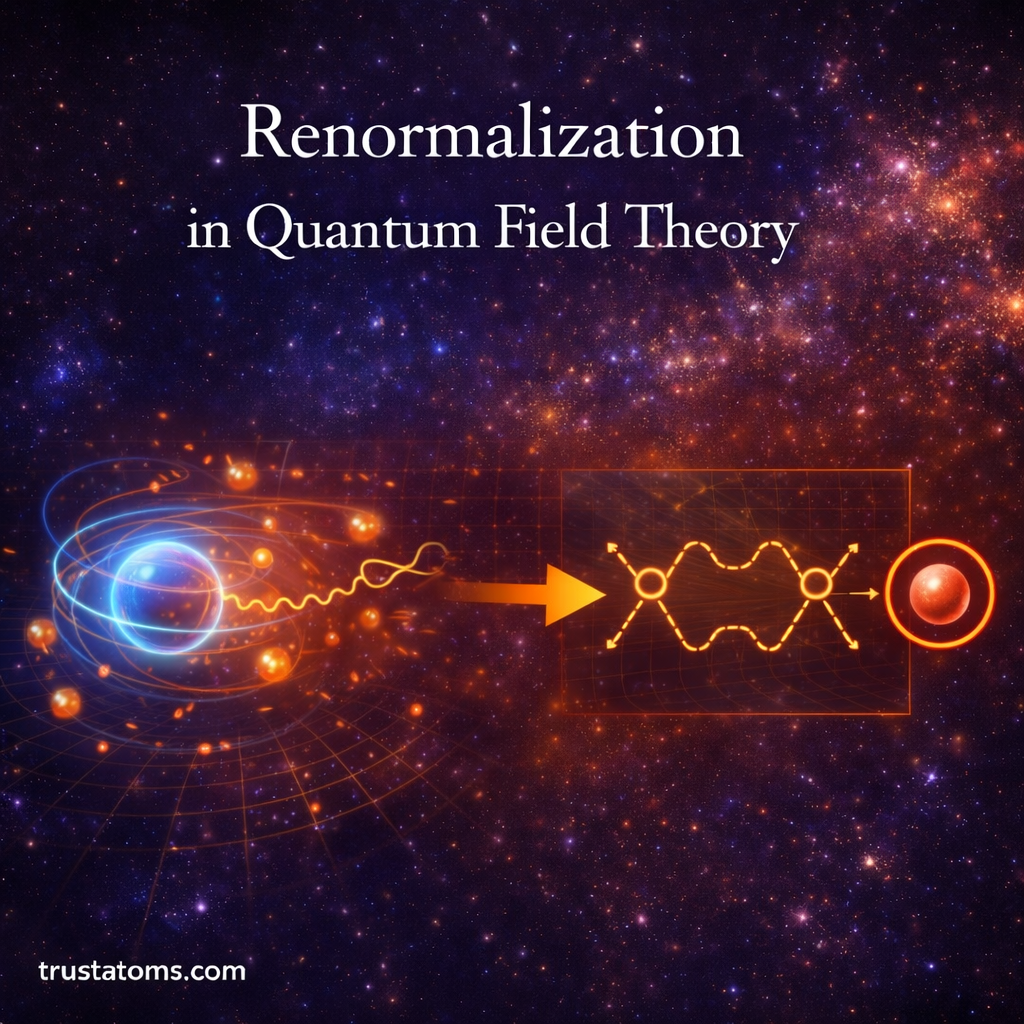
Quantum Field Theory (QFT) is one of the most successful frameworks in physics. It explains:
- The behavior of elementary particles
- The electromagnetic, weak, and strong forces
- Predictions verified to astonishing precision
But when physicists first developed QFT, they ran into a major problem:
The math kept producing infinities.
Renormalization is the method that makes sense of those infinities and turns QFT into a predictive, experimentally accurate theory.
This article explains what renormalization is, why infinities appear, and how physicists resolved the issue.
Why Do Infinities Appear in Quantum Field Theory?
In QFT, particles interact by exchanging other particles.
These interactions are calculated using perturbation theory, where:
- Interactions are expanded into series
- Each term corresponds to a diagram (often called a Feynman diagram)
At higher orders of calculation, certain integrals diverge.
They produce:
- Infinite corrections to mass
- Infinite corrections to charge
- Infinite energy densities
Clearly, infinite physical quantities do not make sense.
The challenge was:
How can a theory that produces infinities still make correct predictions?
The Core Idea of Renormalization
Renormalization works by recognizing an important distinction:
There is a difference between:
- Bare quantities (theoretical parameters)
- Physical quantities (measured in experiments)
The infinities arise in the bare parameters.
But physical measurements remain finite.
Renormalization systematically absorbs the infinities into redefinitions of parameters such as:
- Mass
- Charge
- Field strength
After this process, the theory yields finite, measurable predictions.
A Simple Conceptual Picture
Imagine you measure the charge of an electron.
In QFT:
- The electron is surrounded by a cloud of virtual particles.
- These fluctuations modify the observed charge.
The “bare” electron charge is not directly measurable.
What we measure already includes quantum corrections.
Renormalization adjusts the theory so that calculated predictions match measured values.
Regularization: The First Step
Before renormalization, physicists apply regularization.
Regularization introduces a temporary mathematical tool to control infinities.
Examples include:
- Momentum cutoffs
- Dimensional regularization
- Pauli–Villars method
These techniques make divergent integrals manageable.
Once controlled, the infinities can be isolated and absorbed into parameters.
Renormalizable vs. Non-Renormalizable Theories
Not all theories can be renormalized.
A theory is renormalizable if:
- Only a finite number of parameters need redefinition.
- Predictions remain well-defined at high energies.
Examples of renormalizable theories:
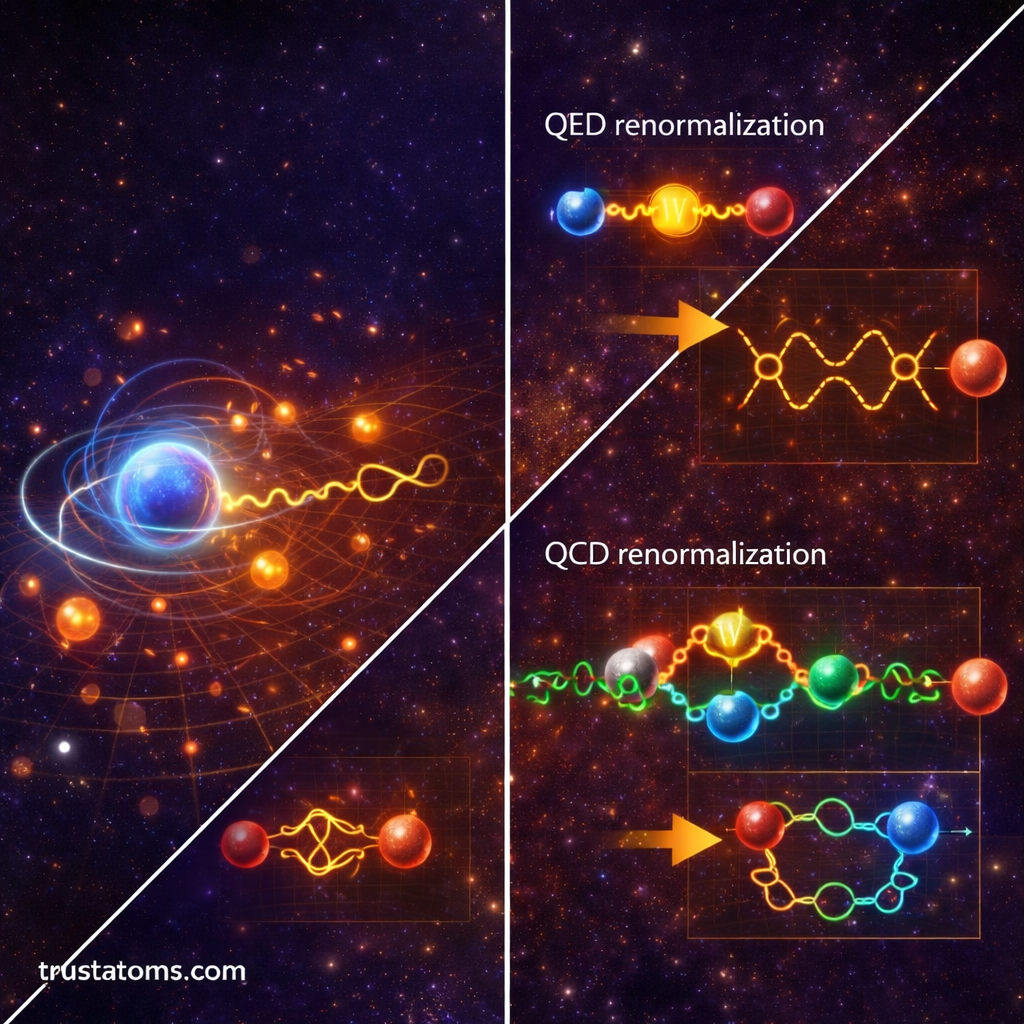
- Quantum Electrodynamics (QED)
- Quantum Chromodynamics (QCD)
- The Standard Model
A non-renormalizable theory requires infinitely many parameters, making it lose predictive power.
Early quantum gravity attempts struggled because of this issue.
Renormalization in Quantum Electrodynamics
Quantum Electrodynamics (QED) was the first theory successfully renormalized.
Key contributors included:
- Richard Feynman
- Julian Schwinger
- Sin-Itiro Tomonaga
They showed that:
- Mass corrections
- Charge corrections
- Field normalization
could all be handled systematically.
QED predictions now match experiments to extraordinary precision — up to 10 decimal places in some cases.
Renormalization made that possible.
The Renormalization Group
Renormalization led to a deeper insight:
Physical constants depend on energy scale.
This idea is captured by the renormalization group (RG).
The renormalization group describes:
- How coupling constants change with energy
- How physical behavior shifts at different scales
- How systems flow between fixed points
For example:
- The electromagnetic coupling changes slightly at higher energies.
- The strong force becomes weaker at very high energies (asymptotic freedom).
This scale dependence is one of the most profound discoveries in modern physics.
Asymptotic Freedom
In Quantum Chromodynamics (QCD):
- At very high energies, quarks interact weakly.
- At low energies, they are tightly confined.
This behavior is explained through renormalization group equations.
Asymptotic freedom was discovered by:
- David Gross
- Frank Wilczek
- Hugh David Politzer
Their work showed that renormalization was not just a mathematical fix — it revealed deep physical structure.
Effective Field Theories
Renormalization changed how physicists think about fundamental laws.
Instead of assuming a theory must work at all scales, physicists now use effective field theories.
An effective theory:
- Works at a particular energy range
- Includes only relevant interactions
- Ignores ultra-high-energy details
This perspective views physics as layered:
- Different laws dominate at different scales.
- High-energy effects are encoded in low-energy parameters.
Renormalization provides the bridge between these layers.
Why Renormalization Was Controversial
Early critics argued:
- “Removing infinities” seemed artificial.
- The procedure looked mathematically suspicious.
However, later developments showed:
- Renormalization has deep physical meaning.
- Scale dependence is fundamental.
- Field theories naturally require parameter redefinition.
Today, renormalization is considered one of the most important conceptual advances in theoretical physics.
Common Misconceptions
Renormalization Just Cancels Infinities
It does more than cancel infinities.
It explains how physical parameters depend on energy scale.
Infinities Mean the Theory Is Wrong
Not necessarily.
They often signal that parameters must be interpreted properly.
Renormalization Is Only for Particle Physics
It also appears in:
- Condensed matter physics
- Critical phenomena
- Statistical mechanics
The renormalization group applies to many complex systems.
Why Renormalization Matters
Renormalization:
- Makes quantum field theory predictive
- Explains scale-dependent behavior
- Reveals deep connections between energy scales
- Underpins the Standard Model
Without renormalization, modern particle physics would not exist in its current form.
Final Takeaway
Renormalization in Quantum Field Theory began as a way to handle infinities.
It evolved into a powerful framework for understanding:
- Scale dependence
- Running coupling constants
- Effective theories
- The deep structure of interactions
What once looked like a mathematical workaround became one of the most profound ideas in modern physics.
Renormalization does not merely fix equations.
It reveals how nature changes with scale.