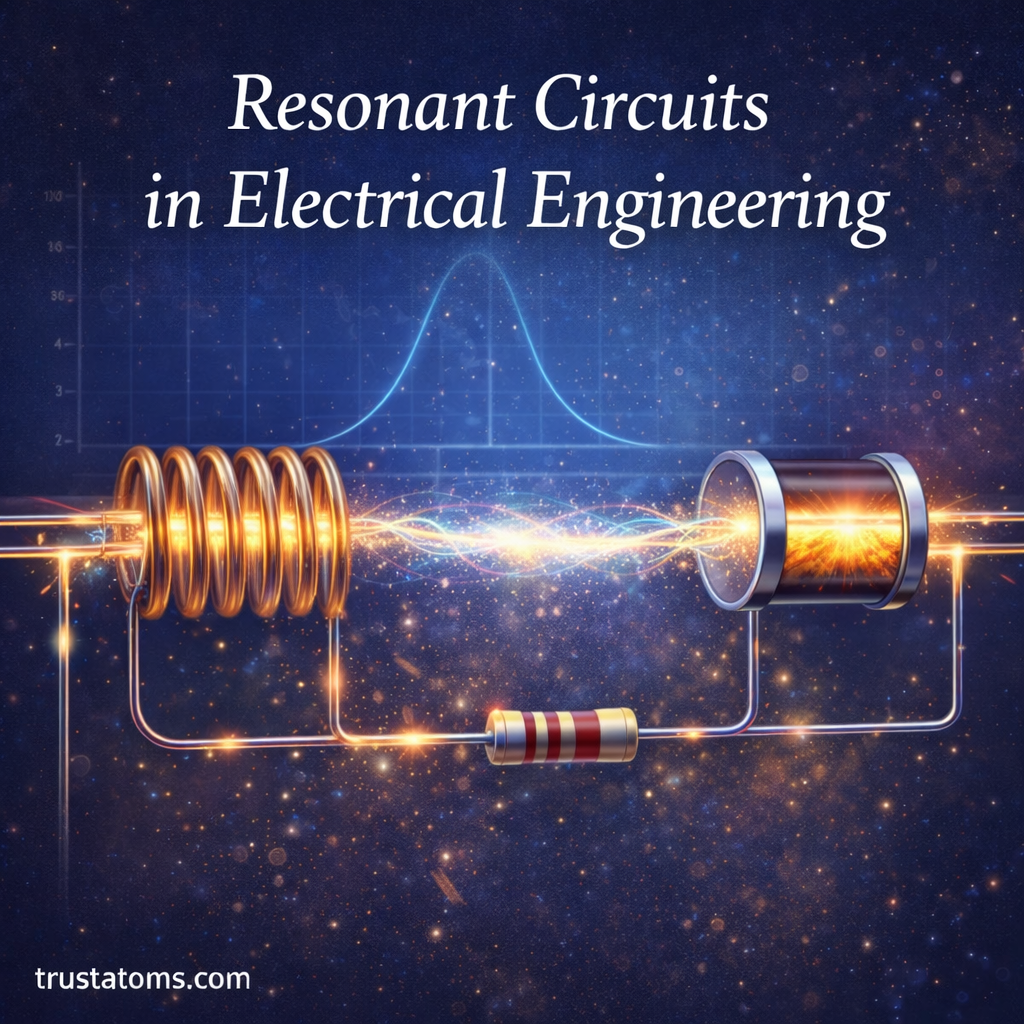
Resonant circuits are a foundational concept in electrical engineering and physics. They allow electrical systems to select specific frequencies, amplify signals, filter noise, and transfer energy efficiently.
From radios and wireless communication to power systems and signal processing, resonant circuits are everywhere.
In this guide, you’ll learn how resonant circuits work, why resonance occurs, and how they are used in real-world electrical systems.
What Is a Resonant Circuit?
A resonant circuit is an electrical circuit that naturally oscillates at a specific frequency called its resonant frequency.
It typically includes:
- An inductor (L)
- A capacitor (C)
- Sometimes a resistor (R)
At resonance:
- Energy transfers back and forth between the inductor and capacitor.
- The circuit responds strongly to one particular frequency.
- Reactive effects balance each other.
This phenomenon is called electrical resonance.
The Core Components Explained
Inductor (L)
An inductor:
- Stores energy in a magnetic field.
- Resists changes in current.
- Causes current to lag voltage.
Inductors are often coils of wire wrapped around a core.
Capacitor (C)
A capacitor:
- Stores energy in an electric field.
- Resists changes in voltage.
- Causes current to lead voltage.
Capacitors consist of two conductive plates separated by an insulating material.
Resistor (R)
A resistor:
- Dissipates energy as heat.
- Controls current flow.
- Affects how sharp or broad resonance appears.
While resonance can occur without resistance, real-world circuits always include some resistance.
How Resonance Happens
In a simple LC circuit:
- The capacitor stores electrical energy.
- It discharges into the inductor.
- The inductor builds a magnetic field.
- That field collapses, recharging the capacitor.
- The cycle repeats.
This continuous energy exchange creates oscillation.
At the resonant frequency:
- Inductive reactance equals capacitive reactance.
- The reactive effects cancel each other.
- The circuit behaves differently depending on its configuration.
Types of Resonant Circuits
Series Resonant Circuit
In a series configuration:
- Components are connected in a single loop.
- At resonance, impedance is minimal.
- Current reaches its maximum value.
Series resonance is often used in tuning and signal selection.
Parallel Resonant Circuit
In a parallel configuration:
- Components are connected across the same voltage source.
- At resonance, impedance is maximal.
- Current drawn from the source is minimal.
Parallel resonance is common in filtering applications.
Resonant Frequency
The resonant frequency depends on:
- Inductance (L)
- Capacitance (C)
It increases when:
- Inductance decreases
- Capacitance decreases
Resonant frequency is one of the most important design parameters in communication systems.
Engineers carefully select component values to achieve the desired frequency response.
Quality Factor (Q)
The quality factor (Q) measures how sharp or selective the resonance is.
High Q means:
- Narrow bandwidth
- Strong frequency selectivity
- Low energy loss
Low Q means:
- Broader frequency response
- Greater damping
- Higher energy loss
The resistor in a circuit significantly influences Q.
Bandwidth and Selectivity
Bandwidth refers to the range of frequencies around resonance that the circuit responds to.
In practical systems:
- Narrow bandwidth improves signal filtering.
- Wider bandwidth allows more frequencies to pass.
This balance is crucial in radio and communication engineering.
Real-World Applications of Resonant Circuits
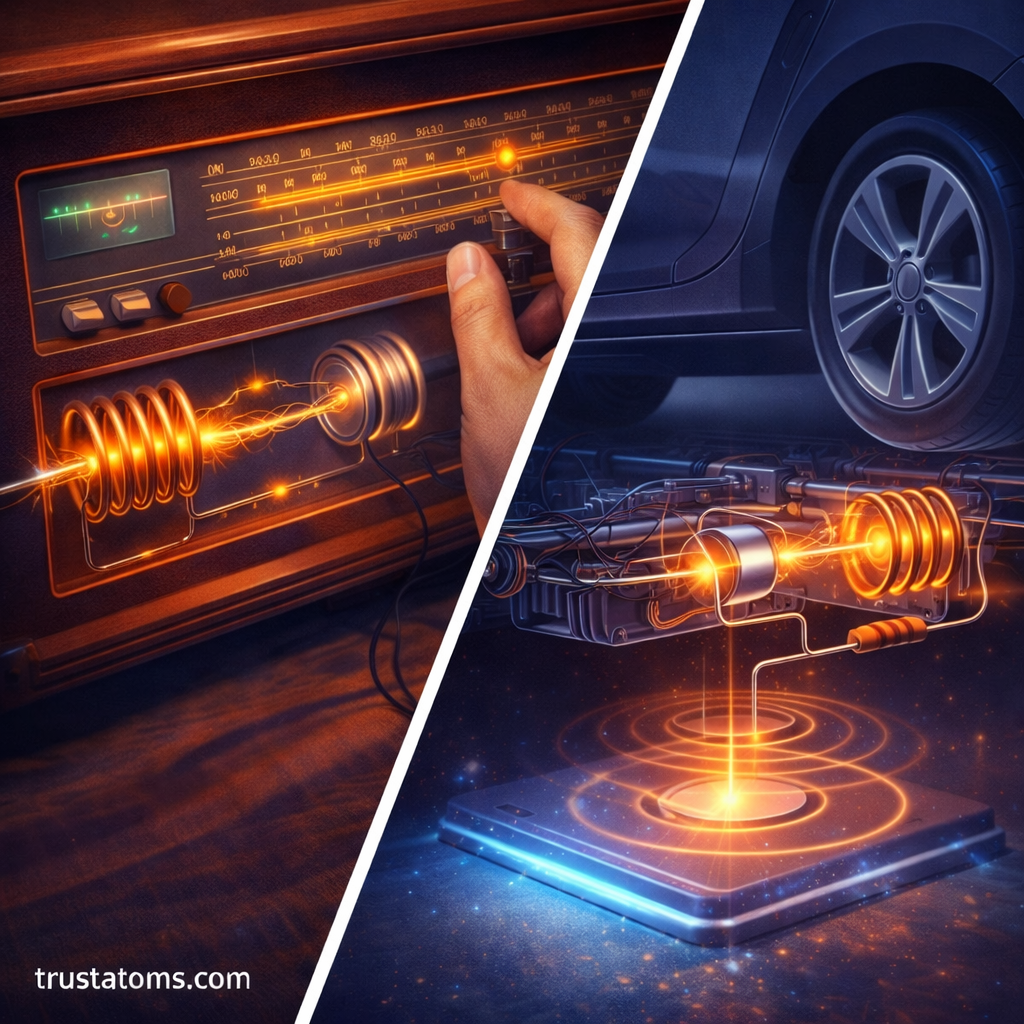
Resonant circuits are essential in many technologies.
1. Radio Receivers
Tuning a radio involves:
- Adjusting a resonant circuit.
- Selecting a specific broadcast frequency.
- Filtering out other signals.
Without resonance, clear radio reception would be impossible.
2. Wireless Communication
Resonant circuits help:
- Match antenna impedance.
- Improve signal transmission.
- Enhance receiver sensitivity.
Modern wireless devices rely heavily on resonance principles.
3. Power Systems
In power engineering, resonance can:
- Improve energy transfer efficiency.
- Stabilize voltage in certain applications.
- Cause unwanted oscillations if not controlled.
Understanding resonance prevents harmful electrical instability.
4. Oscillators
Oscillator circuits use resonance to:
- Generate stable frequencies.
- Provide timing signals.
- Control clocks in electronics.
Many digital systems depend on resonant-based oscillators.
Energy Exchange in Resonant Circuits
At resonance:
- Energy shifts between electric and magnetic fields.
- Minimal energy is lost in ideal systems.
- Voltage or current can become significantly amplified.
This amplification effect is why resonant circuits are powerful tools in engineering.
Practical Design Considerations
When designing resonant circuits, engineers must consider:
- Component tolerances
- Temperature effects
- Parasitic resistance
- Frequency stability
- Safety margins
Even small changes in component values can shift resonant frequency.
Precision is essential in high-frequency systems.
Common Misconceptions
“Resonance Always Means High Current”
Not necessarily.
In parallel circuits, current from the source can be minimal at resonance.
“Resonance Is Always Beneficial”
Resonance can cause:
- Voltage spikes
- Equipment damage
- Electrical instability
Engineers must carefully control resonance in power systems.
“Only Radios Use Resonance”
Resonant circuits are used in:
- Medical devices
- Telecommunications
- Consumer electronics
- Industrial machinery
They are foundational to modern electrical engineering.
Why Resonant Circuits Matter
Resonant circuits demonstrate how electrical energy:
- Oscillates naturally under certain conditions
- Can be selectively amplified
- Enables frequency-based technologies
They form the backbone of:
- Signal processing
- Wireless communication
- Power control systems
Without resonance, much of modern electronics would not function.
Final Takeaway
Resonant circuits in electrical engineering rely on the interaction between:
- Inductors
- Capacitors
- Resistance
At the resonant frequency:
- Reactive effects balance.
- Energy oscillates efficiently.
- The circuit becomes highly frequency-sensitive.
Mastering resonance unlocks deeper understanding of communication systems, signal filtering, oscillators, and energy transfer technologies.
Resonant circuits are not just theoretical constructs — they power the connected world around us.