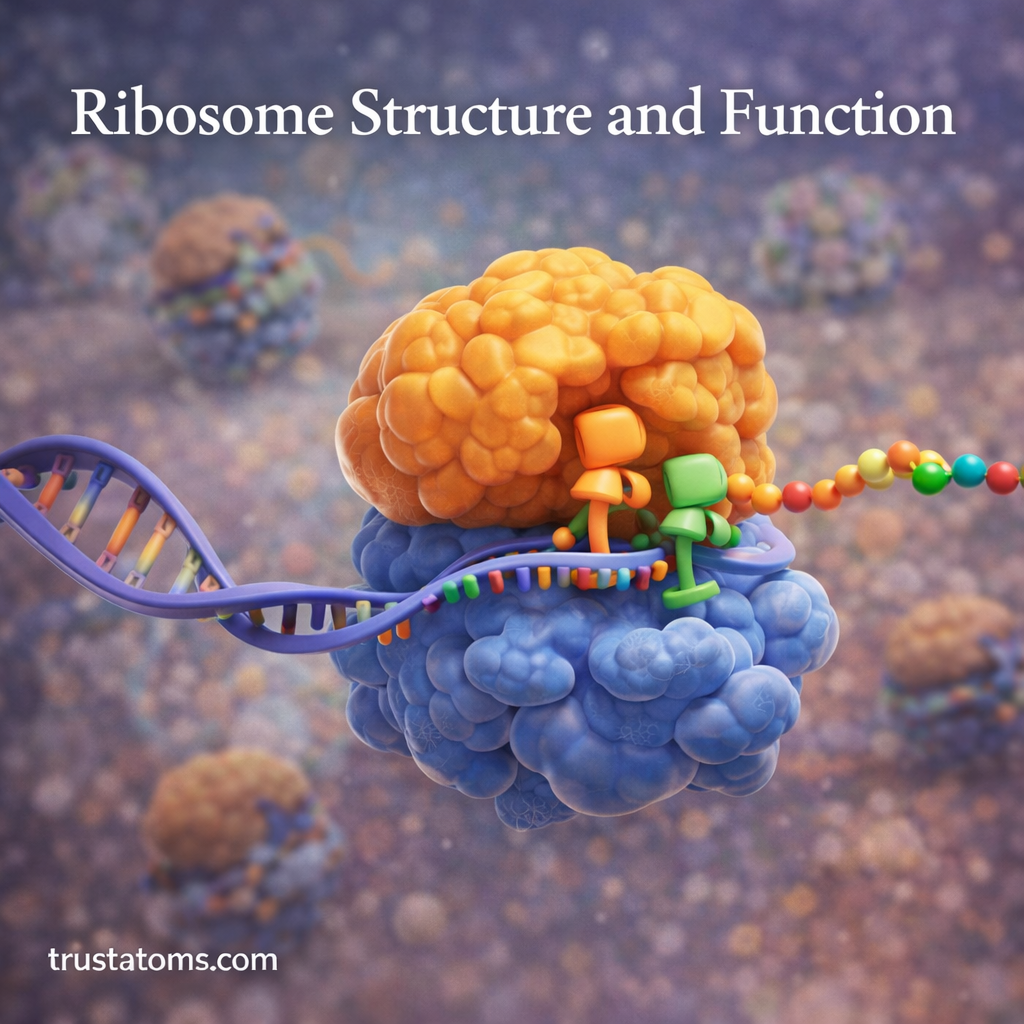
Ribosomes are essential molecular machines found in all living cells. Their primary role is to build proteins by translating genetic information from messenger RNA (mRNA) into chains of amino acids. Because proteins perform most of the work inside cells—such as catalyzing reactions, transporting molecules, and forming structural components—ribosomes play a central role in sustaining life.
Ribosomes operate through a highly coordinated process involving RNA molecules, proteins, and various translation factors. Understanding ribosome structure and function helps scientists explain how genetic information becomes functional proteins and how cellular systems maintain efficient protein production.
What Is a Ribosome?
A ribosome is a complex molecular structure responsible for protein synthesis, the process of assembling amino acids into proteins.
Ribosomes are found in:
- The cytoplasm of cells
- Attached to the rough endoplasmic reticulum in eukaryotic cells
- Inside mitochondria and chloroplasts
- Within prokaryotic cells such as bacteria
Despite differences between organisms, the fundamental purpose of ribosomes remains the same: translating genetic instructions into proteins.
Basic Components of a Ribosome
Ribosomes are made from two main types of molecules:
- Ribosomal RNA (rRNA)
- Ribosomal proteins
Together, these components form a structure capable of reading mRNA sequences and assembling amino acids in the correct order.
A ribosome consists of two subunits:
- A small subunit that reads the mRNA strand
- A large subunit that joins amino acids together
These subunits come together during protein synthesis and separate when the process is complete.
Ribosome Structure
Although ribosomes are microscopic, they are highly organized molecular systems.
Small Ribosomal Subunit
The small subunit plays a key role in decoding genetic information.
Its main functions include:
- Binding to messenger RNA
- Ensuring correct pairing between mRNA codons and transfer RNA (tRNA) anticodons
- Initiating the translation process
This subunit ensures the correct reading frame for protein production.
Large Ribosomal Subunit
The large subunit performs the chemical reactions needed to build proteins.
Important roles of the large subunit include:
- Catalyzing peptide bond formation
- Holding the growing protein chain
- Coordinating the movement of transfer RNA molecules
The catalytic center responsible for peptide bond formation is known as the peptidyl transferase center.
Ribosomes in Prokaryotic vs. Eukaryotic Cells
Ribosomes exist in both prokaryotic and eukaryotic organisms, but their structures differ slightly.
Prokaryotic Ribosomes
Prokaryotic ribosomes are smaller and are often referred to as 70S ribosomes.
They consist of:
- A 50S large subunit
- A 30S small subunit
These ribosomes are commonly found in bacteria.
Eukaryotic Ribosomes
Eukaryotic ribosomes are larger and are known as 80S ribosomes.
They include:
- A 60S large subunit
- A 40S small subunit
These ribosomes are present in the cytoplasm and on the rough endoplasmic reticulum of eukaryotic cells.
The Process of Protein Translation
Ribosomes perform protein synthesis through a process called translation, which occurs in three main stages.
1. Initiation
During initiation:
- The small ribosomal subunit binds to messenger RNA
- The start codon (usually AUG) is recognized
- A transfer RNA carrying the amino acid methionine binds to the ribosome
- The large ribosomal subunit joins to form a complete ribosome
This step establishes the starting point for protein synthesis.
2. Elongation
Elongation is the stage where the protein chain grows.
During this process:
- Transfer RNA molecules bring amino acids to the ribosome
- The ribosome forms peptide bonds between amino acids
- The ribosome moves along the mRNA strand
This sequence repeats until the protein chain reaches its required length.
3. Termination
Termination occurs when the ribosome encounters a stop codon on the mRNA.
At this stage:
- Release factors bind to the ribosome
- The completed protein is released
- Ribosomal subunits separate and become available for another round of translation
Ribosome Binding Sites and tRNA Interaction
Ribosomes contain specific binding regions that allow transfer RNA molecules to interact during translation.
These sites include:
- A site (Aminoacyl site) – accepts incoming tRNA carrying an amino acid
- P site (Peptidyl site) – holds the tRNA with the growing protein chain
- E site (Exit site) – releases empty tRNA after amino acid transfer
The coordinated movement between these sites ensures accurate protein assembly.
Ribosomes and the Rough Endoplasmic Reticulum
In eukaryotic cells, many ribosomes attach to the rough endoplasmic reticulum (RER).
These ribosomes specialize in producing proteins destined for:
- Cell membranes
- Secretion outside the cell
- Cellular compartments such as lysosomes
Proteins synthesized on free ribosomes usually remain inside the cytoplasm.
Ribosome Regulation and Cellular Efficiency
Cells regulate ribosome activity to maintain efficient protein production.
Important regulatory mechanisms include:
- Controlling mRNA availability
- Adjusting ribosome numbers
- Modifying translation factors
- Responding to cellular stress conditions
Because protein synthesis requires large amounts of energy, cells carefully control ribosome activity.
Ribosomes and Antibiotics
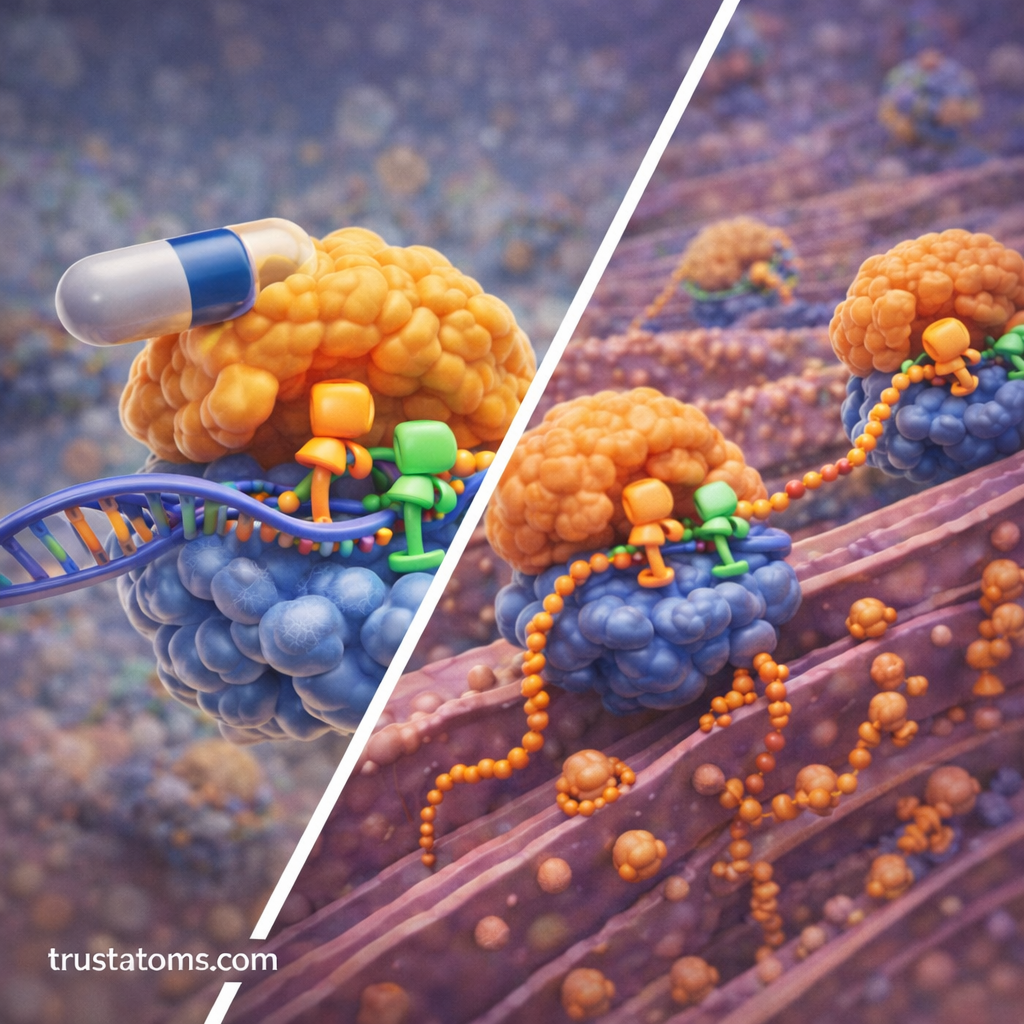
Many antibiotics target bacterial ribosomes because their structure differs from eukaryotic ribosomes.
Examples of antibiotic actions include:
- Blocking the ribosome’s ability to read mRNA
- Preventing peptide bond formation
- Disrupting tRNA binding
By interfering with bacterial protein synthesis, these drugs can stop bacterial growth without harming human cells.
Why Ribosomes Are Essential for Life
Ribosomes are among the most important molecular structures in biology. Every protein produced inside a cell originates from ribosomal activity.
Their significance includes:
- Converting genetic information into functional proteins
- Supporting cellular growth and repair
- Enabling metabolism and signaling pathways
- Maintaining cellular structure and function
Without ribosomes, cells would be unable to produce the proteins required for survival.
Final Thoughts
Ribosomes serve as the central machinery for protein synthesis in all living organisms. Through a complex interaction of ribosomal RNA, proteins, messenger RNA, and transfer RNA, these molecular structures translate genetic instructions into functional protein molecules.
By understanding ribosome structure and function, scientists gain deeper insight into how cells operate, how antibiotics work, and how molecular systems convert genetic information into the biological processes that sustain life.