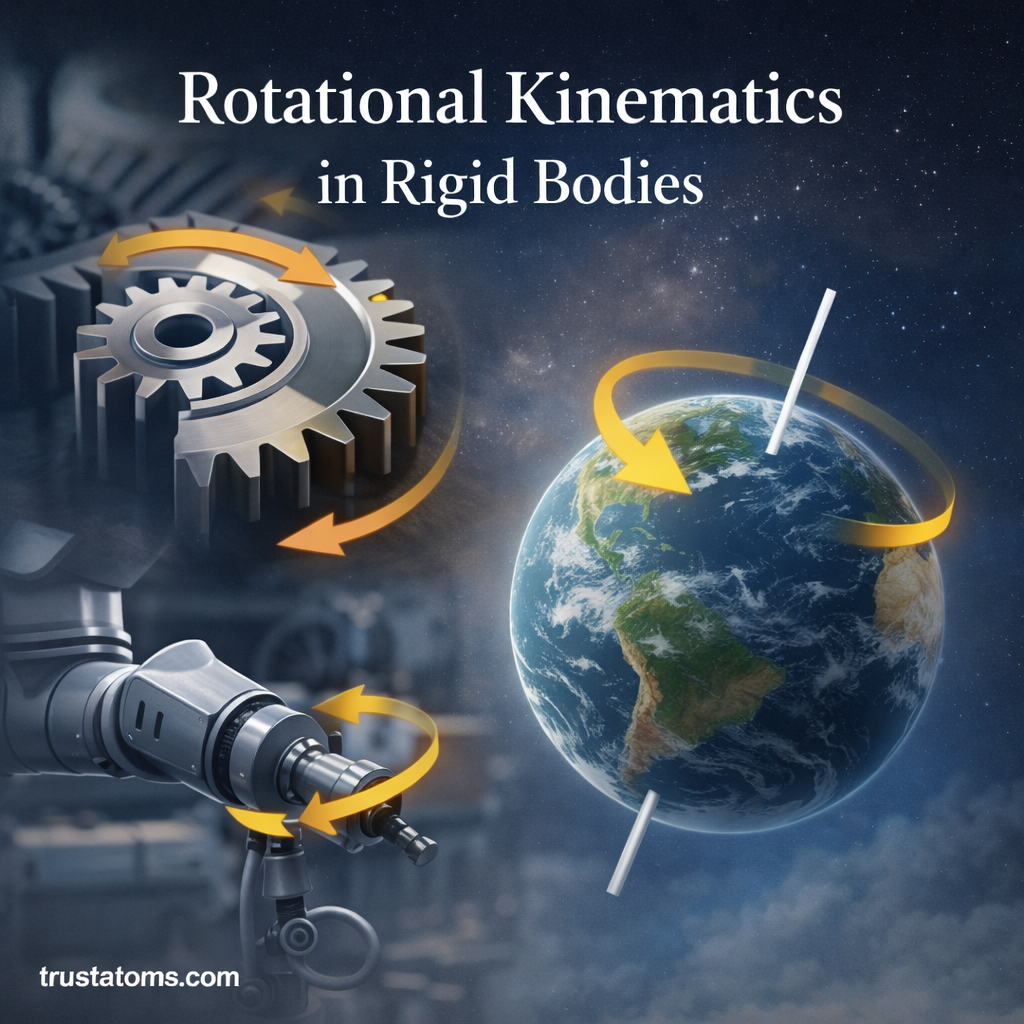
Rotational motion is everywhere — from spinning wheels and rotating gears to planets orbiting stars. While linear motion describes objects moving in straight lines, rotational kinematics focuses on how rigid bodies rotate around an axis.
Understanding rotational kinematics in rigid bodies is essential in physics, engineering, robotics, aerospace, and mechanical system design. In this guide, we’ll break it down clearly and connect it to real-world systems.
What Is Rotational Kinematics?
Rotational kinematics describes motion involving rotation without considering the forces that cause it.
It focuses on:
- Angular displacement
- Angular velocity
- Angular acceleration
- Time
Just like linear kinematics studies position, velocity, and acceleration in straight-line motion, rotational kinematics studies their angular equivalents.
What Is a Rigid Body?
A rigid body is an object that does not deform when it moves.
That means:
- The distance between any two points on the object remains constant.
- The shape of the object does not change.
- All parts rotate together around a common axis.
Examples of rigid bodies include:
- A spinning wheel
- A rotating gear
- A ceiling fan
- A solid disk
In ideal physics problems, rigid bodies simplify motion analysis.
Angular Motion vs Linear Motion
Rotational kinematics mirrors linear kinematics, but with angular quantities.
Here’s the conceptual comparison:
- Linear displacement → Angular displacement
- Linear velocity → Angular velocity
- Linear acceleration → Angular acceleration
If you understand straight-line motion, you already have the foundation for understanding rotational motion.
Angular Displacement
Angular displacement describes how far an object rotates.
Instead of measuring in meters, it is measured in radians.
Key ideas:
- One full rotation equals 2π radians.
- Positive direction is usually counterclockwise.
- Angular displacement describes change in orientation, not distance traveled.
For example:
If a wheel rotates half a turn, its angular displacement is π radians.
Angular Velocity
Angular velocity measures how fast an object rotates.
It describes:
- How quickly the angle changes over time
- The direction of rotation
If a fan spins faster, its angular velocity increases.
Important characteristics:
- Measured in radians per second
- Same for every point in a rigid body
- Points farther from the axis move faster linearly, but share the same angular velocity
Angular Acceleration
Angular acceleration describes how quickly angular velocity changes.
It occurs when:
- A motor speeds up
- A rotating object slows down
- A spinning object reverses direction
If a turntable gradually increases speed, it has constant angular acceleration.
Rotational Kinematic Equations
Rotational kinematics uses equations similar to linear motion under constant acceleration.
They relate:
- Angular displacement
- Angular velocity
- Angular acceleration
- Time
These equations allow us to determine:
- Final angular speed
- Time required to reach a certain speed
- Total angle rotated
The structure parallels straight-line motion formulas, making them intuitive once linear kinematics is understood.
Relationship Between Linear and Rotational Quantities
Points on a rotating rigid body move in circular paths.
This creates a connection between angular and linear motion.
For a point at a distance from the axis:
- Greater distance → Greater linear speed
- Same angular velocity → Different linear speeds depending on radius
For example:
On a rotating disk:
- The outer edge moves faster than the center.
- Both share the same angular velocity.
- Linear speed increases with distance from the axis.
This relationship explains why the tips of fan blades move much faster than areas near the hub.
Tangential and Centripetal Acceleration
Rotational motion introduces two types of linear acceleration for points on the object.
Tangential Acceleration
- Occurs when angular velocity changes.
- Points accelerate along the circular path.
- Caused by angular acceleration.
Centripetal Acceleration
- Exists whenever an object moves in a circular path.
- Directed toward the center of rotation.
- Present even if speed is constant.
If a wheel spins at constant speed:
- No tangential acceleration.
- Centripetal acceleration still exists.
Real-World Applications

Rotational kinematics is essential in analyzing:
- Car wheels and braking systems
- Turbines and generators
- Windmills
- Industrial machinery
- Robotics joints
- Planetary motion
Engineers rely on rotational kinematics to:
- Design safe rotational speeds
- Prevent structural failure
- Optimize mechanical efficiency
- Ensure stable motion
Step-by-Step Approach to Solving Rotational Motion Problems
When solving rotational kinematics problems:
- Identify whether acceleration is constant.
- Determine known angular quantities.
- Choose the correct rotational kinematic equation.
- Solve for the unknown variable.
- Convert angular results to linear values if needed.
This method keeps analysis organized and reduces errors.
Common Misconceptions
Students often confuse:
- Angular velocity with linear velocity
- Tangential acceleration with centripetal acceleration
- Distance traveled with angular displacement
Remember:
- Angular velocity is the same across the rigid body.
- Linear velocity changes with distance from the axis.
- Circular motion can involve acceleration even at constant speed.
Why Rotational Kinematics Matters
Understanding rotational kinematics allows us to:
- Predict motion of spinning systems
- Analyze machinery behavior
- Connect angular motion to linear outcomes
- Prepare for deeper study in rotational dynamics
It forms the bridge between simple motion analysis and more advanced topics like torque and angular momentum.
Final Thoughts
Rotational kinematics in rigid bodies provides a structured way to understand how objects spin and rotate. By drawing parallels to linear motion and recognizing how angular quantities behave, complex rotating systems become easier to analyze.
From everyday objects like ceiling fans to large-scale systems like turbines and planetary motion, rotational motion is fundamental to physics and engineering.
Mastering these principles gives you the tools to understand and predict rotational behavior in real mechanical systems.