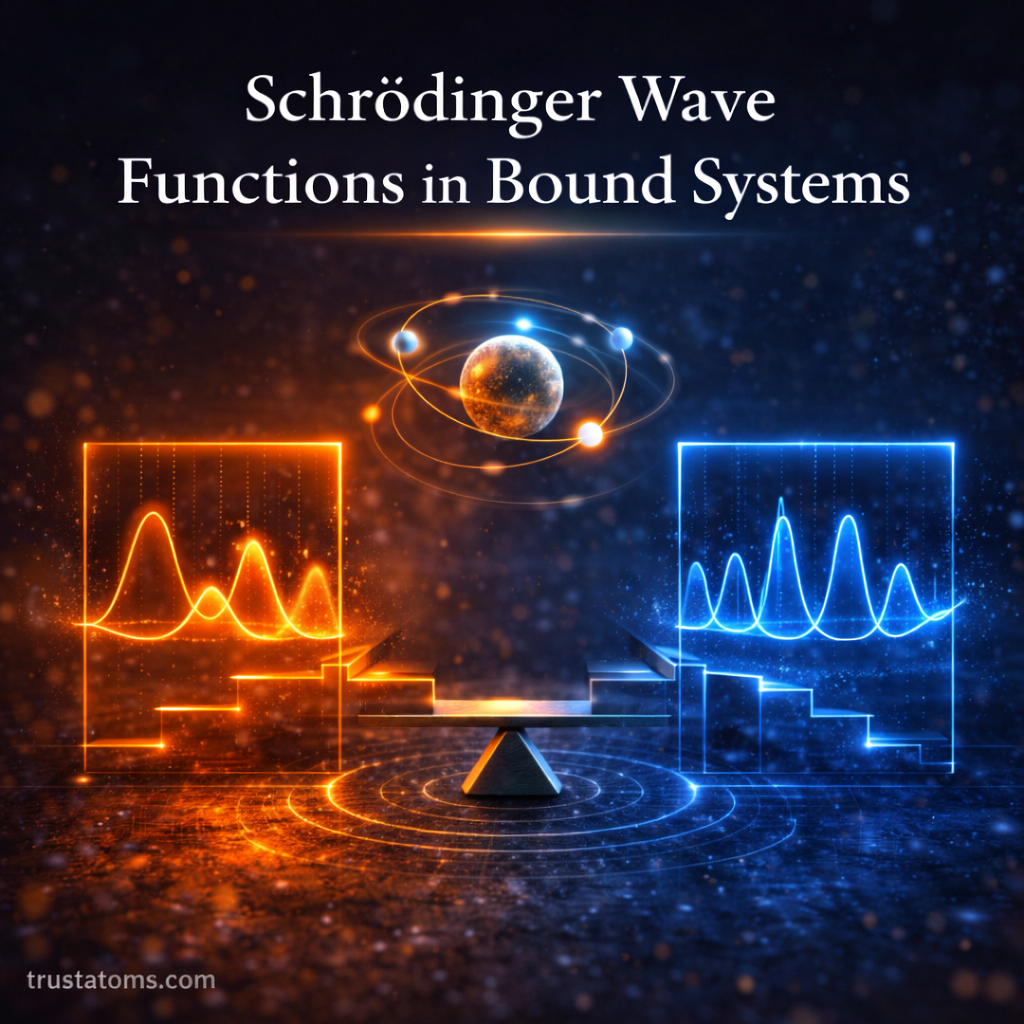
In quantum mechanics, particles such as electrons do not orbit atoms the way planets orbit the Sun. Instead, their behavior is described by wave functions — mathematical objects that encode probabilities.
When a particle is confined to a specific region of space, such as inside an atom or a quantum well, it forms what physicists call a bound system.
In this article, we’ll explore how Schrödinger wave functions describe bound systems, why energy becomes quantized, and how this explains atomic structure and modern technology.
What Is a Wave Function?
A wave function is a mathematical description of a quantum system.
It contains all the measurable information about a particle, including:
- Position probabilities
- Energy states
- Momentum distributions
- Spin properties
The wave function itself is not directly observable. However, the square of its magnitude gives the probability of finding a particle in a particular region of space.
The Schrödinger Equation
The Schrödinger equation is the foundational equation of non-relativistic quantum mechanics.
It describes how wave functions evolve and how energy states are determined.
There are two main forms:
- Time-dependent Schrödinger equation
- Time-independent Schrödinger equation
For bound systems, physicists often use the time-independent version to determine allowed energy levels and stationary states.
What Is a Bound System?
A bound system is one in which a particle is confined to a limited region of space due to forces or potential energy.
Examples include:
- An electron bound to an atomic nucleus
- A particle trapped in a potential well
- Electrons confined inside a semiconductor structure
In these systems:
- The particle cannot escape without additional energy.
- Only specific energy values are allowed.
This restriction leads to quantization.
Energy Quantization in Bound Systems
In classical physics, energy can vary continuously.
In quantum mechanics:
- Bound systems allow only discrete energy levels.
- These allowed energies are called eigenvalues.
Why does this happen?
Because the wave function must satisfy boundary conditions. Only certain wave patterns “fit” inside the confined region.
If the wave does not meet the required conditions, it cannot exist in that system.
The Particle in a Box Model

One of the simplest examples of a bound system is the “particle in a box.”
In this model:
- A particle is trapped between two rigid boundaries.
- The wave function must go to zero at the walls.
- Only standing wave patterns are allowed.
This leads to:
- Discrete energy levels
- Increasing energy spacing for higher states
- Zero probability outside the box
Although simplified, this model captures the essence of quantum confinement.
Wave Function Shapes in Bound Systems
Each allowed energy level corresponds to a specific wave function shape.
Lower energy states:
- Have fewer oscillations
- Are smoother and simpler
Higher energy states:
- Have more nodes (points where the wave function equals zero)
- Oscillate more rapidly
Nodes are regions where the probability of finding the particle is zero.
The number of nodes increases with energy level.
Atomic Bound States
In atoms, electrons are bound to the positively charged nucleus by electromagnetic forces.
The Schrödinger equation predicts:
- Discrete energy levels
- Orbital shapes
- Probability distributions
Instead of circular orbits, electrons form orbitals — regions where they are most likely to be found.
Common orbital shapes include:
- Spherical (s-orbitals)
- Dumbbell-shaped (p-orbitals)
- More complex multi-lobed structures (d- and f-orbitals)
These shapes arise directly from solving the Schrödinger equation.
Normalization of the Wave Function
For a wave function to be physically meaningful:
- The total probability of finding the particle somewhere must equal one.
This requirement is called normalization.
It ensures that the wave function properly represents a physical particle confined within a system.
Probability Density in Bound Systems
The probability density is determined by squaring the wave function’s magnitude.
In bound systems:
- The probability distribution is stable in time for stationary states.
- The particle is not localized at a single point.
- Instead, it has a spatial distribution.
This distribution determines measurable quantities such as average position and energy.
Tunneling and Bound States
Even in bound systems, quantum mechanics allows unusual effects.
One important phenomenon is quantum tunneling.
In some cases:
- A particle has a small probability of being found outside the classical boundary.
- It can pass through barriers that would be impossible in classical physics.
Tunneling is critical in:
- Nuclear fusion
- Semiconductor devices
- Scanning tunneling microscopes
Bound vs Free States
Not all quantum systems are bound.
Bound States
- Particle remains confined
- Discrete energy levels
- Wave function localized
Free States
- Particle not confined
- Continuous energy spectrum
- Wave function extends indefinitely
Atoms and molecules are bound systems, while free electrons in space are not.
Applications in Modern Technology
Schrödinger wave functions in bound systems underpin many technologies.
Semiconductor Devices
Electrons confined in materials form quantized energy bands.
Lasers
Atomic energy level transitions produce coherent light.
Quantum Dots
Tiny semiconductor particles confine electrons, leading to size-dependent energy levels.
Nuclear Physics
Bound states explain nuclear structure and stability.
Understanding confinement allows engineers to design electronic and optical devices with precision.
Why Bound Systems Matter in Physics
Bound systems reveal key insights about quantum reality:
- Energy is quantized.
- Particles exhibit wave behavior.
- Boundary conditions shape physical outcomes.
- Probability replaces certainty at small scales.
Without bound-state wave functions, atomic structure would remain unexplained.
Final Thoughts
Schrödinger wave functions in bound systems describe how particles behave when confined by forces or potentials.
Unlike classical particles, quantum particles form standing wave patterns that lead to discrete energy levels and stable probability distributions.
From atomic orbitals to semiconductor devices, bound systems are fundamental to modern physics and technology.
Understanding these wave functions helps explain why matter has structure — and why the microscopic world behaves so differently from everyday experience.